
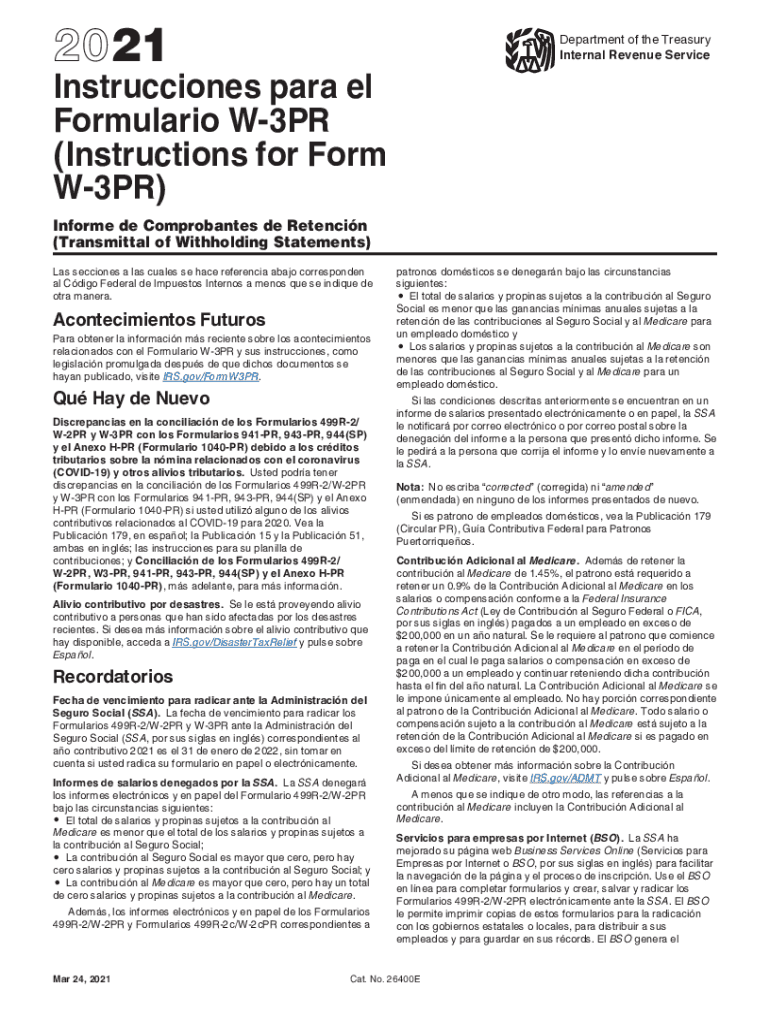







Definition and Meaning of the W-3PR Form
The W-3PR form, officially known as the "Transmittal of Withholding Statements," is used to transmit Forms 499R-2/W-2PR to the Social Security Administration (SSA) in Puerto Rico. The form serves as a summary report of wage and tax information for employees working in Puerto Rico, consolidating multiple Form 499R-2/W-2PR into a single document for efficient processing. It is essential for employers to submit this form to ensure accurate and timely reporting of payroll information to the SSA.
Obtaining the W-3PR Form
To obtain the W-3PR form, employers can visit the official Internal Revenue Service (IRS) website where it is available for download. Alternatively, the form can be acquired through tax preparation software that supports Puerto Rico tax documentation, such as TurboTax or QuickBooks. Employers should ensure they have the latest version, as requirements may change annually. Access through these platforms usually requires some form of user authentication or registration, ensuring secure and accurate submission.
Steps to Complete the W-3PR Form
- Collect Employee Data: Gather all necessary employee wage and tax information from Forms 499R-2/W-2PR.
- Enter Employer Information: Fill in the employer identification number (EIN), business name, address, and contact details.
- Report Totals: Summarize the total wages, compensation, and tax withholdings across all employee forms.
- Review and Validate: Double-check entries for accuracy to avoid discrepancies.
- Sign and Date: Provide an authorized signature and date for form validation.
- Submit the Form: Choose the appropriate submission method, ensuring compliance with filing deadlines.
Why Use the W-3PR Form
Employers use the W-3PR form to ensure that their wage and tax withholdings for employees in Puerto Rico are accurately reported to the SSA. The form is crucial for maintaining compliance with U.S. federal tax laws and ensuring that employees receive accurate credit for their earnings and withholdings. It serves as a way to reconcile the sum of individual employee forms against the totals reported, minimizing the risk of errors.
Important Terms Related to the W-3PR Form
- SSA (Social Security Administration): The U.S. government agency responsible for processing wage reports.
- EIN (Employer Identification Number): A unique identifier used for tax reporting purposes.
- Form 499R-2/W-2PR: The Puerto Rican equivalent of the W-2 form, reporting individual employee income and tax withholdings.
Legal Use of the W-3PR Form
Legally, employers are obligated to use the W-3PR form to transmit collective employee tax data to the SSA for employees working in Puerto Rico. This usage is governed by employment and tax regulations both in Puerto Rico and the broader United States. Failure to comply with these legal requirements could result in penalties or interest charges.
Filing Deadlines and Important Dates
W-3PR forms must be submitted by the last day of February if filing on paper, and by March 31 if submitting electronically. Employers should prepare in advance to ensure all employee information is collected and totals are accurately calculated. Special considerations might be necessary if these dates fall on weekends or holidays, wherein the deadline may shift to the next business day.
Penalties for Non-Compliance
Employers who fail to file the W-3PR form on time or who submit inaccurate information may face penalties from the SSA. These penalties can include fines for late submission, incorrect information, or incomplete forms. To avoid these repercussions, employers should adhere to all filing instructions and deadlines, ensuring all data is precise and deadlines are strictly followed.
State-Specific Rules for the W-3PR Form
The W-3PR form primarily pertains to services and employees based in Puerto Rico, and while it primarily follows federal guidelines, state-specific taxation rules in Puerto Rico must also be addressed. Employers should consult local tax professionals to ensure compliance with Puerto Rican tax laws, which may have unique requirements separate from mainland U.S. practices.




