




01. Edit your form online
Type text, add images, blackout confidential details, add comments, highlights and more.

Type text, add images, blackout confidential details, add comments, highlights and more.

Draw your signature, type it, upload its image, or use your mobile device as a signature pad.

Send it via email, link, or fax. You can also download it, export it or print it out.
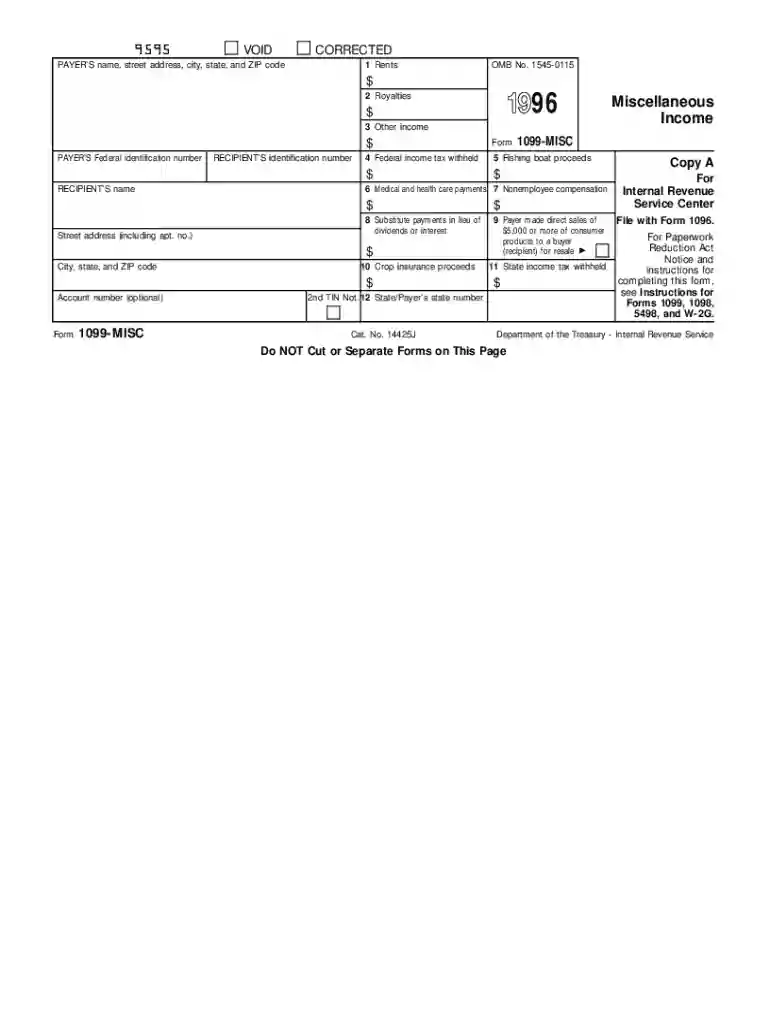
The 1996 Form 1099 refers to a tax document used by businesses and other entities to report various types of income other than wages, salaries, and tips to the Internal Revenue Service (IRS). The form is typically issued for reporting miscellaneous income that individuals may receive throughout the tax year. This includes earnings such as rents, royalties, and other kinds of payments. Understanding this form is crucial for reporting income accurately, as it impacts how one prepares their tax return and ensures compliance with IRS regulations.
Using the form requires understanding its structure and purpose. This form is used by filers to report payments made to non-employees during the tax year. Steps for using the form include:
Identify Recipients: Determine which payees need to receive the form. Recipients typically include independent contractors, freelancers, and contractors paid $600 or more in a year.
Fill Out Necessary Details: Include information about the payer and recipient, such as names, addresses, and taxpayer identification numbers.
Specify Income Types: Use the designated boxes to indicate the type and amount of income paid, like rents or royalties.
Maintain Records: Keep copies of each 1099 form filed and supporting documents for at least four years for future reference and verification purposes.
Completing the 1996 Form 1099 accurately is essential for regulatory compliance. Follow these steps to ensure proper completion:
Gather Information: Obtain all relevant data, including recipient's details and payment amounts.
Provide Accurate Identification: Enter the payer and recipient tax identification numbers correctly to prevent processing delays.
Report Specific Income: Accurately fill in income amounts in the relevant sections of the form. Ensure no fields are left incomplete unless unnecessary.
File Copies: Submit Copy A to the IRS, provide Copy B to the income recipient, and retain additional copies for your records.
Verify Details: Double-check each form for accuracy to minimize errors that could result in penalties by the IRS.
Meeting deadlines for filing the 1996 Form 1099 is critical to avoid penalties. Key dates include:
Recipient Delivery: Ensure all forms are mailed to recipients by January 31 of the following year.
IRS Submission: File Copy A with the IRS by February 28 if submitting paper forms, or March 31 if filing electronically. The digital submission option is encouraged as it is usually faster and more reliable.
Legally, the 1996 Form 1099 is used to report various types of income to the IRS for individuals and business entities who have received payments other than salary or wages. The compliance with the form process is in line with the IRS guidelines, ensuring that all taxable income is accounted for accurately. Misuse or failure to issue the document can lead to penalties, making understanding its legal implications crucial.
Failing to comply with the filing requirements of the 1996 Form 1099 can result in significant penalties. These may include fines for each disregarded form, which increase the longer the delay in filing. Penalties can also apply to incorrect or incomplete information, underscoring the importance of accurate and timely submission. Businesses should prioritize compliance to avoid costly fines and legal scrutiny.
The IRS sets forth specific guidelines regarding the preparation and submission of Form 1099. These directives outline the types of income that must be reported, record-keeping practices, and reporting thresholds. Adhering to these guidelines not only ensures compliance but can also simplify the filing process and help mitigate any potential enforcement actions from the IRS.
Using software such as TurboTax or QuickBooks can simplify the process of preparing the 1996 Form 1099. These applications often integrate functions to assist with data entry, calculate totals, and ensure adherence to IRS rules, making them particularly effective for businesses managing large numbers of 1099 forms. Checking for updates or specific requirements within these programs ensures seamless preparation and submission.
We've got more versions of the 1996 1099 form form. Select the right 1996 1099 form version from the list and start editing it straight away!
| Versions | Form popularity | Fillable & printable |
|---|---|---|
| 2024 | 4.3 Satisfied (49 Votes) | |
| 2022 | 4.9 Satisfied (41 Votes) | |
| 2021 | 4.8 Satisfied (187 Votes) | |
| 2020 | 4.2 Satisfied (31 Votes) | |
| 2019 | 4.4 Satisfied (787 Votes) | |
| 2018 | 4.3 Satisfied (809 Votes) | |
| 2017 | 4.4 Satisfied (1573 Votes) | |
| 2016 | 4.4 Satisfied (963 Votes) | |
| 2015 | 3.9 Satisfied (40 Votes) | |
| 2014 | 3.8 Satisfied (35 Votes) | |
| 2013 | 4 Satisfied (29 Votes) | |
| 2012 | 4 Satisfied (54 Votes) | |
| 2011 | 4.1 Satisfied (22 Votes) | |
| 2010 | 4.4 Satisfied (59 Votes) | |
| 2009 | 4 Satisfied (47 Votes) |
At DocHub, your data security is our priority. We follow HIPAA, SOC2, GDPR, and other standards, so you can work on your documents with confidence.
Specific information needed to complete this form and other forms in the 1099 series is given in the 1996 Instructions for. Forms 1099, 1098, 5498, and W-2G.Read more
Specific information needed to complete this form and other forms in the 1099 series is given in the 1996 Instructions for. Forms 1099, 1098, 5498, and W-2G.
This is the tax ID number intended to be used for. 1099 reporting purposes. Enter an X in the appropriate box to indicate which number is beingRead more


