




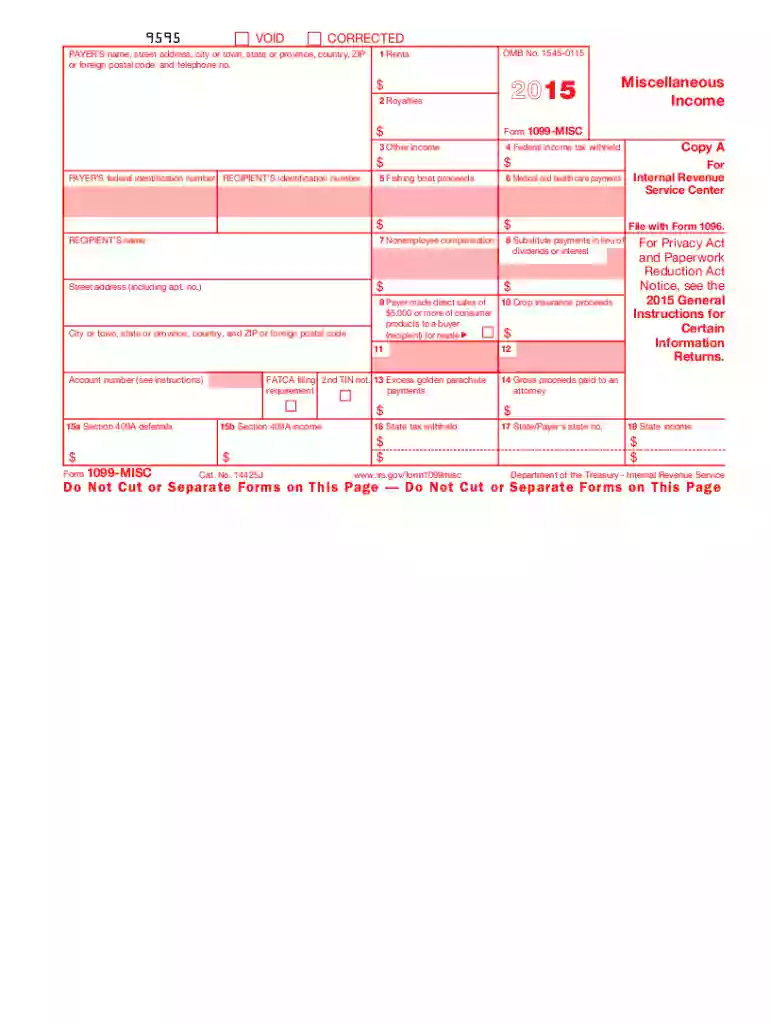
01. Edit your 2015 misc 1099 online
Type text, add images, blackout confidential details, add comments, highlights and more.

Type text, add images, blackout confidential details, add comments, highlights and more.

Draw your signature, type it, upload its image, or use your mobile device as a signature pad.

Send 1099 misc 2015 via email, link, or fax. You can also download it, export it or print it out.
The 2015 fillable 1099 form is a variant of the IRS Form 1099-MISC used to report various types of income. It is typically used by businesses for nonemployee compensation, rents, royalties, and other miscellaneous income that requires reporting. A form is generally necessary for transactions of $600 or more with non-employees. Being "fillable" means this form can be completed digitally, offering a more streamlined process for data entry and submission.
The fillable version of the 2 form is designed to be user-friendly and efficient for online completion.
The IRS provides explicit guidelines on when a 1099 form must be filed. Typically, 1099-MISC forms are due to recipients by January 31, with the deadline for submitting the forms to the IRS falling either on February 28 (paper) or March 31 (electronically).
This form is predominantly used by businesses and individuals who engage independent contractors, freelancers, or others who provide services but are not classified as employees.


The form is a legal requirement under U.S. tax law, ensuring transparency and accountability in income reporting. Legal compliance is crucial, as any discrepancies can trigger audits and penalties.
Multiple submission avenues are available, adapting to the diverse needs of different users.
The growing preference for digital form filing offers a range of advantages over traditional paper forms.
Many financial and accounting software packages support the 2015 fillable 1099 form, enhancing ease of use.
We've got more versions of the 2015 misc 1099 form. Select the right 2015 misc 1099 version from the list and start editing it straight away!
| Versions | Form popularity | Fillable & printable |
|---|---|---|
| 2024 | 4.3 Satisfied (49 Votes) | |
| 2022 | 4.9 Satisfied (41 Votes) | |
| 2021 | 4.8 Satisfied (187 Votes) | |
| 2020 | 4.2 Satisfied (31 Votes) | |
| 2019 | 4.4 Satisfied (787 Votes) | |
| 2018 | 4.3 Satisfied (809 Votes) | |
| 2017 | 4.4 Satisfied (1573 Votes) | |
| 2016 | 4.4 Satisfied (963 Votes) | |
| 2015 | 3.9 Satisfied (40 Votes) | |
| 2014 | 3.8 Satisfied (35 Votes) | |
| 2013 | 4 Satisfied (29 Votes) | |
| 2012 | 4 Satisfied (54 Votes) | |
| 2011 | 4.1 Satisfied (22 Votes) | |
| 2010 | 4.4 Satisfied (59 Votes) | |
| 2009 | 4 Satisfied (47 Votes) |
At DocHub, your data security is our priority. We follow HIPAA, SOC2, GDPR, and other standards, so you can work on your documents with confidence.

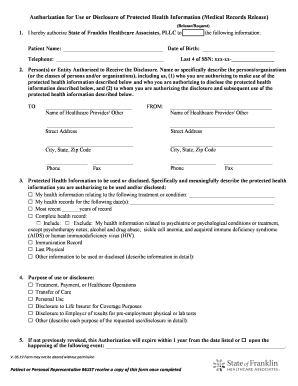



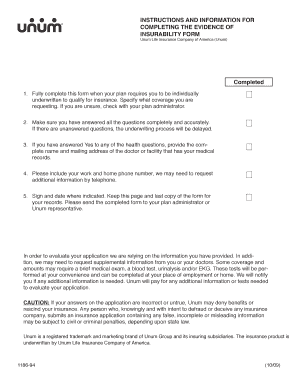
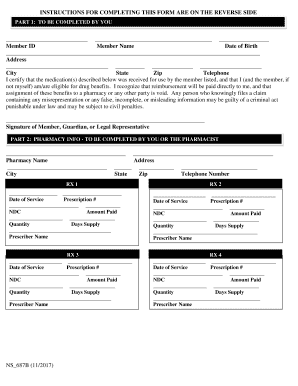

To complete Form 1099-MISC, use: the 2015 General Instructions for Certain Information. Returns, and. the 2015 Instructions for Form 1099-MISC. To orderRead more
IRS and FFI agree that Members should incorporate technology that permits taxpayers to upload forms, such as W-2 and 1099, in order to pre-populate individual,Read more


