




01. Edit your blank 1099 form 2016 online
Type text, add images, blackout confidential details, add comments, highlights and more.

Type text, add images, blackout confidential details, add comments, highlights and more.

Draw your signature, type it, upload its image, or use your mobile device as a signature pad.

Send form 1099 2016 via email, link, or fax. You can also download it, export it or print it out.
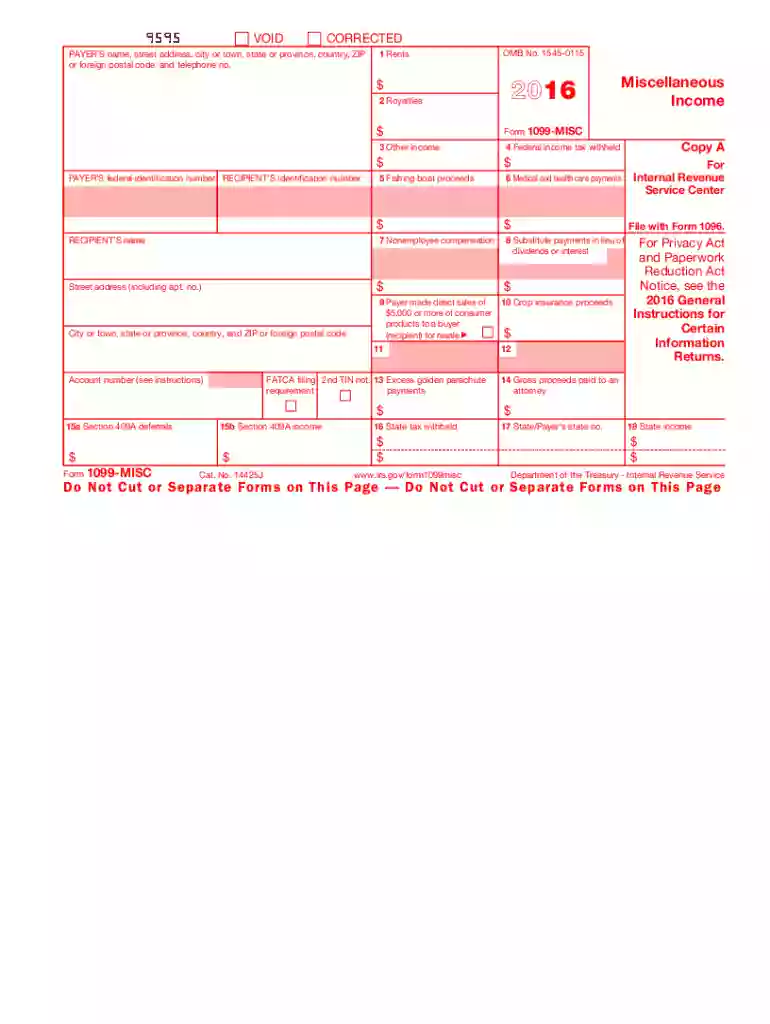
The blank 2 form refers to an IRS document used by businesses and payers to report various types of income other than wages, salaries, and tips. This includes income such as rents, royalties, and nonemployee compensation. The form is an essential part of tax documentation for self-employed individuals and contractors, helping to ensure that income is accurately reported to the IRS. Understanding its significance is crucial for both payers required to file it and recipients who use the information to complete their tax returns.
Utilizing the blank 2 form effectively involves understanding the specific details that must be included. Begin by gathering all necessary information about the recipient, including their taxpayer identification number (TIN) and the total amount of payment made during the year. Fill out each relevant section of the form, ensuring that all entries are accurate to prevent potential issues with the IRS. The completed form should then be sent to both the IRS and the recipient.
Obtaining a blank 2 form can be done through several channels. One option is to order the official forms directly from the IRS using their website or phone service. Alternatively, forms can often be purchased at office supply stores or through tax software services, which offer digital versions compatible with e-filing systems. It is essential to use the official IRS version for Copy A to ensure compatibility with IRS scanning systems.
Several critical elements are present on the 2 form, each serving a unique purpose:
IRS guidelines dictate the proper use of the 2 form, emphasizing the necessity for accuracy. The form must be filed with the IRS by the due date, and any measure to intentionally misrepresent information can lead to penalties. Guidelines also outline the need for the payer to provide the recipient with Copy B of the form. Instructions for filling the form are provided by the IRS to assist taxpayers in complying with federal tax laws.
Timely filing of the 2 form is crucial to comply with IRS regulations. The form must be provided to recipients by January 31 of the following year. Filing with the IRS has two deadlines: by February 28 if filing on paper, or by March 31 if filing electronically. Adhering to these dates helps avoid potential penalties imposed for late submission.
Failure to comply with IRS regulations regarding the 2 form can result in penalties. These may arise from late filing, errors in information reported, or failure to provide a correct form to the recipients. The penalty amount varies depending on the delay in filing and whether the error was intentional. Ensuring accurate and timely submissions minimizes the risk of incurring additional liabilities.
The 2 form can be submitted either electronically or by mail. Electronic filing is encouraged by the IRS as it reduces errors and streamlines processing. Tax software often assists in submitting e-forms directly. Paper submissions require sending Copy A to the designated IRS location listed in the form instructions. Retaining proof of submission is advisable for record-keeping purposes.
We've got more versions of the blank 1099 form 2016 form. Select the right blank 1099 form 2016 version from the list and start editing it straight away!
| Versions | Form popularity | Fillable & printable |
|---|---|---|
| 2024 | 4.3 Satisfied (49 Votes) | |
| 2022 | 4.9 Satisfied (41 Votes) | |
| 2021 | 4.8 Satisfied (187 Votes) | |
| 2020 | 4.2 Satisfied (31 Votes) | |
| 2019 | 4.4 Satisfied (787 Votes) | |
| 2018 | 4.3 Satisfied (809 Votes) | |
| 2017 | 4.4 Satisfied (1573 Votes) | |
| 2016 | 4.4 Satisfied (963 Votes) | |
| 2015 | 3.9 Satisfied (40 Votes) | |
| 2014 | 3.8 Satisfied (35 Votes) | |
| 2013 | 4 Satisfied (29 Votes) | |
| 2012 | 4 Satisfied (54 Votes) | |
| 2011 | 4.1 Satisfied (22 Votes) | |
| 2010 | 4.4 Satisfied (59 Votes) | |
| 2009 | 4 Satisfied (47 Votes) |
Signing paperwork on a mobile device is fast, simple, and doesn’t require software installation when you have an account with DocHub. Log in from any browser, fill in your empty fields with your data, and click on Sign → Create your signature. You can draw your eSignature just as you usually do on paper, add its image to your form 1099 misc 2016, or type in your name and stylize its look. Whatever option you choose, your document will be valid.
With a swift editing system like DocHub, you do not require anything but a browser and connection to the internet to modify your 1099 form 2016 online quickly. Add your document or find the relevant form in DocHub’s catalog, open our editor with a single click, and finish it electronically. To revise your forms anytime, sign up a free account with DocHub.
At DocHub, your data security is our priority. We follow HIPAA, SOC2, GDPR, and other standards, so you can work on your documents with confidence.

Jan 4, 2017 If you received, repaid, or had tax withheld from the SSEB portion of tier 1 benefits during 2016, you will receive Form RRB-1099, Payments byRead more
Nov 15, 2016 Lizzie and Fitz complete. Form 8965, checking the box on line 7 and leaving Part III blank. Example 2. The facts are the same as in Example 1Read more
Recipients identification number. For your protection, this form may show only the last four digits of your social security number (SSN),Read more


