




01. Edit your 1099 form 2020 online
Type text, add images, blackout confidential details, add comments, highlights and more.

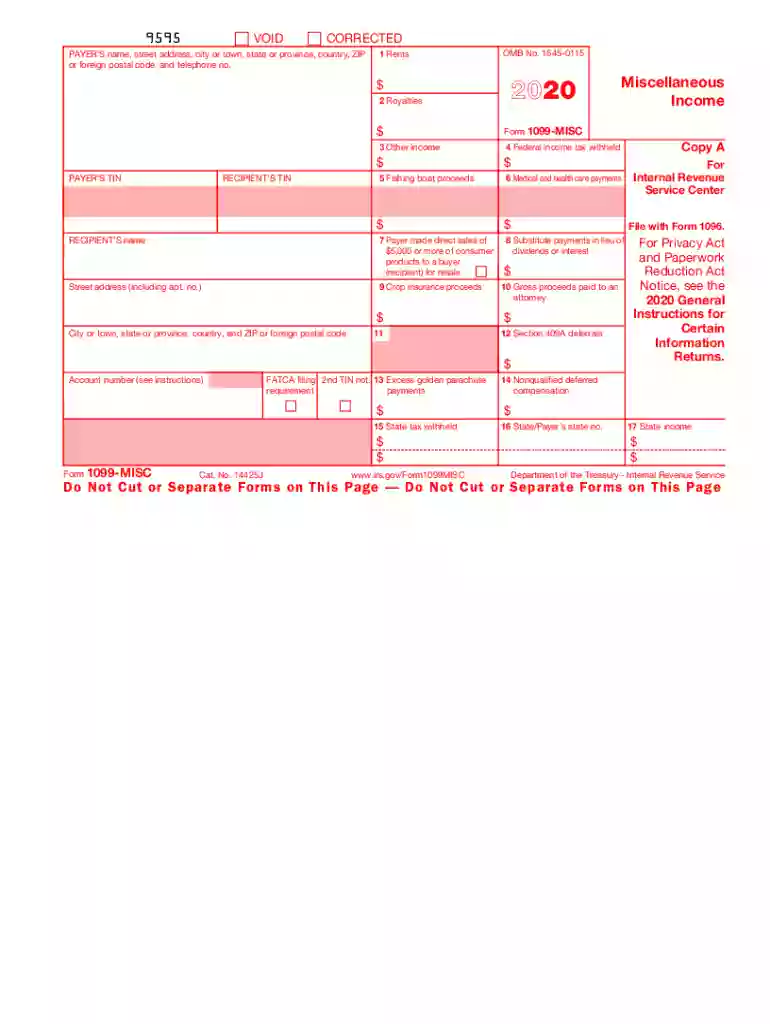
Type text, add images, blackout confidential details, add comments, highlights and more.

Draw your signature, type it, upload its image, or use your mobile device as a signature pad.

Send 2020 fillable 1099 via email, link, or fax. You can also download it, export it or print it out.
The 1099 form is an essential document used in the United States tax system to report various types of income that aren't from employment wages. This form primarily serves independent contractors, freelancers, and businesses to declare payments made to other parties exceeding specific thresholds defined by the IRS. The 1099 form family includes several versions, each designated for different types of income, such as dividends, interests, or miscellaneous income. Understanding the precise function of each type helps ensure accurate income reporting.
To use the 1099 form effectively, individuals and entities must accurately fill it out based on the type of income being reported. For instance, freelancers should ensure that they receive a 1099-NEC form from their clients or businesses if they earned $600 or more for services rendered within a tax year. Similarly, landlords receiving rental income might utilize a 1099-MISC form. It involves calculating gross payments, verifying recipient information, and ensuring all reportable sums are documented correctly so that the IRS can cross-reference it with the recipient's tax return.
1099 forms are generally issued by the payer of income—this can be a business, organization, or individual contracting work. These forms are often provided by January following the income year to allow recipients sufficient time to report their earnings. Individuals who require a 1099 form can obtain it from their clients, and businesses can order them directly from the IRS or through authorized tax preparation software. Maintaining accurate records of transactions throughout the year simplifies the process of compiling data for the form.
The 1099 form is used by a variety of individuals and entities. Self-employed individuals, independent contractors, freelancers, and business owners are the primary users, as they frequently pay for services rendered by others. Landlords and investors also use 1099 forms to report rental income or investment dividends. Additionally, financial institutions issue forms to customers for interest earned on savings or investments. It provides a reliable mechanism for tax reporting outside of traditional employee-employer relationships.


The 1099 form facilitates compliance with tax laws. It is legally required to report earnings that aren’t covered by W-2 employment forms. Proper use of this form ensures transparency between taxpayers and the IRS, helping prevent income tax evasion. Reporting entities must adhere to legal stipulations regarding submission deadlines and accuracy to avoid facing penalties. Furthermore, recipients are obligated to report all received 1099 income within their tax filings, paying attention to the IRS guidelines to ensure that all income streams are accurately captured and taxed.
The IRS requires that most 1099 forms be provided to recipients by January 31 each year. Forms must be submitted to the IRS by February 28 if filed by paper or by March 31 if filed electronically. Timely filing is critical as the IRS imposes penalties for late submissions. Some extensions may be permissible under certain conditions, but it's imperative to apply for these well in advance to avoid compliance issues.
Non-compliance with 1099 filing requirements can lead to significant penalties, varying based on the delay in filing. Penalties may begin as low as $50 per form if filed within 30 days past the deadline and can reach up to $270 per form in cases of continued non-compliance. Additionally, intentional disregard for filing could result in even steeper fines, emphasizing the importance of understanding and adhering to all 1099 filing requirements and deadlines to avoid unnecessary financial repercussions.
We've got more versions of the 1099 form 2020 form. Select the right 1099 form 2020 version from the list and start editing it straight away!
| Versions | Form popularity | Fillable & printable |
|---|---|---|
| 2024 | 4.3 Satisfied (49 Votes) | |
| 2022 | 4.9 Satisfied (41 Votes) | |
| 2021 | 4.8 Satisfied (187 Votes) | |
| 2020 | 4.2 Satisfied (31 Votes) | |
| 2019 | 4.4 Satisfied (787 Votes) | |
| 2018 | 4.3 Satisfied (809 Votes) | |
| 2017 | 4.4 Satisfied (1573 Votes) | |
| 2016 | 4.4 Satisfied (963 Votes) | |
| 2015 | 3.9 Satisfied (40 Votes) | |
| 2014 | 3.8 Satisfied (35 Votes) | |
| 2013 | 4 Satisfied (29 Votes) | |
| 2012 | 4 Satisfied (54 Votes) | |
| 2011 | 4.1 Satisfied (22 Votes) | |
| 2010 | 4.4 Satisfied (59 Votes) | |
| 2009 | 4 Satisfied (47 Votes) |
At DocHub, your data security is our priority. We follow HIPAA, SOC2, GDPR, and other standards, so you can work on your documents with confidence.




The official printed version of Copy A of this IRS form is scannable, but the online version of it, printed from this website, is not. Do not print and file.Read more
For your protection, this form may show only the last four digits of your TIN (social security number (SSN), individual taxpayer identification number (ITIN),Read more


