




01. Edit your form online
Type text, add images, blackout confidential details, add comments, highlights and more.

Type text, add images, blackout confidential details, add comments, highlights and more.

Draw your signature, type it, upload its image, or use your mobile device as a signature pad.

Send it via email, link, or fax. You can also download it, export it or print it out.
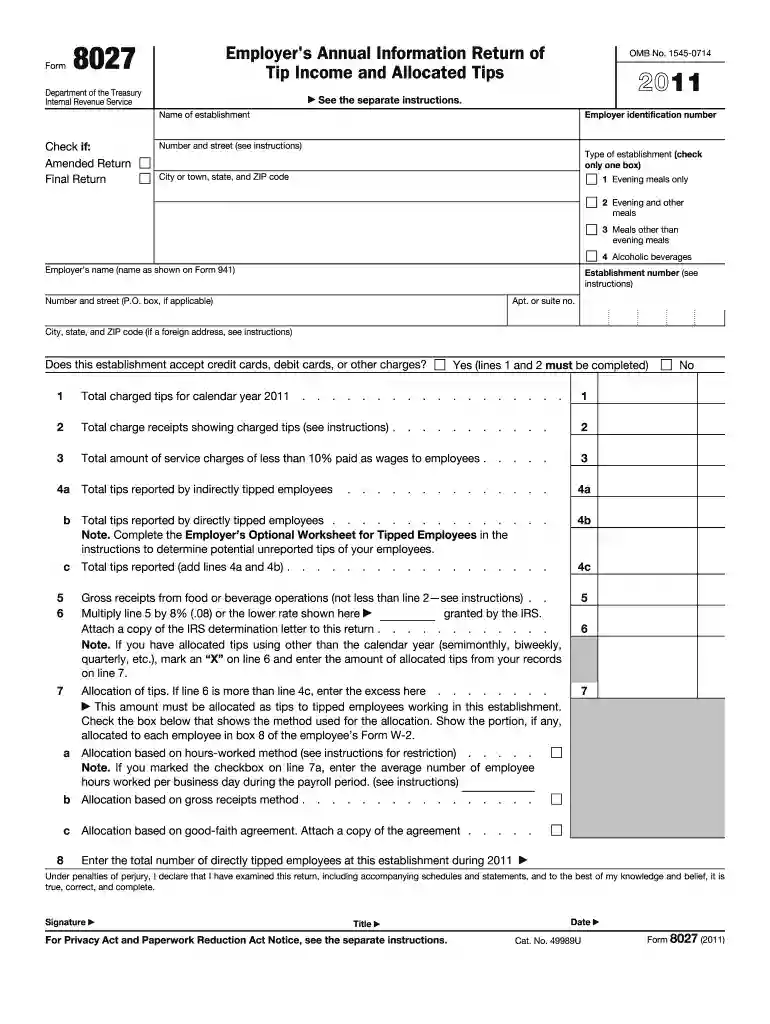
The 2011 Form 8027 is the Employer's Annual Information Return of Tip Income and Allocated Tips, used by employers in the United States to report employee tip income and associated allocations. Issued by the Internal Revenue Service (IRS), this form captures detailed information about tips in establishments where tipping is customary, such as restaurants, bars, and nightclubs. The form tracks the total amount of reported tip income, charged tips, the establishment's name, and employer identification.
Employers must ensure all tipped income is accurately reported to avoid legal complications. Tips directly received by employees, as well as those allocated by the employer, must be accounted for, providing the IRS with a comprehensive view of the business's tipping dynamics. Accurate completion of this form ensures compliance with federal tax laws, which is crucial for businesses to avoid penalties and audits.
Completing the 2011 Form 8027 involves a systematic approach to ensure accuracy. Follow these steps:
Allocation of tips may be required if the reported tip amount is below a required percentage of gross receipts. The employer must then report this on the form under specific allocation methods, such as the Good Faith Agreement or directly using gross receipts and total sales to calculate allocations fairly among employees.
Several key components are critical to correctly filling out the 2011 Form 8027:
Legally, employers must use Form 8027 to comply with IRS tip reporting requirements. Complete reporting aids in accurate distribution of tip credits among employees and ensures that the business adheres to fair labor practices. Failure to comply with regulations related to tip reporting may result in audits and potential penalties for underreporting.
Non-compliance can result in financial penalties from the IRS, including fines for incorrect reporting or failure to file. Employers may also face scrutiny for labor law violations if tip allocations are incorrectly managed, reinforcing the importance of accurate completion.
Form 8027 is primarily used by businesses where tipping is regular, such as:


Different business structures such as sole proprietorships, partnerships, LLCs, and corporations in the service industry all require adherence to form requirements, based on their operational scale and tipping culture.
The 2011 Form 8027 must be filed annually, with significant dates including:
The form content directly impacts employees' W-2 forms, thus affecting both employer and employee filings during tax season. Proper filing ensures seamless tax processing for both parties.
We've got more versions of the 2011 form 8027 form. Select the right 2011 form 8027 version from the list and start editing it straight away!
| Versions | Form popularity | Fillable & printable |
|---|---|---|
| 2025 | 4.5 Satisfied (60 Votes) | |
| 2024 | 4.3 Satisfied (35 Votes) | |
| 2023 | 4.9 Satisfied (24 Votes) | |
| 2022 | 4.4 Satisfied (21 Votes) | |
| 2021 | 4.8 Satisfied (145 Votes) | |
| 2020 | 4.4 Satisfied (42 Votes) | |
| 2019 | 4.4 Satisfied (153 Votes) | |
| 2018 | 4.4 Satisfied (197 Votes) | |
| 2017 | 4.2 Satisfied (101 Votes) | |
| 2016 | 4.4 Satisfied (114 Votes) | |
| 2015 | 4 Satisfied (22 Votes) | |
| 2014 | 4 Satisfied (44 Votes) | |
| 2013 | 4 Satisfied (57 Votes) | |
| 2012 | 4 Satisfied (43 Votes) | |
| 2011 | 4.3 Satisfied (54 Votes) |
At DocHub, your data security is our priority. We follow HIPAA, SOC2, GDPR, and other standards, so you can work on your documents with confidence.
by MM Swann Cited by 4 The form reports gross food and beverage sales receipts, employee-reported tip income, total charge receipts and total charge tips (IRS Form 8027, 2012). InRead more
Attach a copy of the agreement . . . . . 8. Enter the total number of directly tipped employees at this establishment during 2011 ▷. Under penalties of perjury,Read more
Natural CO2 Source Fields are reservoirs of carbon, akin to natural gas (methane), which can be drilled out of ground using techniques similar to oil andRead more


