






Definition & Meaning
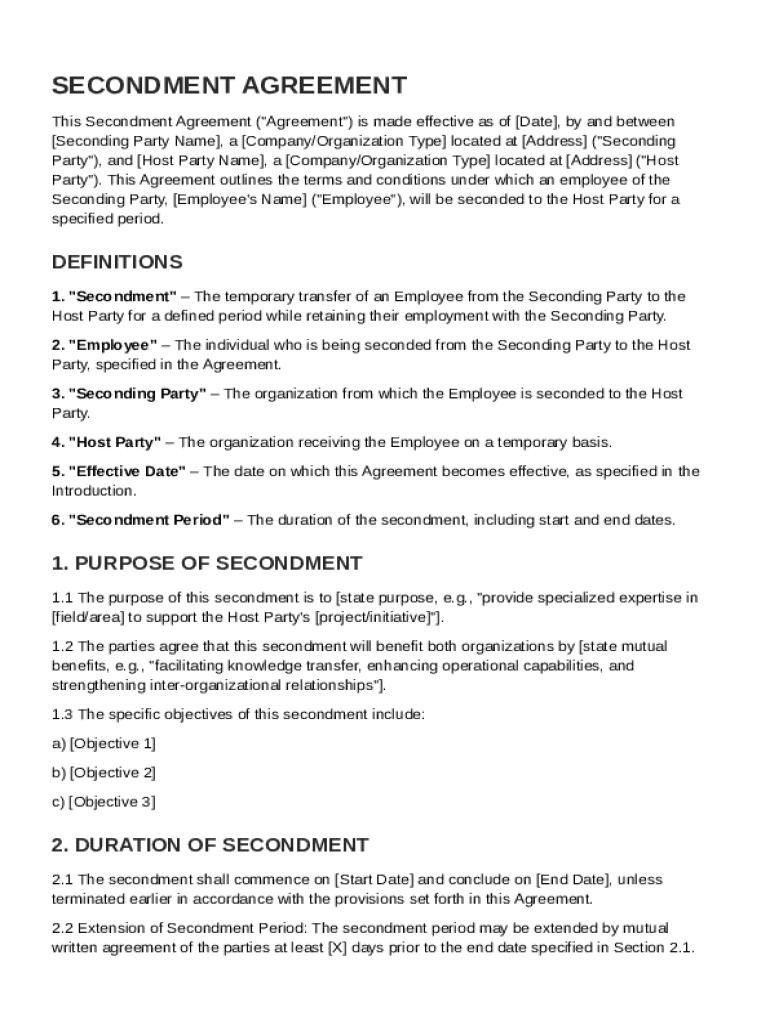
A Secondment Agreement Template is a legal document used to detail the temporary transfer of an employee from one organization, known as the Seconding Party, to another organization, referred to as the Host Party. This agreement outlines essential terms such as duration, roles, responsibilities, and compensation. It also specifies employee rights, confidentiality stipulations, and conditions under which the agreement can be terminated. The goal of a secondment is often to facilitate knowledge transfer between organizations and enhance their operational capabilities while the employee maintains their original employment relationship with the Seconding Party.
Key Elements of the Secondment Agreement Template
The agreement typically includes several key components:
- Parties Involved: Clearly defines the Seconding Party, the Host Party, and the Employee.
- Duration of Secondment: Specifies the start and end dates of the secondment period.
- Roles and Responsibilities: Details the tasks and obligations of the employee during the secondment.
- Compensation and Benefits: Outlines the compensation arrangement, including any salary adjustments or benefits the employee will receive while on secondment.
- Confidentiality and Intellectual Property: Sets terms for handling sensitive information and ownership of any intellectual property generated.
- Termination Conditions: Defines how the agreement can be ended prematurely and any notice periods required.
How to Use the Secondment Agreement Template
Utilizing the Secondment Agreement Template requires careful consideration of the specific needs of both the Seconding and Host Parties. Here’s a step-by-step process:
- Customize the Template: Adjust the template to address the unique aspects of the secondment, such as specific roles or company policies.
- Consult with Legal Counsel: Ensure all legal requirements are met by consulting with a legal professional.
- Review with All Parties: Discuss the terms with both the Seconding and Host Parties and the employee to confirm all parties are in agreement.
- Finalize and Sign: Obtain signatures from authorized representatives of each party and the employee to formalize the agreement.
Steps to Complete the Secondment Agreement Template
Completing the template involves several detailed steps to ensure clarity and compliance:
- Gather Necessary Information: Collect details about the employee, roles, responsibilities, and terms from both organizations.
- Fill Out the Template: Input the gathered information into the template, ensuring all sections are accurately completed.
- Address Potential Issues: Identify any potential contractual issues and make revisions as needed.
- Legal Review: Have the document reviewed by a legal expert for compliance with labor laws and regulations.
- Sign and Execute: Once reviewed and agreed upon, obtain signatures from relevant parties to execute the contract.
- Distribute Copies: Provide copies of the signed agreement to all involved parties for their records.
Legal Use of the Secondment Agreement Template
The legal utilization of the Secondment Agreement Template involves compliance with applicable employment laws and regulations, which may vary depending on the state or organization. Key considerations include:
- Employment Rights: Ensuring the continuity of the employee’s rights under the Seconding Party's employment terms.
- Compliance with Labor Laws: Verifying that the agreement aligns with state and federal employment regulations.
- Conflict Resolution Mechanisms: Incorporating mechanisms to address any disputes that may arise during the secondment period.
Who Typically Uses the Secondment Agreement Template
The template is typically used by:
- Large Corporations: For transferring employees to different branches or departments internationally.
- Government Agencies: When lending staff to other departments or public sector bodies.
- Research Institutions: Transferring researchers or faculty members for collaborative projects.
- Educational Organizations: Seconding teachers or administrators to partner institutions for special programs.


Business Types that Benefit Most from Secondment Agreement Template
Certain businesses and entities can particularly benefit from using a secondment agreement:
- Multi-National Companies: Facilitating cross-border employee transfers.
- Consulting Firms: Temporarily placing employees at client sites.
- Non-Profits: Sharing resources with other charitable organizations without permanently reallocating staff.
- Startups: Gaining expertise from larger partner organizations without permanent hires.
State-by-State Differences
While secondment agreements are generally similar across different jurisdictions, there can be state-specific nuances:
- Labor Law Variations: Different states may have varying labor laws that affect employment terms and rights.
- Tax Implications: State taxes might impact the compensatory arrangements during secondment.
- Legal Compliance: Additional documentation might be necessary to comply with local employment statutes.
Understanding these differences is crucial for organizations to ensure compliance and avoid potential legal issues in any given state.