




01. Edit your form online
Type text, add images, blackout confidential details, add comments, highlights and more.

Type text, add images, blackout confidential details, add comments, highlights and more.

Draw your signature, type it, upload its image, or use your mobile device as a signature pad.

Send it via email, link, or fax. You can also download it, export it or print it out.
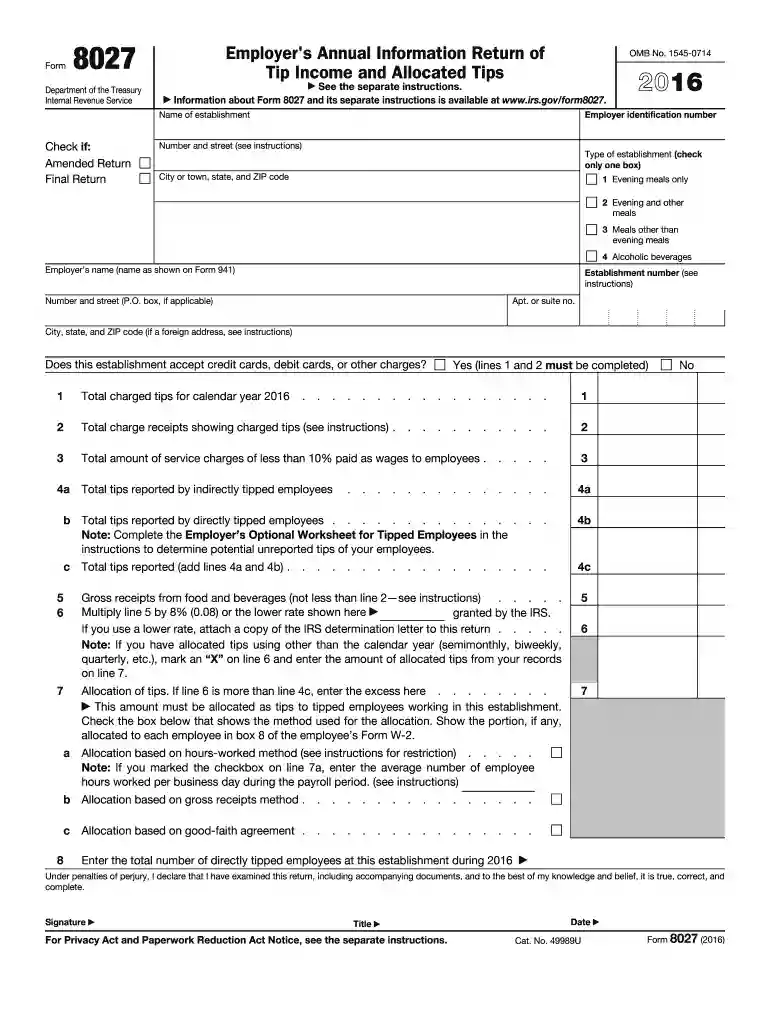
The 2 Form, also known as the Employer's Annual Information Return of Tip Income and Allocated Tips, is used by establishments to report employee tip income and other required financial details. This form provides a breakdown of the total charged tips, service charges, and allocations to employees, making it a critical document for businesses where tipping is commonplace, such as restaurants and bars. Reporting on this form must be accurate and honest, as it is a significant part of tax compliance with the IRS.
Completing the 2 Form involves several distinct steps that require attention to detail in order to ensure accuracy and compliance.
The IRS provides several ways for employers to obtain the 2 Form.
The 2 Form is primarily used by businesses in the hospitality industry, where tipping is a standard practice. Restaurants, bars, hotels, and cafes are typical users, as they have to report employee tip earnings to ensure compliance with federal wage and tax laws. These businesses often have dedicated personnel to manage tip reporting, including financial managers and HR professionals.


The primary legal use of the 2 Form is to comply with tax laws relating to tip income. The IRS mandates accurate reporting under penalties of perjury. This form helps ensure employees are correctly reporting their earnings, which are subject to income taxes like other types of wages. Employers must ensure that the reported tips meet federal wage requirements and include accurate allocated tip details to avoid legal consequences such as audits or fines.
The deadline for filing the 2 Form was March 31, 2017, for electronic submissions and February 28, 2017, for paper submissions. Timely filing is crucial to avoid penalties. Employers should mark these dates in their calendar and set reminders to ensure compliance. Errors or omissions can lead to financial penalties, so accuracy and timeliness are crucial.
Failing to accurately file the 2 Form can result in significant penalties from the IRS. Non-compliance may lead to fines based on the level of error or negligence.
Employers should strive to be thorough and punctual in their filings to avoid such risks.
Familiarity with key terms is essential for correct completion:
Understanding these terms helps ensure detailed and error-free preparation and submission of the form.
We've got more versions of the 2016 8027 form form. Select the right 2016 8027 form version from the list and start editing it straight away!
| Versions | Form popularity | Fillable & printable |
|---|---|---|
| 2025 | 4.5 Satisfied (60 Votes) | |
| 2024 | 4.3 Satisfied (35 Votes) | |
| 2023 | 4.9 Satisfied (24 Votes) | |
| 2022 | 4.4 Satisfied (21 Votes) | |
| 2021 | 4.8 Satisfied (145 Votes) | |
| 2020 | 4.4 Satisfied (42 Votes) | |
| 2019 | 4.4 Satisfied (153 Votes) | |
| 2018 | 4.4 Satisfied (197 Votes) | |
| 2017 | 4.2 Satisfied (101 Votes) | |
| 2016 | 4.4 Satisfied (114 Votes) | |
| 2015 | 4 Satisfied (22 Votes) | |
| 2014 | 4 Satisfied (44 Votes) | |
| 2013 | 4 Satisfied (57 Votes) | |
| 2012 | 4 Satisfied (43 Votes) | |
| 2011 | 4.3 Satisfied (54 Votes) |
At DocHub, your data security is our priority. We follow HIPAA, SOC2, GDPR, and other standards, so you can work on your documents with confidence.
Welcome to the Chadron State College policies web page. All officially approved CSC policies and Nebraska State College System policies will be listed on thisRead more
Use Form 8027-T to send Forms 8027 to the Internal. Revenue Service if you have more than one establishment for which you have to file Form 8027.Read more
May 2, 2017 See the Instructions for Form. 8027, Employers Annual Information Return of Tip. Income and Allocated Tips. Do not include this amount in.Read more


