






Definition and Meaning of the California EFT Authorization Agreement
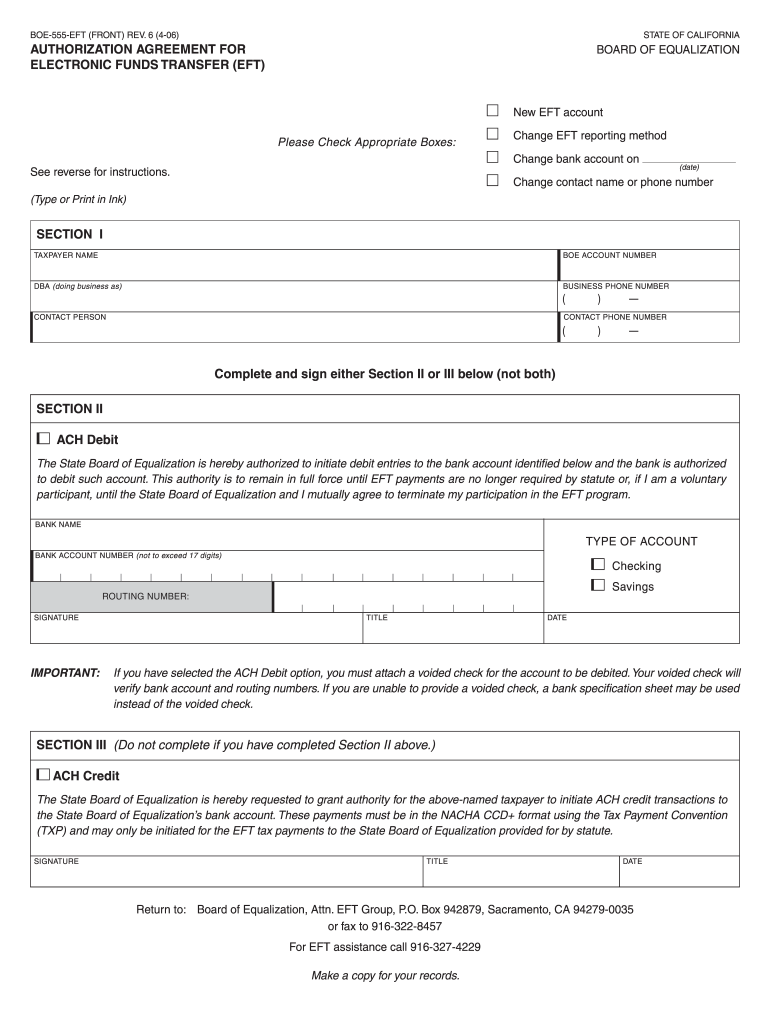
The California EFT Authorization Agreement is a critical document used by businesses and individuals to authorize electronic funds transfers (EFT) with the State of California. This form is essential for automating payments or tax transactions electronically, ensuring efficient and secure handling of funds. When you complete this agreement, you grant permission to the entity, such as the California Department of Tax and Fee Administration (CDTFA), to debit or credit your designated account for purposes like tax payments or refunds.
Key Features
- Authorization for Transactions: Allows for direct transactions between your bank account and the state for various purposes, including tax obligations.
- Security: Incorporates rigorous security measures to protect sensitive financial information during transfers.
- Efficiency: Streamlines payment processes, reducing the need for paper checks and manual intervention.
How to Use the California EFT Authorization Agreement
Utilizing the California EFT Authorization Agreement involves several important steps to ensure effective configuration and compliance with state requirements.
Step-by-Step Instructions:
- Obtain the Form: Access the form through the appropriate state/government department's website or request it by phone or mail.
- Complete Required Fields: Fill in necessary details, such as your bank account information, taxpayer identification number, and contact information.
- Attach Relevant Documents: Provide any required supporting documentation, such as a voided check, to confirm bank details.
- Submit the Form: Send the completed form to the specified address or electronic submission platform, following any outlined instructions particular to method or format.
- Confirmation and Activation: Await confirmation of activation from the state to begin utilizing the EFT system.
Examples
Suppose you're a business owner making quarterly sales tax payments to the state. This form allows you to set up predictable, automated debits from your company account directly to the CDTFA, simplifying your financial workflow and ensuring timely payments.
Steps to Complete the California EFT Authorization Agreement
Completing the California EFT Authorization Agreement accurately is vital for a smooth electronic funds transfer process. The form involves key sections that each require specific information.
Detailed Completion Process:
-
Identification Information: Clearly provide your business or personal identification information. This includes your full name, business name (if applicable), contact information, and taxpayer ID.
-
Bank Details: Accurately fill out your bank's routing number and account number. Double-check these details to ensure no errors that could delay the process.
-
Transaction Types: Specify the types of transactions authorized, such as periodic tax payments or refunds. This determines how the state will interact with your account.
-
Sign and Date: The agreement must be signed and dated by an authorized individual to validate consent for electronic transactions.
Importance of the California EFT Authorization Agreement
Engaging with the California EFT Authorization Agreement is crucial for entities that aim to maintain compliance and optimize their payment processes.
Benefits:
- Reliable Payment Processing: Ensures timely transactions, crucial for maintaining good standing with state authorities.
- Cost-Effective Solution: Reduces administrative costs related to paper checks and manual payment methods.
- Audit Trail: Provides a clear record of payments and transactions, facilitating easier reconciliation and audit processes.
Who Typically Uses the California EFT Authorization Agreement
This agreement is primarily used by:
- Business Owners: For automating sales and use tax payments.
- Contractors: Those who need regular interaction with state payroll or procurement.
- Individuals: Engaged in ongoing payment commitments with state agencies.


Examples
- Corporations: Handling substantial volume and value transactions for tax liabilities.
- Nonprofits: Managing government grant funding through automated transfers.
Key Elements of the California EFT Authorization Agreement
Several critical components make up this form, each necessary to finalize the authorization efficiently.
Core Components:
- Authorization Clause: Legal statement granting permission for account access.
- Liability Clause: Outlines the responsibilities of both parties involved in the transaction process.
- Amendment Section: Details how changes to the agreement can be requested and implemented.
- Revocation Policy: Provides conditions under which authorization can be withdrawn.
State-Specific Rules for the California EFT Authorization Agreement
California has distinct regulations governing EFT transactions that differ from federal provisions or those of other states.
Regional Considerations:
- Compliance Standards: Must adhere strictly to California's regulatory framework, under entities like the CDTFA.
- Transfer Schedules: Recognizes specific business days and national holidays which may affect transaction timing.
- Fees and Penalties: Defines fees associated with insufficient funds or incorrect submissions, promoting accurate and timely completion.
Examples of Using the California EFT Authorization Agreement
Examining real-world scenarios provides clarity on the utility of this form.
Case Studies:
- Small Business Scenario: An emerging retailer uses this agreement to manage its sales tax efficiently. Regular EFTs reduce the risk of late payments, enhance cash flow management, and simplify accounting tasks.
- Professional Services: Independent consultants who remit taxes across multiple states find electronic submission through this form facilitates seamless integration with financial systems.
Ultimately, the California EFT Authorization Agreement serves as a robust tool for modern financial operations, providing both a secure and compliant mechanism for interaction with state agencies.