Definition & Meaning
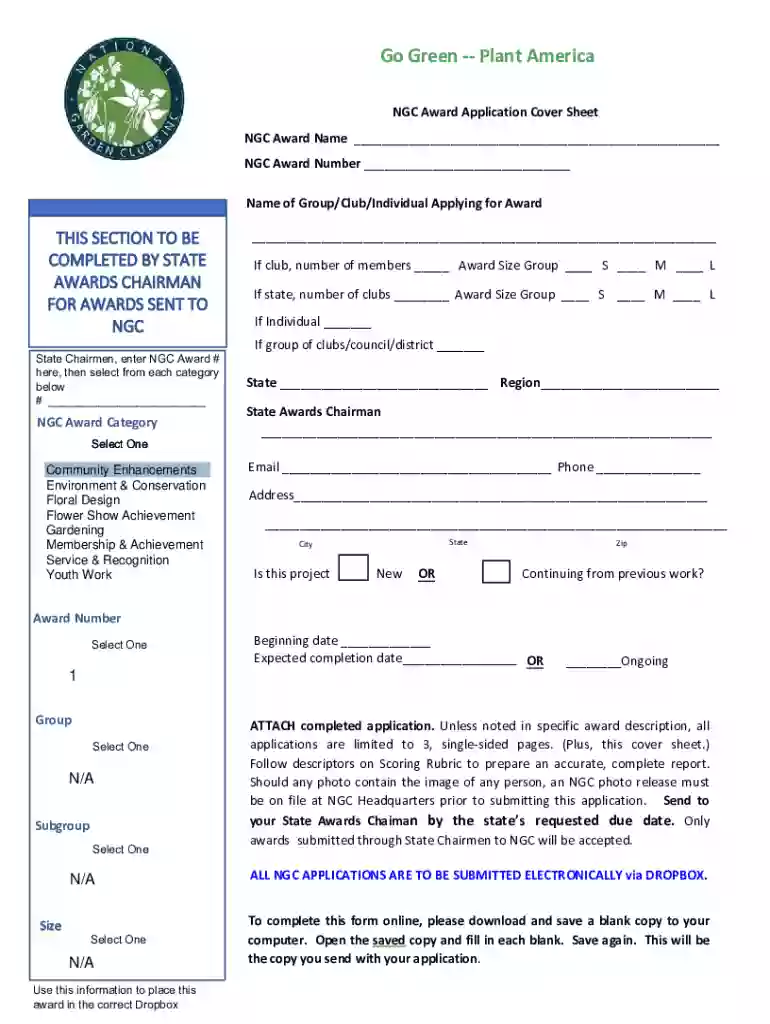
The NGC Award Application Cover Sheet 2 serves as the preliminary page in the submission process for awards associated with community, environmental, and gardening projects. It acts as a formal introduction, providing essential details about the applicant and the nature of the project. The cover sheet ensures that all incoming applications are standardized and contain the necessary initial information for review by award committees.
Additional Context
- Purpose: To standardize submissions, making it easier for reviewers to assess the eligibility and relevance of each application.
- Key Contents: Applicant identity, project scope, award category indicators, and basic contact information.
How to Use the NGC Award Application Cover Sheet 2
Utilizing the cover sheet correctly ensures that applications are processed efficiently and adhere to the standards set by the award committee. Below are the steps to properly use it:
- Download the Form: Access the NGC Award Application Cover Sheet 2 from the official website or requested platform.
- Complete All Sections: Fill in every required field, ensuring accuracy and clarity.
- Attach Additional Documents: Pair the cover sheet with required supporting documents.
Common Usage Tips
- Clarity & Completeness: Ensure all fields are filled accurately to avoid processing delays.
- Digital Completion: Whenever possible, complete and submit the form digitally to expedite processing.
Steps to Complete the NGC Award Application Cover Sheet 2
Completing the form accurately is crucial for successful submission. Below is a step-by-step guide:
- Enter Applicant Information: Include name, address, and contact details.
- Select Award Categories: Indicate the specific awards for which you are applying.
- Detail Project Status: Provide current status and timeline of the project.
- Review for Errors: Check for any mistakes or omissions before submission.
Common Errors
- Omissions: Forgetting essential fields can delay or nullify the application.
- Inaccurate Category Selection: Misaligning the project with incorrect award categories could result in disqualification.
Key Elements of the NGC Award Application Cover Sheet 2
The cover sheet encompasses several critical sections that must be accurately completed:
- Applicant Details: Ensures proper identification of the individual or organization applying.
- Project Information: Provides a concise overview of the project.
- Submission Guidelines: Highlights the preferred formatting and methods of submission.
Detailed Explanation
- Applicant Section: Necessary for applicant verification.
- Project Section: Assists in preliminary assessment of project suitability and impact potential.
Required Documents
Submitting the correct documents alongside the cover sheet is vital for a successful application. Common required documents include:
- Project Proposal: Detailed description of the project.
- Budget Plan: Financial breakdown of the project costs.
- Previous Achievements: Any previous awards or recognitions that underscore the applicant's achievements.
Examples of Documents
- Letters of Recommendation: Providing character and capability endorsements.
- Visual Aids: Photos or diagrams that illustrate the project’s scope and progress.
Application Process & Approval Time
Understanding the application timeline helps manage expectations:
- Submission Deadline: Ensure all materials are submitted by the specified deadline.
- Review Period: Typical review time ranges from several weeks to a few months.
- Notification: Applicants are usually notified electronically regarding the outcome.
Timeline Considerations
- Early Submission: Encouraged to allow ample review time.
- Follow-Up: Contact points for inquiries regarding application status.
Form Submission Methods (Online / Mail / In-Person)
The platform provides multiple submission avenues:
- Online Submission: Preferred for speed and efficiency.
- Mail Submission: Ensure proper packaging and tracking.
- In-Person Submission: Possible at designated locations, providing receipt confirmations.
Submission Preferences
- Electronic Methods: Strongly recommended to preserve document integrity and ensure faster processing.
- Hybrid Approach: Combines both digital and physical methods for redundancy.
Legally Binding Electronic Signatures
DocHub provides a reliable and secure method for the electronic signing of the NGC Award Application Cover Sheet 2. Signatures collected through the platform comply with legal standards, ensuring enforceability:
- Signature Creation: Options include drawing, typing, or uploading a signature.
- Secure Submission: Utilize SSL encryption to ensure secure transmission.
Compliance and Security
- ESIGN Act Adherence: All signatures meet federal requirements for electronic signatures.
- Security Measures: Include 256-bit SSL encryption to protect applicant data during submission.
Targeted Users
- Non-Profits: Frequently engage in projects eligible for awards under the NGC framework.
- Educational Institutions: Seek awards for student-led or faculty-sponsored environmental projects.
Form Variants and Alternatives
While the NGC Award Application Cover Sheet 2 is the standard, understanding other variants or older versions can be useful:
- Previous Versions: Ensure you are using the most current form for submission.
- Related Documents: Similar forms may exist for specific award categories.
Importance of Current Forms
- Version Accuracy: Always verify that you are utilizing the latest form specifications, which can influence eligibility and submission accuracy.
Digital vs. Paper Version
Deciding between digital and paper formats depends on several factors:
- Digital Format: Offers ease of access and rapid processing.
- Paper Format: Might be necessary for contexts lacking digital access.
Considerations for Choice
- Access to Technology: Digital is preferable for those with the means to submit electronically.
- Document Tracking: Digital formats simplify the process of tracking document history and edits.