
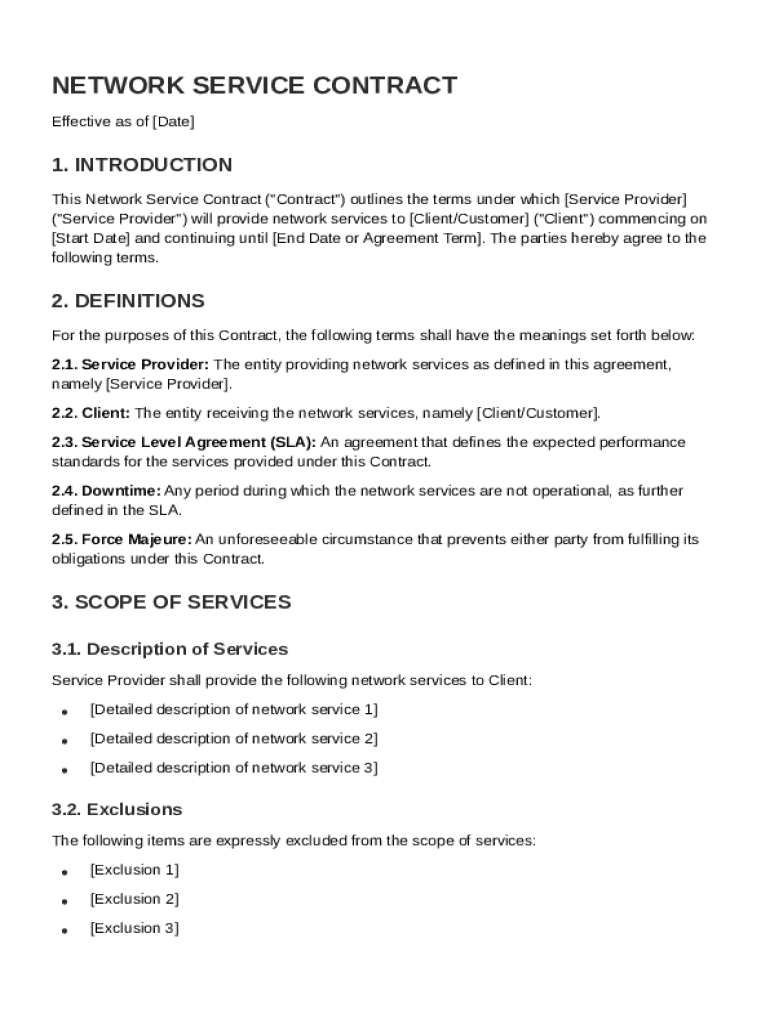







Definition and Purpose of the Network Service Contract Template
A Network Service Contract Template is a standardized document designed to outline the terms and conditions associated with the provision of network services between a service provider and a client. This template serves as a legal framework that governs the relationship and expectations between the two parties. It typically includes sections detailing the scope of services, performance metrics, payment obligations, confidentiality clauses, and liability limitations. By utilizing a template, both parties can ensure that all essential elements are covered, reducing the likelihood of misunderstandings and disputes.
How to Use the Network Service Contract Template
Using the Network Service Contract Template involves several key steps to ensure that the document is comprehensive and tailored to the specific needs of the service exchange. First, review the template’s pre-filled sections to understand its default provisions. Next, customize the template by entering specific details such as the names of the involved parties, the exact services to be provided, performance standards, and payment schedules. It is crucial to read through each clause, modifying any sections to better fit the particular agreement. Additionally, both parties should review the document together to ensure that all terms are mutually agreed upon before signing.
Steps to Complete the Network Service Contract Template
- Review: Begin by carefully reading the entire template to understand standard terms.
- Customize: Insert specific details like party names, services, and payment terms.
- Modify Clauses: Adjust any clauses that need further customization to better meet the requirements of the agreement.
- Review with Party: Discuss the document with the other party to ensure mutual understanding.
- Signatures: Once all modifications are agreed upon, both parties should sign the document to formalize the contract.
Key Elements of the Network Service Contract Template
The template typically consists of various elements that are critical to defining the business relationship. Among these, some of the most important include:
- Scope of Services: This section outlines the services the provider will deliver, including any specific deliverables.
- Payment Terms: Details about how and when payments will be made, including any penalties for late payment.
- Performance Metrics: Standards against which the services will be measured to ensure quality and timeliness.
- Confidentiality Obligations: Clauses that protect sensitive information exchanged between parties.
- Liability Limitations: Defines the extent to which each party is liable in case of a breach or failure in service.
Important Terms Related to the Network Service Contract Template
Understanding the terminology used in the Network Service Contract Template is vital for proper implementation and compliance. Terms such as "Service Provider," "Client," "Scope," "Performance Metrics," and "Liability" often carry specific meanings within the context of these agreements. Knowing these terms helps parties better comprehend their rights and obligations, ensuring a smoother contractual process. It is advisable to seek clarification on any terms that may be unclear before finalizing the document.
Legal Use and Compliance
The Network Service Contract Template must comply with applicable legal standards to ensure it is enforceable. This includes adhering to state and federal data protection laws, especially if personal data is involved in the services provided. The agreement should also mention any specific regulations related to the industry in which the services are offered. Legal consultation may be necessary to tailor the template fully to comply with jurisdiction-specific laws, thereby avoiding potential legal pitfalls.
Who Typically Uses the Network Service Contract Template
This template is commonly utilized by businesses that provide network services, such as IT companies, telecommunications firms, and internet service providers. Clients who often enter into these contracts include corporations seeking managed IT services, small businesses needing network installation and maintenance, and individual clients requiring specialized networking work. By using a standardized template, these diverse groups can efficiently establish clear service expectations and responsibilities.


Examples of Using the Network Service Contract Template
Practical scenarios demonstrate the utility of the Network Service Contract Template. Consider an IT company providing managed services to a rural hospital. The contract outlines services such as network monitoring, security updates, and support availability. Another example might involve a telecommunications company supplying a corporation with internet connectivity and phone services; the contract details bandwidth requirements and network uptime guarantees. These examples underscore how the template facilitates clear communication and accountability between service providers and clients.
Software Compatibility and Integration
DocHub's platform offers seamless integration with various file formats and systems, beneficial for businesses using the Network Service Contract Template. The template can be easily imported from platforms like Google Drive or Dropbox, edited online, and then exported for further use in popular software like QuickBooks or Microsoft Office. This compatibility ensures that businesses can incorporate the template into their existing workflows without additional technological hurdles, thus streamlining document management and collaboration.




