Concrete Driveway Contract Template 2026

Get Form
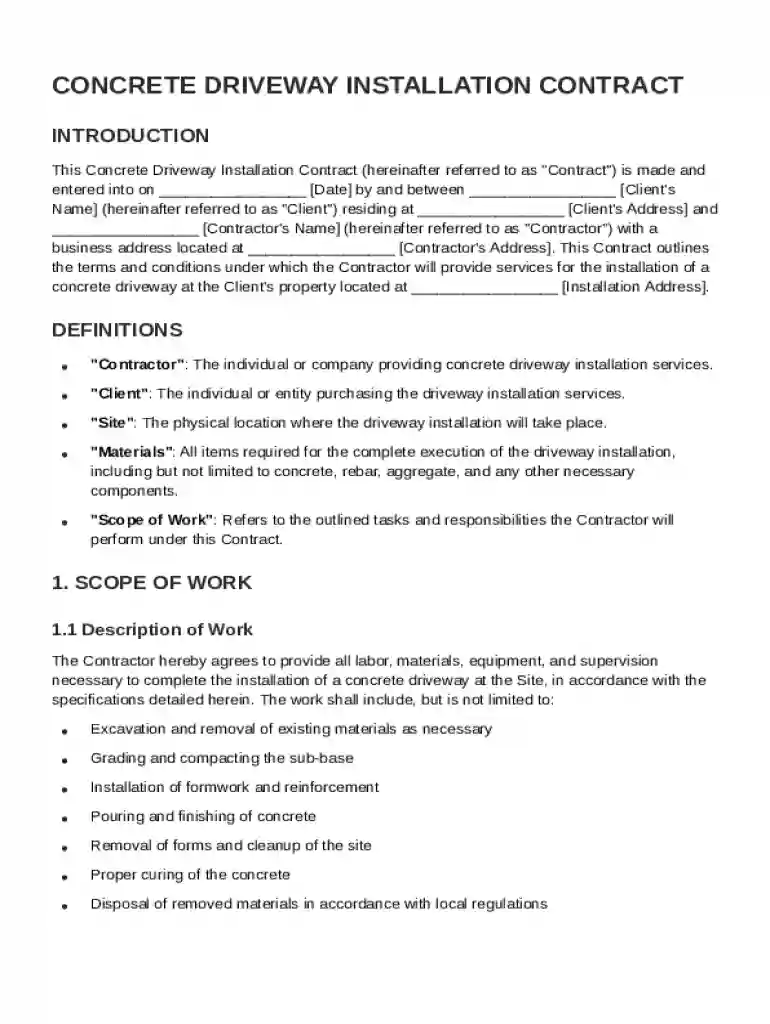
Concrete Driveway Contract Template Preview on Page 1

Here's how it works

01. Edit your form online
Type text, add images, blackout confidential details, add comments, highlights and more.

02. Sign it in a few clicks
Draw your signature, type it, upload its image, or use your mobile device as a signature pad.

03. Share your form with others
Send it via email, link, or fax. You can also download it, export it or print it out.

Definition & Meaning

The Concrete Driveway Contract Template is a formal agreement used between a client and a contractor to outline the terms and conditions for installing a concrete driveway. This template provides a structured framework that delineates the roles, responsibilities, and expectations of both parties involved in the project. By using this template, both clients and contractors can ensure clarity and avoid misunderstandings, as it includes vital components such as scope of work, payment terms, and warranties. This contract is crucial for legally binding agreements and helps in managing project execution smoothly.

Key Elements of the Concrete Driveway Contract Template

Scope of Work

The scope of work is a critical section that details the tasks the contractor will complete as part of the driveway installation. It includes:

  • Preparation of the site
  • Types of materials to be used, such as concrete grade
  • Dimensions and design of the driveway
  • Timeline for project completion

Each task is clearly defined to ensure both the client and contractor have a mutual understanding of the work required, minimizing potential disputes over incomplete or unsatisfactory work.

Payment Terms

The payment terms specify the financial obligations of the client and the compensation agreed upon for the contractor's services:

  • Total contract price and its breakdown
  • Payment schedule and methods
  • Conditions for advance payments, if any
  • Penalties for late payment or default

Defining payment terms in the contract ensures transparency and trust between the parties, safeguarding the contractor's right to receive timely payment.

How to Use the Concrete Driveway Contract Template

Using the Concrete Driveway Contract Template effectively involves several steps to ensure all necessary information is accurately captured:

  1. Review the Entire Template: Both parties should thoroughly read the template to understand its contents.
  2. Customize the Template: Tailor the template to the specifics of the driveway project, including the details of the tasks, budget, and timeline.
  3. Fill in Required Information: Complete sections with pertinent details such as client and contractor contact information, project location, and specific terms.
  4. Negotiate Terms if Necessary: Both parties can negotiate terms until a mutual agreement is reached. Ensure any changes are documented in the contract.
  5. Finalize and Sign: Once both parties are satisfied, finalize the document by signing it.

This structured approach to using the contract template helps prevent any oversight that might lead to future contractual disputes.

Legal Use of the Concrete Driveway Contract Template

The Concrete Driveway Contract Template serves as a legally binding document once signed by both parties. Its legality stems from the inclusion of essential elements consistent with contract law, such as an offer, acceptance, and consideration. To ensure its enforceability:

  • Ensure the template complies with federal, state, and local laws.
  • Review the contract with legal counsel for additional safeguards.
  • Include clauses that address dispute resolution and termination rights.

This legal framework is essential to protect the interests of both the client and contractor, ensuring a fair resolution process in case of disagreements.

State-Specific Rules for the Concrete Driveway Contract Template

While the Concrete Driveway Contract Template is widely applicable across the United States, understanding and incorporating state-specific regulations enhances its relevance and compliance:

  • License Requirements: Some states may require contractors to hold specific licenses.
  • Permitting Laws: Local regulations might necessitate permits for driveway installations.
  • Zoning Laws: Zoning regulations can affect driveway dimensions and materials.

Contractual agreements should be reviewed to accommodate these regional nuances, providing for legal compliance and smooth project execution.

Examples of Using the Concrete Driveway Contract Template

To illustrate the practical use of the template:

  • Residential Projects: A homeowner hiring a contractor to replace an old driveway.
  • Commercial Projects: A business commissioning a contractor to create a larger parking area utilizing concrete for durability and aesthetics.
  • Municipal Works: A local government contracting to upgrade multiple public paths.

These examples demonstrate the template's versatility and utility across various project scales and sectors, underscoring its adaptability.

Important Terms Related to the Concrete Driveway Contract Template

Understanding key terms is crucial for navigating and comprehending the contract:

  • Contractor: The party responsible for performing the work per the agreement.
  • Client: The individual or entity commissioning the work.
  • Warranties: Assurances regarding the quality and longevity of the completed work.
  • Change Orders: Amendments to the original contract terms agreed upon by both parties.

Familiarizing oneself with these terms facilitates better interpretation and execution of the contract.

Who Typically Uses the Concrete Driveway Contract Template

The primary users of this contract template include:

  • Homeowners seeking improvements or new installations for their driveways.
  • Contractors offering construction or remodeling services for exterior spaces.
  • Real Estate Developers incorporating new concrete features in their projects.

This broad spectrum of users makes the template a valuable tool for various stakeholders involved in concrete driveway projects.


decoration image ratings of Dochub
be ready to get more

Complete this form in 5 minutes or less

Get form

Got questions?

We have answers to the most popular questions from our customers. If you can't find an answer to your question, please contact us.
Contact us
The Three Essentials of a Valid Concrete Contract Define scope clearly (e.g. formwork, finish type, reinforcement) Avoid miscommunication on site conditions, schedule, or material specs. Present a polished, branded proposal and contract bundle. Align your estimates, invoices, and legal terms in one document flow.
Yes you can write your own contracts. A written contract is only a written record of something that has already been agreed in speech. So to start with write down in simple terms what has been agreed already, that is a good starting point.
When pouring a concrete driveway, thickness matters. A standard residential concrete driveway should be at least 4 inches thick, but we recommend 5 to 6 inches for heavier vehicles or longer durability. For commercial driveways, the thickness should be 6 to 8 inches to handle heavier loads.
Write the contract in six steps Start with a contract template. Open with the basic information. Describe in detail what you have agreed to. Describe how the contract will end. Say which laws apply and how disputes will be resolved. Include space for signatures.

Security and compliance

At DocHub, your data security is our priority. We follow HIPAA, SOC2, GDPR, and other standards, so you can work on your documents with confidence.

Learn more
ccpa2
pci-dss
gdpr-compliance
hipaa
soc-compliance