
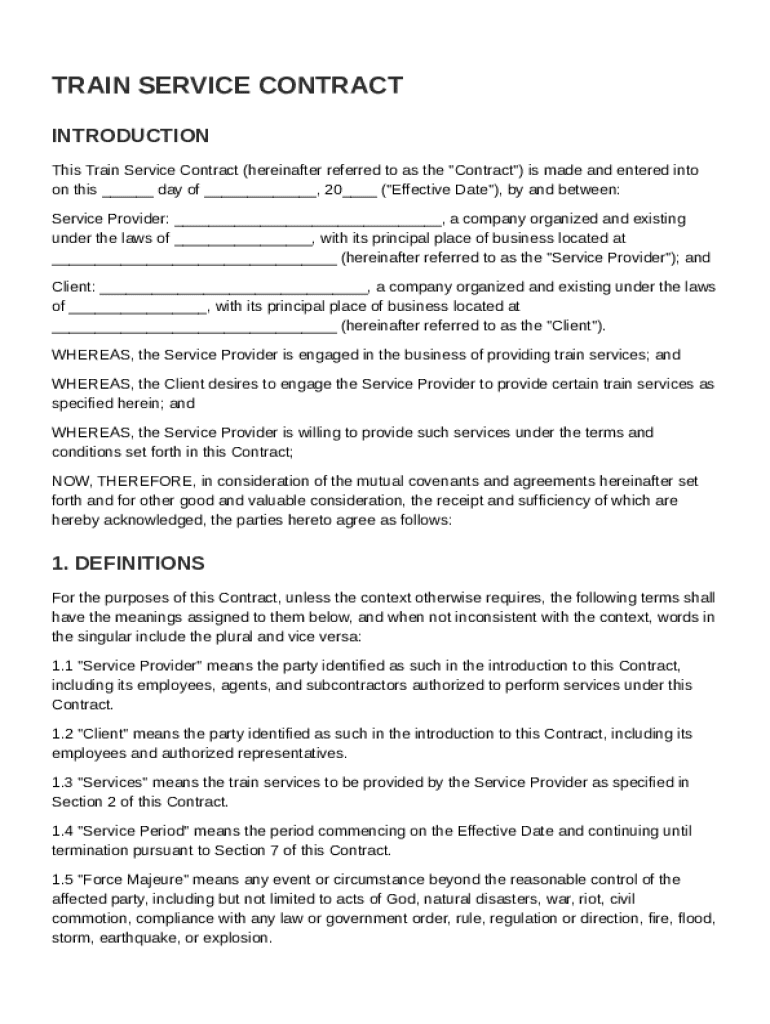







Definition & Meaning
A Train Service Contract Template is a structured document designed to formalize the agreement between a service provider and a client for train transportation services. This contract sets out the detailed obligations, rights, and expectations of both parties, enabling smooth operations and management of train services. Key components typically include the scope of services, payment arrangements, performance standards, and terms for liability. This template ensures compliance with legal and operational standards in the U.S., making it essential for both service efficiency and legal protection.
Common Components
- Scope of Services: Specifies the range of services offered, such as passenger transport, freight hauling, or maintenance.
- Payment Terms: Details on pricing structures, payment schedules, and methods.
- Roles and Responsibilities: Outlines the duties of both the service provider and the client.
- Performance Standards: Sets benchmarks for quality and timeliness of service delivery.
- Liability and Indemnification: Covers the extent of liability and indemnity clauses to protect each party.
- Termination Conditions: Details scenarios for ending the contract, including breach of terms.
Key Elements of the Train Service Contract Template
The effectiveness of a Train Service Contract Template heavily relies on its key elements that provide the contract's framework. These essential elements guide the preparation, execution, and enforcement of the agreement.
Detailed Sections
- Definitions: Provides specific meaning to terms used throughout the contract for clarity.
- Service Deliverables: Clearly lists out deliverables, timelines, and key milestones.
- Communication Protocols: Specifies regular reporting and communication methods between parties.
- Amendment Process: Describes how contract changes can be negotiated and formalized.
- Dispute Resolution: Establishes methods for addressing disputes, such as negotiation, mediation, or arbitration.
- Miscellaneous Provisions: Includes jurisdiction, force majeure, and confidentiality clauses.
Steps to Complete the Train Service Contract Template
Completing the Train Service Contract Template involves systematic steps that ensure all relevant information is accurately captured and agreed upon.
Step-by-Step Guide
- Initial Consultation: Both parties meet to discuss the scope and expectations.
- Drafting the Contract: Use the template to outline services, terms, and applicable conditions.
- Review and Edit: Both parties review the document to ensure accuracy and completeness.
- Finalize Terms: Confirm all terms and conditions, including payment and deliverables.
- Legal Review: Optionally, have a legal professional review the document.
- Sign the Contract: Both parties sign the contract to formalize the agreement.
- Document Management: Store the signed contract securely, ensuring easy access for reference.
Who Typically Uses the Train Service Contract Template
This template is utilized by a variety of businesses and organizations within the train service industry.


Typical Users
- Railway Companies: Operators who offer passenger or freight services.
- Logistics and Transport Firms: Companies involved in managing supply chains and distribution.
- Consulting Firms: Businesses providing consultancy in transportation operations.
- Public Transit Authorities: Government agencies overseeing regional train systems.
- Legal Professionals: Lawyers providing contract management services for transportation clients.
Legal Use of the Train Service Contract Template
Legal compliance is crucial when drafting and executing the Train Service Contract Template. Understanding its legal implications helps parties avoid potential disputes and liabilities.
Legal Considerations
- Compliance with Transport Laws: Ensures adherence to federal and state transport regulations.
- Contractual Legal Standards: Maintains consistency with general contract law principles in the U.S.
- Validity of Electronic Signatures: Electronic signatures are legally binding under the ESIGN Act.
- Regulatory Requirements: Covers industry-specific regulations pertinent to train services.
State-Specific Rules for the Train Service Contract Template
Certain provisions within a Train Service Contract can vary based on state-specific regulations. It's important to customize these elements in accordance with local laws.
Regional Variations
- Licensing and Permits: State requirements for licensing and operational permits.
- Environmental Regulations: Compliance with state-level environmental impact assessments.
- Labor Laws: Variation in labor laws affecting workforce management and safety compliance.
- Tax Obligations: Differences in taxation related to services rendered within different states such as sales tax or usage tax.
Software Compatibility
A Train Service Contract Template needs to be accessible and editable using popular software tools to ensure efficient document handling.
Compatible Tools
- DocHub: Streamlines editing, signing, and managing contracts online.
- Google Workspace: Enables collaboration and management within Google Drive and Docs.
- Microsoft Office Suite: Can be edited in Word and stored in Excel for tracking purposes.
- Adobe Acrobat: For managing PDF versions of the template.
Business Types that Benefit Most from Train Service Contract Template
Different types of businesses find unique advantages by using a Train Service Contract Template.
Beneficial Business Models
- Large Corporations: Require detailed service agreements for extensive transportation operations.
- Small and Medium Enterprises (SMEs): Necessitate structured agreements to expand service reach without legal pitfalls.
- Public Sector Entities: Benefit from structured agreements for public transportation projects.
- Startups in Transportation: Gain clarity and legal protection during initial service launches.
Important Terms Related to Train Service Contract Template
Understanding the specific terminologies associated with the Train Service Contract Template ensures clarity and precision in its usage.
Key Terminologies
- Service Level Agreement (SLA): Defines service deliverables and performance metrics.
- Force Majeure: Relieves parties from liability due to uncontrollable events.
- Indemnity Clauses: Allocates risk and responsibility for damages or loss.
- Confidentiality Agreement: Protects sensitive information shared between parties.




