




Definition and Meaning of an Exclusive Rights Agreement
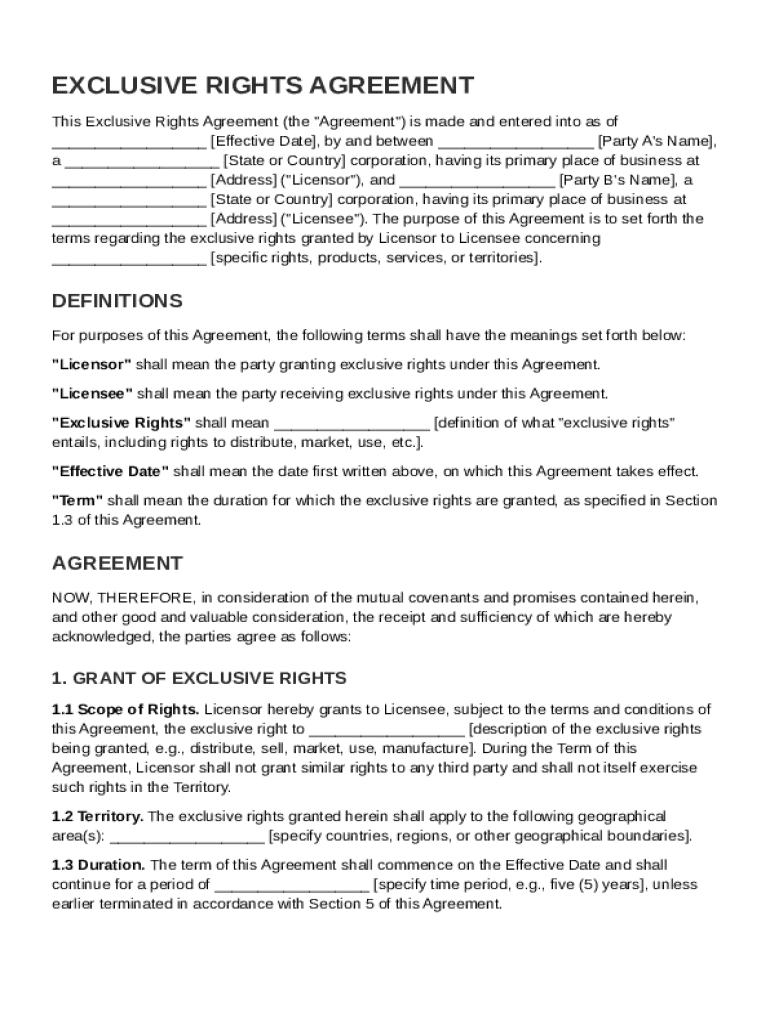
An Exclusive Rights Agreement is a legal document that outlines specific terms and conditions under which a Licensor grants exclusive rights to a Licensee. This agreement typically includes the rights to use, produce, or sell certain products, services, or intellectual property in particular territories or markets. The agreement establishes a clear understanding between both parties, detailing obligations, compensation, and the scope of exclusivity.
Key Components of Exclusivity
- Exclusive Rights: Allows the Licensee sole rights to the specified product or service.
- Scope: Defines the geographical area or market where exclusivity applies.
- Duration: Specifies the time frame for which the exclusive rights are granted.
Practical Applications
In practice, businesses use Exclusive Rights Agreements to secure market position and reduce competition. For example, a tech company might use this agreement to license software exclusively to a specific geographic region, ensuring competitors cannot market similar solutions within the same area.
How to Use the Exclusive Rights Agreement Template
The Exclusive Rights Agreement Template serves as a guideline for drafting a clear and legally sound agreement. Users can customize the template to fit specific needs and legal requirements.
Steps to Customize
- Identify Parties: Clearly state the Licensor and Licensee involved.
- Define Rights: Specify what rights are being granted and any limitations.
- Set Objectives: Clarify the goals both parties aim to achieve under this agreement.
- Compensation Terms: Outline how the Licensee will pay the Licensor.
- Termination Conditions: Define how and under what circumstances the agreement can be terminated.
Customization Benefits
Adapting the template to fit particular circumstances ensures that the agreement covers all necessary aspects relevant to both parties. For example, including a section that addresses intellectual property rights may be critical for tech industry agreements.
Steps to Complete the Exclusive Rights Agreement Template
To complete an Exclusive Rights Agreement Template effectively, it is important to follow a structured process that ensures all details are accurately covered.
Detailed Process
-
Gather Information
- Collect all necessary details about the parties involved.
- Determine the specific rights and territories involved.
-
Draft Initial Agreement
- Use the template to outline basic terms.
- Integrate any specific clauses relevant to the industry or situation.
-
Review and Revise
- Legally review the drafted document.
- Make necessary amendments ensuring legal compliance.
-
Finalize and Sign
- Obtain signatures from both parties.
- Ensure both parties retain a copy of the finalized agreement.
Example Scenario
In a scenario where a music producer grants exclusive distribution rights to a record label, the template can help include essential terms such as royalty percentages and marketing requirements, ensuring both parties have clear guidelines and expectations.
Legal Use of the Exclusive Rights Agreement Template
Using the Exclusive Rights Agreement Template requires an understanding of the applicable legal protocols to ensure the document is enforceable in court.
Legal Considerations
- Compliance with Laws: The agreement should comply with relevant laws in the jurisdiction it will apply.
- Confidentiality Clauses: Protects sensitive information exchanged during the agreement.
- Dispute Resolution: Outlines processes for resolving disputes outside of court.
U.S. Legal Context
In the U.S., exclusivity agreements must adhere to antitrust laws. These laws prevent companies from creating monopolies or engaging in unfair business practices. Legal advice is recommended to ensure the agreement aligns with these provisions.
Key Elements of the Exclusive Rights Agreement Template
Understanding the core components of the template helps ensure that all critical areas are addressed within the agreement.
Essential Sections
-
Definitions: Clearly defines specific terms used within the agreement.
-
Obligations: Lists responsibilities and duties of both parties.
-
Compensation and Payment: Details on how and when payments will be made.
-
Termination Provisions: Conditions under which the agreement can be ended.
-
Amendments: Procedures for making changes to the agreement.
Importance of Precision
Ensuring each of these elements is precisely defined reduces the risk of misunderstandings and helps protect the interests of both parties involved. Using industry-specific language can add clarity to sectors such as pharmaceuticals or technology.
Who Typically Uses the Exclusive Rights Agreement Template
The template is commonly utilized across various industries and by different types of business entities.

Common Users
- Corporations: Often engaged in partnerships or exclusive distribution arrangements.
- Small Businesses: Utilizing the template to secure niche market segments.
- Entrepreneurs: Looking to protect innovative products or services.

Industry Examples
- Entertainment: Agreements between artists and record labels.
- Technology: Software companies licensing products to different regions.
- Manufacturing: Companies securing exclusive manufacturing rights to specific products.
These examples illustrate the broad applicability of exclusive rights agreements across different sectors, each requiring tailored terms to address industry-specific needs.
Important Terms Related to Exclusive Rights Agreement Template
Familiarity with key legal and industry terms within the context of an Exclusive Rights Agreement facilitates a better understanding of its provisions.
Common Terms
- Licensor: The party granting rights.
- Licensee: The party receiving rights.
- Territory: The specific geographic area covered by the agreement.
Detailed Breakdown
- Royalty Fee: A payment for ongoing use of the licensed rights.
- Non-Disclosure Agreement (NDA): May accompany the agreement to protect confidential information.
- Force Majeure Clause: Addresses unforeseeable events preventing parties from fulfilling contract obligations.
Understanding these terms aids in navigating the intricate details often involved in exclusive licensing agreements, thereby enhancing their effectiveness and enforceability.
Real-World Examples of Using the Exclusive Rights Agreement Template
Practical examples demonstrate how Exclusive Rights Agreement Templates function in various scenarios, highlighting their flexibility and utility.
Case Studies
- Publishing: A book publisher enters into an agreement with an author for exclusive rights to publish and distribute a novel in North America.
- Fashion Industry: A designer grants a clothing manufacturer exclusive rights to produce and sell specific apparel lines within European markets.
- Software Development: A tech firm licenses an innovative application to a company for exclusive distribution rights in Asian regions.
Lessons Learned
These examples illustrate the importance of a well-drafted agreement in protecting interests, managing risks, and facilitating mutual understanding and cooperation between licensor and licensee. Such agreements can lead to increased market reach and enhanced profitability when appropriately structured.