




01. Edit your form online
Type text, add images, blackout confidential details, add comments, highlights and more.

Type text, add images, blackout confidential details, add comments, highlights and more.

Draw your signature, type it, upload its image, or use your mobile device as a signature pad.

Send it via email, link, or fax. You can also download it, export it or print it out.
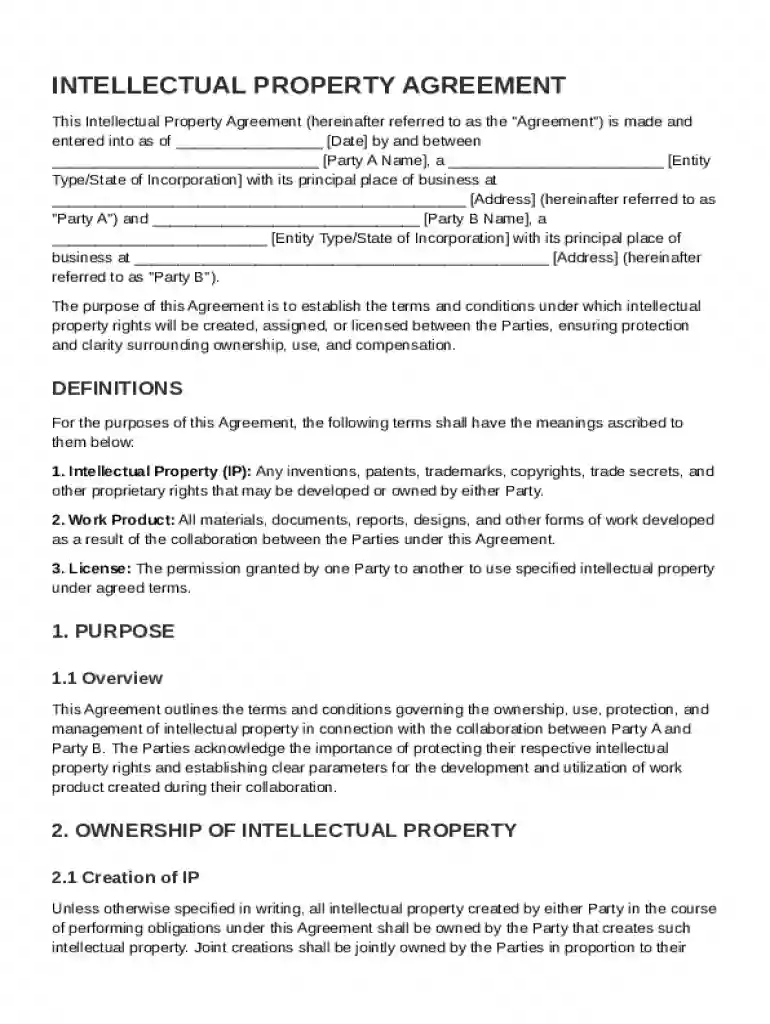
An Intellectual Property Agreement Template serves as a foundational document that outlines the terms and conditions related to the creation, ownership, licensing, and protection of intellectual property (IP). It provides a formal structure for determining who holds rights to intellectual property generated through collaboration or partnership, which includes creations such as inventions, designs, brand names, works of art, and proprietary methodologies. Commonly, it involves agreements between parties, often labeled as Party A and Party B, who are stakeholders in the IP. Understanding this template ensures proper documentation of each party's contributions and protects their lawful rights.
Intellectual property, as defined in this context, includes both "created" and "pre-existing" work, necessitating clear terms on what constitutes new IP versus what each party brings into the arrangement. Key legal terms within the template may include "Work Product" which refers to the output resulting from the agreement, and "License" that details how the created IP can be used or commercialized by involved parties.
When completing an Intellectual Property Agreement Template, several crucial components should be included to ensure the document is comprehensive and legally sound.
Ownership Rights: Detailed provisions on who will own the IP rights, whether they will be shared or exclusively held by one party, and the process for transferring ownership if necessary.
Licensing Terms: Specifics about how intellectual property can be licensed, including terms covering fees, royalties, permissions, and restrictions on usage. This section is vital for determining how others, besides the owners, can utilize the IP.
Confidentiality Obligations: Enforced measures to protect sensitive information disclosed during the collaboration. This often includes non-disclosure agreements and specifies what information is considered confidential.
Dispute Resolution: A plan for handling disputes, often involving mediation or arbitration strategies to address disagreements regarding the IP rights, thus avoiding litigation.
Termination Clauses: Clear conditions under which the agreement can be terminated, including the effects of termination on ownership and licensing rights.
Using this template involves several steps designed to customize it to suit the specific needs of your agreement.
Identify Parties Involved: Clearly list all parties entering into the agreement, ensuring that all potential contributors to intellectual property are included.
Fill Out Ownership & Rights: Define who will hold ownership rights and any specific terms, such as joint ownership or singular ownership by one party.
Specify Licensing Details: Outline any licensing arrangements, including terms, territory, duration, and any exclusivity rights.
Draft Confidentiality and Security Terms: Develop the necessary confidentiality agreements to protect proprietary information during and after collaboration.
Review Termination and Dispute Resolution: Align on how to handle termination and resolve disputes should issues arise during the terms of the agreement.
Finalize and Sign: Have all parties review, agree, and sign the completed document to make it legally binding.
Understanding the terminology used within an intellectual property agreement is critical for both legal and practical purposes.
Intellectual Property (IP): Refers to creations of the mind which are legally recognized with rights that enable owners to benefit from their inventions or works.
Work Product: Any output or creation that results from the collaboration, which may include inventions, designs, methodologies, etc.
License: Official permission that allows one party to use another's intellectual property under agreed terms.
Royalties: Payments made to the IP owner for the ongoing use of their property.
Non-Disclosure Agreement: A contract that establishes a confidential relationship between the parties to protect sensitive information.
Understanding these terms is essential for a thorough appreciation of the rights and obligations within the agreement.
Completing this template involves a meticulous process to ensure that all necessary elements are covered.
Preparation: Gather all preliminary information, including the specifics of the intellectual property to be covered and the parties involved.
Customizing the Template: Adjust the template to reflect the unique aspects of the agreement, ensuring that it accurately represents the terms each party has agreed upon.
Incorporating Legal Advice: Consulting with legal experts to ensure the language and clauses used are compliant with applicable laws.
Clarify Terms and Conditions: Ensure that every clause, term, and provision within the template is clear and understandable to all parties.
Signing the Document: Once reviewed and agreed upon, all parties should sign the agreement, making it legally binding.
Distributing Copies: Provide signed copies to all parties involved for their records and future reference.
Each step must be completed with precision and attention to detail, reinforcing the legal robustness of the agreement.
The Intellectual Property Agreement Template must be used in accordance with legal standards and practices in the United States.
Compliance with the ESIGN Act: Electronic signatures on the agreement are legally binding if adhered to under the ESIGN Act, ensuring valid and enforceable documentation.
State-Specific Adjustments: Be aware of and make provisions for state-specific laws and requirements that might impact the agreement's enforceability.
Regular Review and Updates: Frequently review the agreement for compliance with new laws or industry standards, updating terms as necessary to keep it current.
These considerations help maintain the agreement's validity and protect against potential legal challenges.
Practical examples can illustrate how this template might be employed in real-world scenarios.
Research Collaborations: Two companies engaging in a joint research project might use this template to clearly outline the ownership and usage rights of any innovations developed during the project.
Creative Partnerships: A graphic designer and a technology firm might draft an IP agreement to define the rights associated with a collaboratively designed app interface.
Corporate Consultancy: A business consultant could enter into an agreement with a client to determine the ownership of any proprietary strategies or methods developed.
These examples show the template's diversity and applicability across various industry contexts.
This template is commonly used by various entities and professionals across multiple industries:
Businesses: Corporations and startups often use these agreements during partnerships or collaborations that involve shared intellectual output.
Educational Institutions: Universities employ IP agreements to manage inventions and discoveries made by faculty and students.
Creative Professionals: Artists, writers, and designers engage in these agreements to protect their creations when working with partners or clients.
Technology Firms: Companies in tech often require IP agreements to handle new inventions or software developed jointly with other entities.
The versatile nature of the template makes it applicable across a broad spectrum of professional activities that involve intellectual property creation and management.


At DocHub, your data security is our priority. We follow HIPAA, SOC2, GDPR, and other standards, so you can work on your documents with confidence.


Aug 1, 2016 Software license agreement. This software delivery contains various software that are subject to different license agreements. The.
THIS ASSIGNMENT AGREEMENT is effective the day of. , 20 (the Effective Date) is made by. (Assignor), a Citizen of the United States residing at. (


