




01. Edit your form online
Type text, add images, blackout confidential details, add comments, highlights and more.

Type text, add images, blackout confidential details, add comments, highlights and more.

Draw your signature, type it, upload its image, or use your mobile device as a signature pad.

Send it via email, link, or fax. You can also download it, export it or print it out.
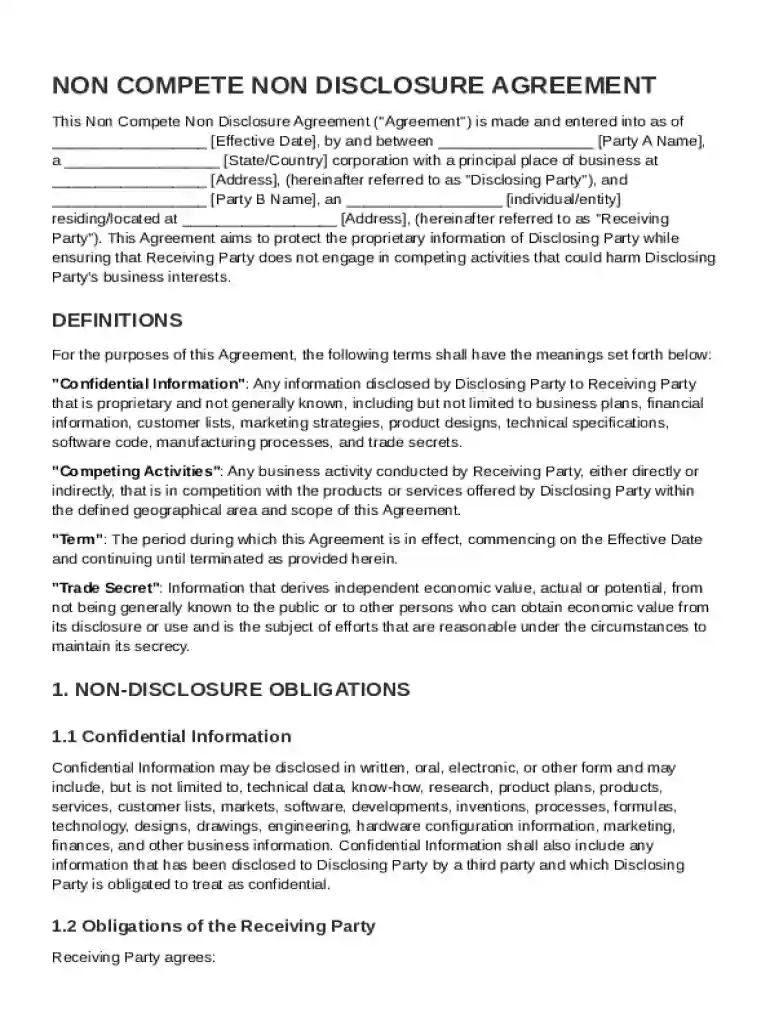
A Non-Compete Non-Disclosure Agreement (NCNDA) serves as a dual-purpose document to protect sensitive information and prevent competitive activities. It is typically used between a disclosing party and a receiving party. The agreement aims to safeguard the proprietary information of the disclosing party while restricting the receiving party from engaging in any competing business activities. Essential terms such as "Confidential Information," which refers to the data meant to remain private, and "Competing Activities," which detail prohibited business practices, form the backbone of the agreement.
Understanding the core elements of an NCNDA is crucial to its effectiveness. These elements generally include clauses that outline:
In the U.S., NCNDAs are legally binding, but their enforceability varies by state. These agreements must comply with contract laws, and their terms should be reasonable to be upheld. It is crucial to adhere to state-specific regulations, which may influence aspects such as the permissible scope of restrictions or duration. Consulting with legal counsel is advisable to ensure adherence to applicable laws and regulations.
Several key terms are critical to understanding NCNDAs:
NCNDAs are prevalent in industries rich in proprietary information. They are most commonly used by:


The enforceability and scope of NCNDAs vary significantly across the U.S. Some states, like California, have stringent limitations on non-compete clauses, while others allow more lenient provisions. It's essential to understand the specific legal requirements in your state to draft an enforceable agreement. Legal advice is often necessary to navigate these state-specific nuances correctly.
Consider a scenario where a tech startup is developing a groundbreaking software application. The team may use an NCNDA to prevent developers from working on similar projects with competitors. Similarly, a company involved in R&D for new pharmaceuticals might employ this agreement to maintain the confidentiality of their formulas and research data until patents can be filed.
Certain business entities inherently require robust protection of their confidential information and trade secrets. These include:
By understanding and utilizing a well-crafted Non Compete Non Disclosure Agreement Template, businesses in these sectors can better manage their critical information while maintaining a competitive edge.
At DocHub, your data security is our priority. We follow HIPAA, SOC2, GDPR, and other standards, so you can work on your documents with confidence.



THIS MUTUAL CONFIDENTIALITY AND NON-DISCLOSURE AGREEMENT (this. Agreement) is entered into and made effective as of the later of the two signature dates
Mar 24, 2022 You must add a non-compete provision if the consulting firm doesnt want to work with your competitors AFTER the project is completed. You must


