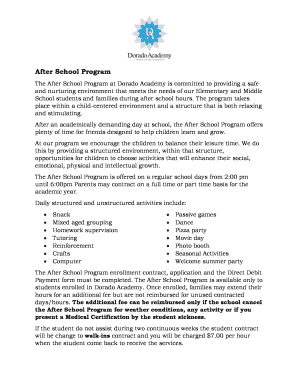
01. Edit your form online
Type text, add images, blackout confidential details, add comments, highlights and more.

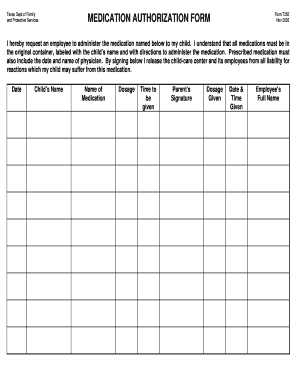
Type text, add images, blackout confidential details, add comments, highlights and more.

Draw your signature, type it, upload its image, or use your mobile device as a signature pad.

Send it via email, link, or fax. You can also download it, export it or print it out.
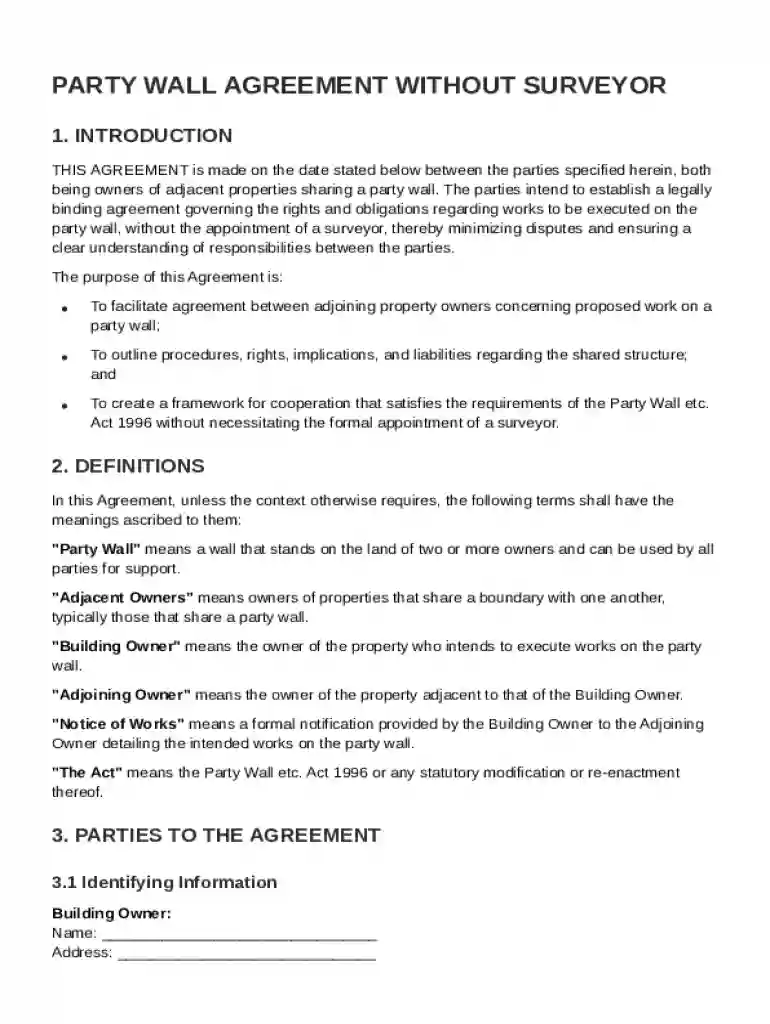
A "Party Wall Without Surveyor Agreement Template" refers to a legal framework for property owners who share a common boundary, such as a wall, and wish to carry out works on that structure. This type of agreement helps avoid the need for a surveyor by clearly defining the responsibilities, rights, and obligations between the involved parties. By fostering mutual consent, this template aims to minimize disputes and ensure both parties are prepared in case legal matters arise. This is especially pertinent under the Party Wall etc. Act 1996.
Using this template involves several steps to ensure that all necessary information is incorporated and mutual consent is reached:
Initial Discussion: Property owners should discuss the proposed work informally to set the groundwork for formalizing the agreement.
Drafting the Agreement: Use the template to draft the agreement, customizing sections as needed to suit both parties.
Review: Both parties should thoroughly review all terms, ensuring comprehension and agreement.
Finalize: Once all conditions are met, both parties can sign to formalize the agreement, creating a binding contract.
Retention: Keep copies of the signed agreement for legal protection and future reference.
Several crucial components make up the template, ensuring a comprehensive agreement between property owners:
Definitions: Establishes commonly used terminology within the agreement to avoid misunderstandings.
Rights and Obligations: Clearly delineates the responsibilities and rights of each party, including who will manage construction.
Access Procedures: Outlines how access will be granted to undertake necessary works, ensuring minimal disruption.
Indemnity Clauses: Protects parties from potential financial claims resulting from works undertaken on the party wall.
Dispute Resolution: Provides a step-by-step approach to handle disagreements, which might include mediation or arbitration.
Termination Conditions: Details under what circumstances the agreement can be terminated, protecting parties' interests.
Filling out the template requires attention to detail to ensure all legal requirements are met:
Personal Details: Enter names and addresses of both the Building Owner and the Adjoining Owner.
Property Description: Describe the properties involved, including any pertinent characteristics of the party wall itself.
Nature of Works: Clearly define the proposed works, along with time frames and estimated completion dates.
Signatures: All parties must provide legally recognized signatures, along with the date of signing.
Adjustments: Customize any additional sections that might require special attention unique to the properties in question.
This agreement template is utilized to ensure compliance with existing laws – notably the Party Wall etc. Act 1996. This Act applies throughout England and Wales and mandates that property owners engage in proper dialogue regarding boundary works. The template ensures that both parties are protected legally and that property boundaries are respected during construction activities.
Residential Properties: Homeowners planning to extend their living areas may use this agreement to define terms where their expansion shares a boundary with a neighbor.
Commercial Buildings: Businesses conducting renovations that alter structural boundaries could implement the agreement to define access rights during construction.
Renovations Involving Shared Walls: This includes loft conversions, basement digs, or any remodeling work affecting shared walls or structures.
This type of agreement is most often employed by individuals or entities impacted by construction works on jointly-owned structures. Typical users include:
Residential Owners: Neighbors looking to cooperate on property alterations without external interference.
Commercial Property Managers: Administrators of shared business properties that require renovation.
Legal Partners/Attorneys: Professionals advising clients on property law, especially concerning boundary matters.


Knowing the key terms related to the agreement helps in better understanding the legal context:
Building Owner: The individual initiating works on the shared structure.
Adjoining Owner: Neighbor who shares the party wall boundary and must consent to the proposed works.
Party Wall: Physical boundary commonly shared between two separate properties.
Scope of Works: Specific constructions affecting the party wall, outlined in the agreement to prevent disputes.
At DocHub, your data security is our priority. We follow HIPAA, SOC2, GDPR, and other standards, so you can work on your documents with confidence.