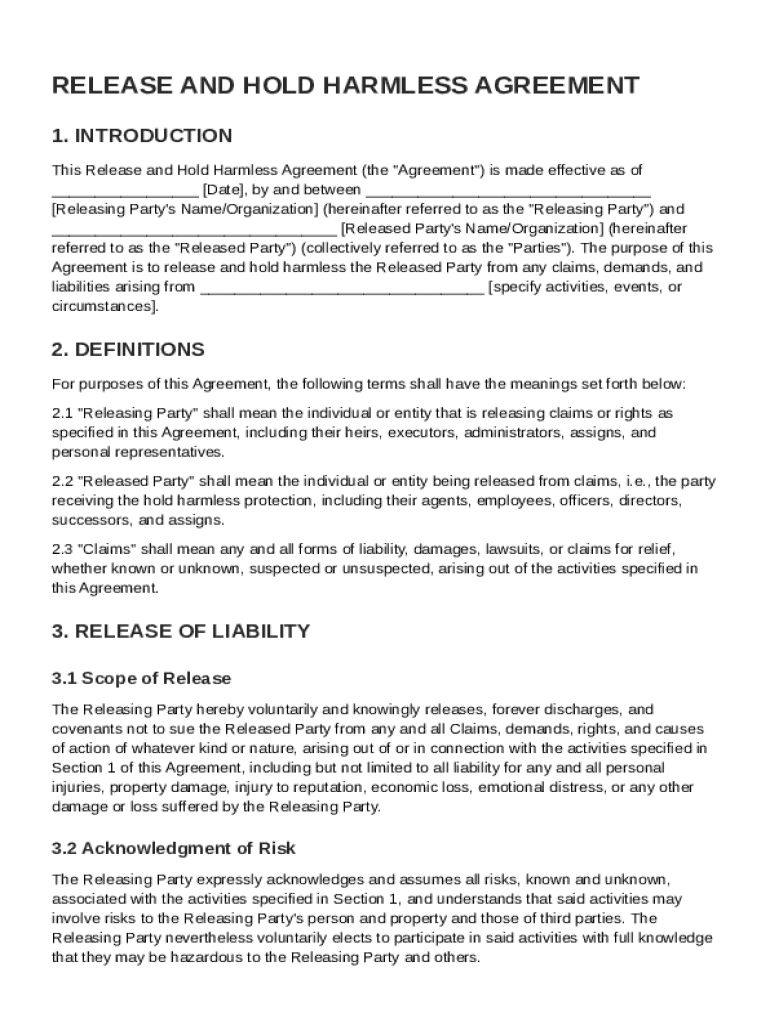







Definition and Meaning of Release and Hold Harmless Agreement
A Release and Hold Harmless Agreement is a legal document that facilitates the release of one party (Releasing Party) from liability claims by another party (Released Party) arising from specified activities or circumstances. This agreement is instrumental in mitigating legal risks by acknowledging and accepting potential dangers associated with certain actions or events. Typically, it incorporates definitions of key terms to ensure clarity between involved parties, outlines the scope of the liability release, and establishes indemnification responsibilities, ensuring that all parties understand their roles and obligations.
Key Elements of the Release and Hold Harmless Agreement Template
The Release and Hold Harmless Agreement Template includes several crucial elements that ensure the agreement is comprehensive and legally sound:
- Parties Involved: Clearly identifies the Releasing Party and the Released Party, establishing who is agreeing to release whom from liability.
- Scope of Release: Specifies the activities or conditions under which the release of liability applies, ensuring all parties understand the extent of the release.
- Acknowledgment of Risk: Includes a section where the Releasing Party acknowledges any risks involved in the activities and agrees to hold the Released Party harmless.
- Indemnification Clause: Details responsibilities for indemnification, ensuring that parties understand who will cover costs if claims arise.
- Legal Fees Clause: Addresses who will bear the costs of legal fees if disputes occur, which can vary based on the agreement’s terms.
- Governing Law: Indicates the jurisdiction under which the agreement will be governed, often reflecting the state in which the activities occurred.
- Severability: Ensures that if any part of the agreement is deemed unenforceable, the rest of the document remains in effect.
- Entire Agreement: States that the document encompasses the entire understanding of the parties, preventing any external documents or agreements from influencing the terms.
Steps to Complete the Release and Hold Harmless Agreement Template
- Identify the Parties: Clearly list the names and contact information of both the Releasing Party and the Released Party.
- Define the Scope: Describe the activities or circumstances covered by the release, detailing what liabilities are included.
- Acknowledge the Risks: Inform the Releasing Party about the risks and have them acknowledge acceptance within the document.
- Indemnification Agreement: Specify who is responsible for indemnification and outline the conditions under which it applies.
- Legal Terms: Include details on governing law and the jurisdiction that will interpret the agreement.
- Finalize the Document: Ensure that legal terms such as severability and entire agreement clauses are included.
- Signatures: Both parties must sign the document to confirm their agreement to the terms and conditions.
Legal Use of the Release and Hold Harmless Agreement Template
This agreement serves as a legally binding contract between parties to limit liability related to specific activities. Under U.S. law, such agreements are commonly used in activities that involve risk, such as sports events, recreational activities, or certain business transactions. The agreement should be crafted carefully to meet legal standards and must be signed prior to the occurrence of the specified activities to be enforceable.
Important Terms Related to the Release and Hold Harmless Agreement
Understanding the terminology within a Release and Hold Harmless Agreement is crucial:
- Release: Frees one party from potential claims or actions from another party associated with defined activities.
- Hold Harmless: An agreement where one party agrees to indemnify another, assuming responsibility for liability.
- Indemnification: The act of protecting or compensating for losses or damages under specific circumstances.
- Jurisdiction: Refers to the area of legal authority that governs the agreement, often indicated by state law.
Examples of Using the Release and Hold Harmless Agreement Template
Practical uses of this template extend across various scenarios:
- Sports and Recreational Activities: Ensures organizers are not liable for participant injuries or accidents.
- Business Transactions: Protects companies from liabilities that may arise from services or products.
- Event Hosting: Shields hosts or venues from claims by attendees, especially at public events.
- Contractor Engagements: Used by homeowners hiring contractors to waive liability for work-related injuries.
State-Specific Rules for the Release and Hold Harmless Agreement
While there is a general structure for these agreements, state laws can vary significantly in the United States:
- California: Strict regulations on enforceability, requiring clear and explicit language on the scope of release.
- Texas: Allows broad form indemnification under certain business agreements, with specified limitations.
- New York: Often requires additional consideration for a release of liability to be enforceable.
- Florida: Enforces clear and unequivocal language indicating that the parties are waiving certain rights.
Who Typically Uses the Release and Hold Harmless Agreement Template
This template is widely utilized by:
- Event Organizers: To limit liability during public and private events.
- Sports Facilities: Ensuring participants acknowledge and accept risks involved in activities.
- Businesses: As part of service provision and contracting scenarios.
- Educational Institutions: For field trips or extracurricular activities requiring risk acknowledgment.
In providing detailed and comprehensive information, the content ensures that anyone utilizing a Release and Hold Harmless Agreement Template understands both the functionality and application of the document.