
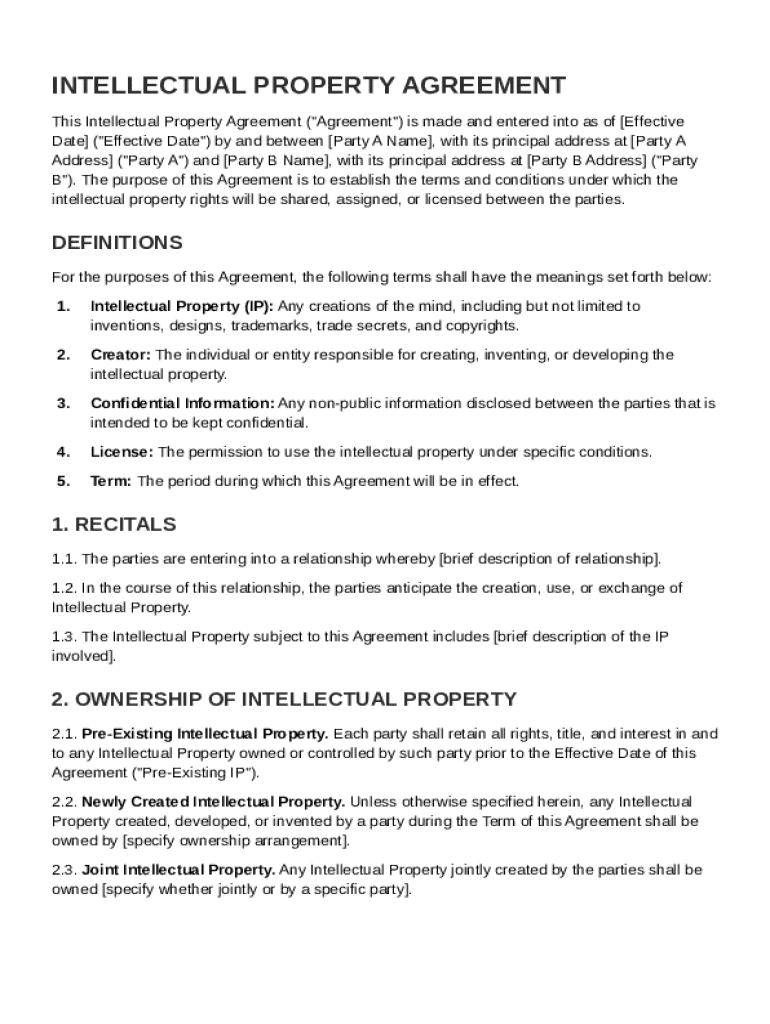







Definition and Purpose of the Intellectual Property Contract Template
The Intellectual Property Contract Template is a structured legal document designed to outline the terms and conditions related to intellectual property (IP) between parties. It serves as a formal agreement that delineates ownership rights, usage permissions, transfer conditions, and confidentiality obligations concerning IP assets, whether they're existing creations or newly developed. By defining roles such as the creator, licensee, and licensor, the template ensures both parties have a clear understanding of their rights and responsibilities. This document is a crucial tool for companies, entrepreneurs, and individuals engaged in collaborations that involve the sharing or commercialization of intellectual property.
Key Elements of the Intellectual Property Contract Template
The template comprises several fundamental components essential for establishing a comprehensive and enforceable IP agreement:
- Ownership Rights: It specifies the ownership status of pre-existing and newly created IP assets, ensuring that creators and inventors retain appropriate rights while allowing others to access or utilize the IP under negotiated terms.
- Licensing Terms: It outlines conditions under which IP can be licensed, including scope, duration, and fees, enabling parties to commercially exploit the IP within defined boundaries.
- Transfer of Rights: Provisions for the assignment or transfer of IP rights to another party, along with any associated conditions, ensure legal compliance and protection for both parties.
- Confidentiality Obligations: A section dedicated to protecting sensitive information exchanged between parties, preventing unauthorized disclosure of proprietary details.
- Warranties and Indemnifications: This addresses the assurances parties make regarding the IP's originality and legality, and the indemnification responsibilities if these assurances are breached.
Steps to Complete the Intellectual Property Contract Template
Completing the Intellectual Property Contract Template involves the following systematic steps:
- Initial Information Gathering: Collect detailed information about the IP assets, parties involved, and the intended purpose of the agreement.
- Defining Key Terms and Conditions: Clearly define IP-specific terms, including the nature of the IP, ownership rights, usage permissions, and the scope of licenses granted.
- Drafting the Agreement: Fill in the template with precise details, reflecting the agreed-upon terms and conditions.
- Review and Edit: Carefully review the document for accuracy and completeness, ensuring it aligns with both parties' expectations and legal requirements.
- Legal Consultation and Finalization: Seek legal advice to confirm the document's validity and comprehensiveness, then finalize and sign the agreement.
Legal Use and Compliance of the Intellectual Property Contract Template
Compliance with legal standards is pivotal for the enforceability of an Intellectual Property Contract. The template must adhere to the legal framework relevant to intellectual property laws in the United States. Considerations for legal use include:
- Adhering to IP Law: Ensuring all definitions and clauses conform to federal and state IP laws.
- Inclusion of Governing Law: The agreement should state the applicable state law under which it will be governed.
- Verification of Parties' Rights: Confirm the right of parties to enter into the agreement and transfer or license IP.
Consultation with an attorney specializing in IP law is often essential to ensure comprehensive legal compliance.
How to Use the Intellectual Property Contract Template
Using the Intellectual Property Contract Template effectively involves several strategic approaches:
- Customizing the Template: Tailor the template to reflect the specific needs and agreements of the parties involved, adjusting sections such as licensing terms and confidentiality clauses as necessary.
- Iterative Adjustments: Throughout negotiations, adjust the template to incorporate evolving terms from discussions.
- Integrating Additional Clauses: Depending on the complexity of the IP arrangement, incorporate additional clauses that may cover dispute resolution, joint IP development, or termination conditions.
Important Terms Related to the Intellectual Property Contract Template
When dealing with the Intellectual Property Contract Template, understanding key terminologies is crucial:
- Intellectual Property (IP): Encompasses creations of the mind, such as inventions, literary and artistic works, designs, symbols, names, and images used in commerce.
- Licensor/Licensing: The party that grants permission to another to use their IP.
- Licensee: The party that receives rights to use another's IP.
- Confidential Information: Any non-public or proprietary information exchanged between parties within the agreement framework.
Who Typically Uses the Intellectual Property Contract Template
This template is widely used across various sectors by:
- Entrepreneurs and Startups: For establishing clear IP ownership and licensing terms at the inception of new business ventures.
- Established Corporations and SMEs: In contexts where collaboration on inventions, trademarks, or patents requires clear delineation of rights and responsibilities.
- Academic Institutions: When entering research collaborations or commercializing intellectual discoveries.


Examples of Using the Intellectual Property Contract Template
Practical applications of the template include:
- Technology Companies Collaborating on Joint Ventures: Define IP ownership for co-developed products and negotiated licensing terms.
- Content Creators Assigning Rights to Publishers: Outline the specific licenses granted to use copyrighted works such as books or music.
- Manufacturers Implementing Innovative Design Solutions: Licensing proprietary technology to third-party manufacturers to expand market reach.
Each scenario illustrates the template's flexibility and utility in safeguarding and commercializing IP assets in various business environments.




