







Definition & Meaning
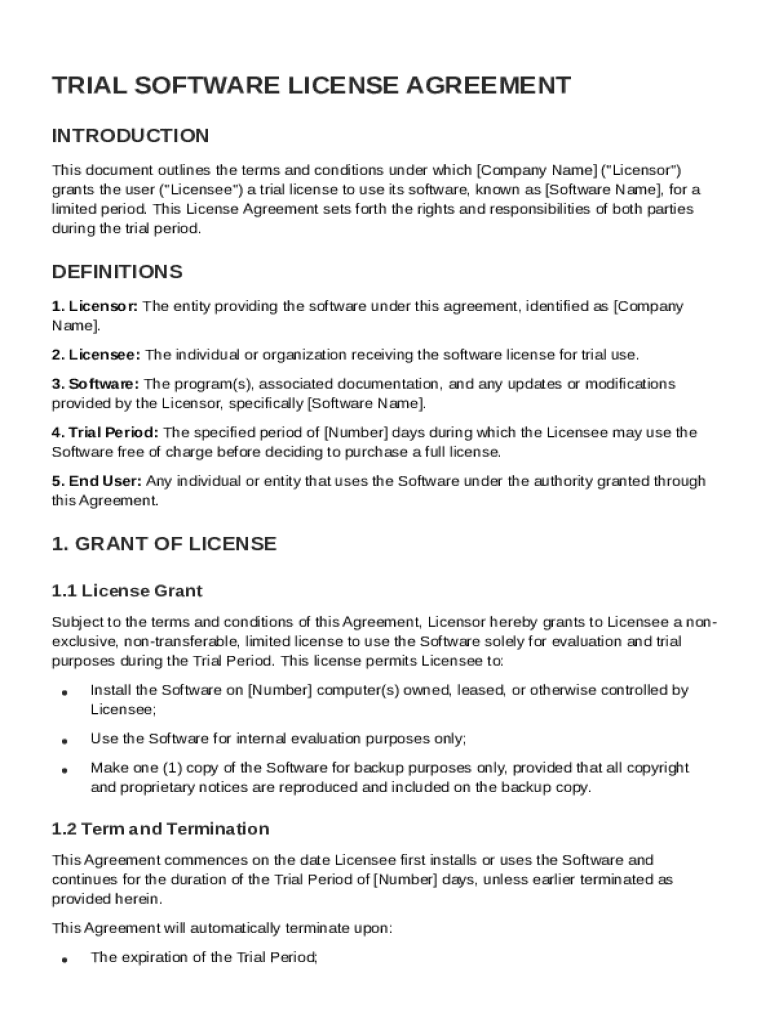
A Trial Software License Agreement Template delineates the terms under which a software provider, or Licensor, grants a user, or Licensee, a temporary, non-exclusive, and non-transferable license to evaluate a product. The agreement typically outlines the roles, responsibilities, and restrictions involved during the trial period, which is often specified by the Licensor. This document helps both parties understand their rights and obligations, ensuring compliance with legal and operational expectations. The trial period allows users to assess the software's functionalities without a long-term commitment, providing them with insights into its potential impact on their operations.
- Licensor and Licensee: The Licensor is often a software company that provides the software for evaluation. The Licensee is the user or entity evaluating the software.
- Trial Period: It specifies the duration for which the trial license is valid, setting clear boundaries for the evaluation period.
- Non-exclusive and Non-transferable: The agreement clarifies that the Licensee neither has exclusive rights to the software nor the ability to transfer it to another party.
How to Use the Trial Software License Agreement Template
Utilizing the Trial Software License Agreement Template involves several structured steps to ensure that both parties are aligned on the terms of use during the trial period. Initially, it's essential to customize the template with specific details relevant to the software being evaluated.
- Download the Template: Access the template from a reliable source, such as DocHub, to ensure it's comprehensive and legally sound.
- Input Software and Company Details: Enter the specific names and descriptions of the software and the involved parties.
- Specify the Trial Period: Clearly define the start and end dates of the trial period to avoid misunderstandings.
By adhering to these steps, organizations can effectively set up a trial period that safeguards their interests and provides users with clarity regarding their privileges and restrictions.
Important Terms Related to Trial Software License Agreement Template
Understanding the terminology in a trial software license agreement is crucial for both parties to avoid potential legal pitfalls. These terms define the scope of use, protect intellectual property, and lay down the foundations for compliance.
- Intellectual Property Rights: Indicates that all software rights remain with the Licensor, ensuring no transfer of ownership occurs.
- Confidentiality Obligations: Both parties may be required to keep proprietary information confidential during and after the trial period.
- Disclaimers of Warranties: The agreement usually states that the software is provided "as is," with no warranties or guarantees regarding its performance.
Legal Use of the Trial Software License Agreement Template
To legally use a Trial Software License Agreement, it's important to adhere to all clauses mentioned in the document. Ensuring compliance with governing laws and software usage restrictions protects both the Licensor and Licensee from potential legal disputes.
Governing Law
The agreement often contains a clause specifying which jurisdiction's laws will govern any disputes, often favoring the Licensor's location. For U.S.-based agreements, this might mean selecting a state with favorable laws for software licenses.
Compliance and Breaches
- Compliance: The Licensee must comply with all terms, including limitations on copying, disassembly, and redistribution.
- Breaches: Violations may result in termination of the license, along with potential legal actions for infringement.
Key Elements of the Trial Software License Agreement Template
When drafting or reviewing a Trial Software License Agreement, certain elements are essential for clarity and legal soundness. These key components form the framework that governs the Licensee’s use of the software.
- Usage Rights: Clearly defines what the Licensee can and cannot do with the software during the trial.
- Termination Clause: Outlines conditions under which the trial license can be terminated by either party.
- Support Provisions: Specifies whether the Licensor provides any form of support or updates during the trial.
Examples of Using the Trial Software License Agreement Template
Different scenarios and examples can help illustrate the practical application of a Trial Software License Agreement. These examples often underscore the agreement's flexibility and utility in various business contexts.
- Small Business Evaluation: A small enterprise might use a time-limited trial to determine if the software enhances efficiency before investing in a full license.
- Educational Testing: Institutions might evaluate software to assess its benefits in a learning environment without incurring upfront costs.
State-Specific Rules for the Trial Software License Agreement Template
Trial Software License Agreements in the U.S. might be subject to state-specific rules that affect enforceability or interpretation. While many states follow similar principles, variations can exist.
- California: Known for strong consumer protection laws, California may impose additional requirements on software licenses, especially regarding user data privacy.
- New York: Agreements must be clear and unambiguous to ensure enforceability under New York's stringent contract interpretation standards.
Understanding these state-specific nuances is crucial for Licensors and Licensees operating in or across different jurisdictions.
Steps to Complete the Trial Software License Agreement Template
Completing a Trial Software License Agreement involves a series of structured steps to ensure legal compliance and operational clarity. Following a systematic process minimizes the risk of oversights and helps solidify mutual understanding.
- Review Default Terms: Begin by thoroughly reading the template to ensure it fits general requirements.
- Customize Key Sections: Modify necessary sections to reflect company-specific terms or software details.
- Consult Legal Counsel: Engage legal experts to review the agreement, ensuring it meets jurisdictional requirements and protecting proprietary interests.
- Finalize and Execute: Once reviewed, both parties should sign the agreement to activate the trial period legally.
By following these steps, organizations can effectively manage the trial period and address any legal or operational contingencies that may arise.




