01. Edit your form online
Type text, add images, blackout confidential details, add comments, highlights and more.

Type text, add images, blackout confidential details, add comments, highlights and more.

Draw your signature, type it, upload its image, or use your mobile device as a signature pad.

Send it via email, link, or fax. You can also download it, export it or print it out.
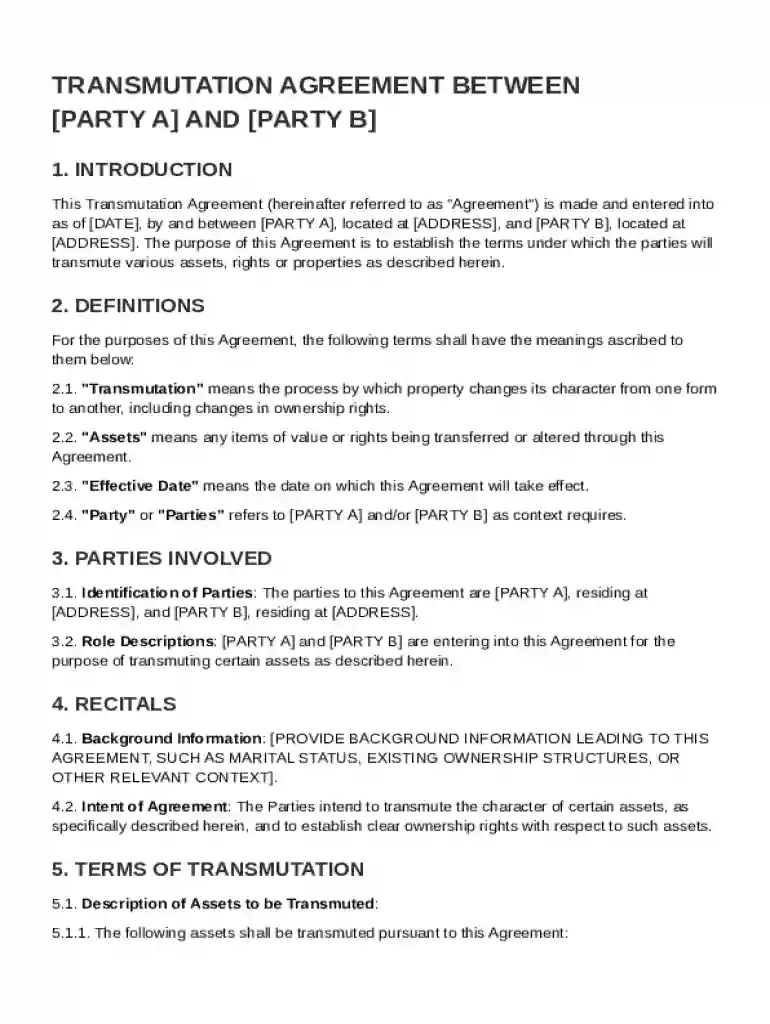
The Transmutation Agreement Template is designed to clearly define the terms under which assets, rights, or properties are transmuted, or transferred between parties. Central to the agreement is the detailed identification of both Party A and Party B, alongside an explicit description of each asset involved. The template outlines the new ownership status post-transmutation, ensuring all parties are aware of their rights and obligations. Furthermore, the document includes essential legal components such as representations and warranties from both parties, indemnification clauses to protect against potential losses, and governing law provisions, ensuring the agreement adheres to applicable jurisdictional laws. Dispute resolution mechanisms are also incorporated to address potential conflicts, facilitating a smoother resolution process through mediation or arbitration.
Within the agreement, representations and warranties are statements assuring certain facts are true at the time of execution. These provisions protect both parties, as they guarantee that the transmuting assets are free from encumbrances and that each party has the legal right to transact. For instance, Party A might represent that they hold clear title to the asset being transferred, while Party B assures they have the financial capability to accept such a transfer. By including these assurances, the agreement builds a foundation of trust and accountability.
Indemnification clauses serve to shield parties from losses or damages arising from specific circumstances. For instance, if an undisclosed liability of an asset surfaces post-transfer, the indemnifying party commits to cover the associated costs. These clauses are crucial as they allocate risk and responsibility clearly between parties, protecting against financial losses due to possible breaches or overlooked obligations.
Completing the Transmutation Agreement Template involves several critical steps, each requiring careful consideration to ensure legal compliance and clarity.
Identify the Parties Involved: Begin by detailing the full legal names and addresses of Party A and Party B. Confirm that both parties have the legal capacity to enter into the agreement.
Describe the Assets: Provide a comprehensive description of each asset involved in the transmutation. This might include real estate properties, business interests, or intellectual property rights.
Outline the Transmutation Terms: Clearly specify the new ownership structure post-transfer, including any conditions or considerations attached to the transfer.
Include Legal Provisions: Integrate essential legal terms such as indemnification clauses, dispute resolution methods, and termination conditions.
Review and Sign: Both parties must carefully review the agreement to ensure accuracy and completeness before signing. Signatures should be witnessed or notarized where applicable to enhance validity.
The Transmutation Agreement Template plays a vital role in legal asset reallocation, often used during marriage, divorce, or business reorganization. In matrimonial contexts, the agreement facilitates the conversion of separate property into community property or vice versa, allowing couples to tailor their financial arrangements. Legally, this requires full disclosure from both parties to avoid future disputes over asset ownership.
The document must comply with state laws concerning asset transfers. This often involves notarization and may necessitate court approval, especially in divorce cases. Parties are advised to consult legal professionals to address complex situations and ensure the agreement aligns with prevailing legal standards.
Effectively using the Transmutation Agreement Template requires a clear understanding of your specific needs and the involved legalities.
Customization: Tailor the template to reflect the unique terms and conditions agreed upon by the parties involved. Modify sections as necessary to fit the particularities of the asset types and the transaction's context.
Legal Consultation: Engage with a legal expert to confirm that all included clauses are appropriate for the intended jurisdiction, especially considering variances in state laws around property rights and transmutation agreements.
Ongoing Reviews: Periodically review the agreement to ensure it remains relevant and compliant with any legal changes. Amend the document when significant changes occur in the relationship or asset value.
The Transmutation Agreement Template is predominantly utilized by individuals undergoing marital property adjustments and business stakeholders reorganizing asset ownership structures. It is also frequently employed by estate planners who advise on wealth transfer strategies, aiming to balance inheritance issues or tax implications effectively. Legal advisors often facilitate the agreement's creation and execution to ensure each party's interests remain safeguarded throughout the process.


Several key terms are often associated with the Transmutation Agreement Template, each critical to understanding the document's function and scope.
Transmutation: The act of changing the character or nature of an asset, typically from separate to joint ownership or from personal to business use.
Community Property: A legal concept wherein most assets acquired during a marriage are owned jointly by spouses. This is particularly relevant in states that adhere to community property laws.
Separate Property: Assets acquired before marriage or through inheritance or gift, typically exempt from division during a divorce unless transmuted into community property.
Different states in the U.S. have varied regulations governing the use of transmutation agreements, particularly concerning marital property. For example, community property states like California and Texas enforce stricter guidelines on property transmutation, typically requiring written agreements or clear evidence of intent to transmute.
California: Requires an explicit declaration in writing indicating the intention to transmute property. Legal counsel is strongly recommended to navigate these complexities.
Texas: Enforces a more rigorous standard for transmute marital property, where mutual consent and clear documentation are essential.
Understanding these state-specific nuances is paramount for ensuring the enforceability of the transmutation agreement. Legal advice should be obtained to comply with local requirements effectively.
At DocHub, your data security is our priority. We follow HIPAA, SOC2, GDPR, and other standards, so you can work on your documents with confidence.