01. Edit your form online
Type text, add images, blackout confidential details, add comments, highlights and more.

Type text, add images, blackout confidential details, add comments, highlights and more.

Draw your signature, type it, upload its image, or use your mobile device as a signature pad.

Send it via email, link, or fax. You can also download it, export it or print it out.
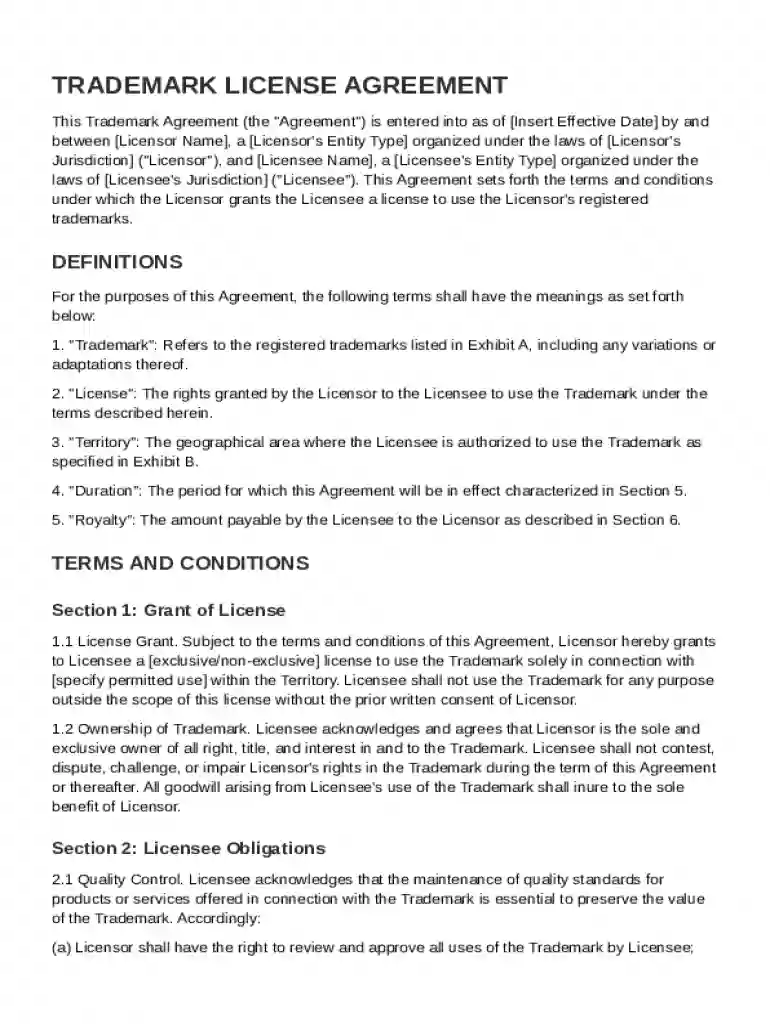
The Trademark Agreement Template is a structured document designed to facilitate the process of licensing registered trademarks. It formalizes the terms under which a Licensor grants a Licensee the authority to use one or more trademarks. The agreement is crucial for protecting the intellectual property rights of the Licensor while ensuring that the Licensee adheres to specified standards. Key terms within the agreement typically include the definition of the trademarks involved, rights granted, and any usage restrictions. The document is an essential tool for businesses seeking to expand their brand reach through licensing arrangements.
Using the Trademark Agreement Template involves several critical steps to ensure its effectiveness and compliance with legal standards. Initially, the Licensor must clearly identify the trademarks to be licensed and define the scope of their use. Users should customize the template to reflect specific terms, such as the duration of use, geographical limitations, and any exclusivity rights. It’s crucial to include clauses detailing quality control measures to uphold the integrity of the trademark. Signatures from both parties are necessary to render the agreement legally binding. Examples include technology companies licensing their brand to authorized manufacturers or fashion brands permitting select retailers to sell their products.
Completing the Trademark Agreement Template requires a systematic approach.
Each section of the agreement must be filled out accurately to prevent future disputes. For instance, a software company may specify that their trademark can only be used in connection with particular services.
The Trademark Agreement Template consists of several critical elements that ensure its validity.
Including these elements guarantees that the agreement fully protects the interests of both parties involved.
The legal use of the Trademark Agreement Template hinges on its adherence to intellectual property laws. The agreement must comply with both federal and state laws governing trademarks. It is crucial for both parties to understand their rights and obligations under the agreement, particularly regarding the use of the trademark in advertising and promotion. Proper legal use includes regularly monitoring compliance with quality standards and promptly addressing any breaches. A clothing brand, for example, may stipulate in its agreement that retailers can only use its trademarks on specific apparel styles, maintaining control over brand image.
Understanding the important terms related to the Trademark Agreement Template is vital for grasping its full scope.
Recognizing these terms helps in the precise crafting and negotiation of trademark agreements. Businesses can use this knowledge to effectively protect and monetize their brand assets.
Trademark agreements may vary based on state-specific rules that govern trademarks. While federal laws such as the Lanham Act provide a general framework, state laws can impact aspects like registration fees, requirements for proving use, and remedies for infringement. It is crucial to customize the agreement to comply with local regulations. Companies operating across multiple states need to be cognizant of differences in trademark laws to ensure their agreements are enforceable. Legal counsel with expertise in intellectual property can provide invaluable guidance in tailoring agreements to meet state-specific requirements.
Practical examples of using the Trademark Agreement Template can illuminate its application in real-world scenarios.
In each case, the agreement ensures that the Licensor retains control over how their trademark is used, preserving its value and standing in the market.
At DocHub, your data security is our priority. We follow HIPAA, SOC2, GDPR, and other standards, so you can work on your documents with confidence.