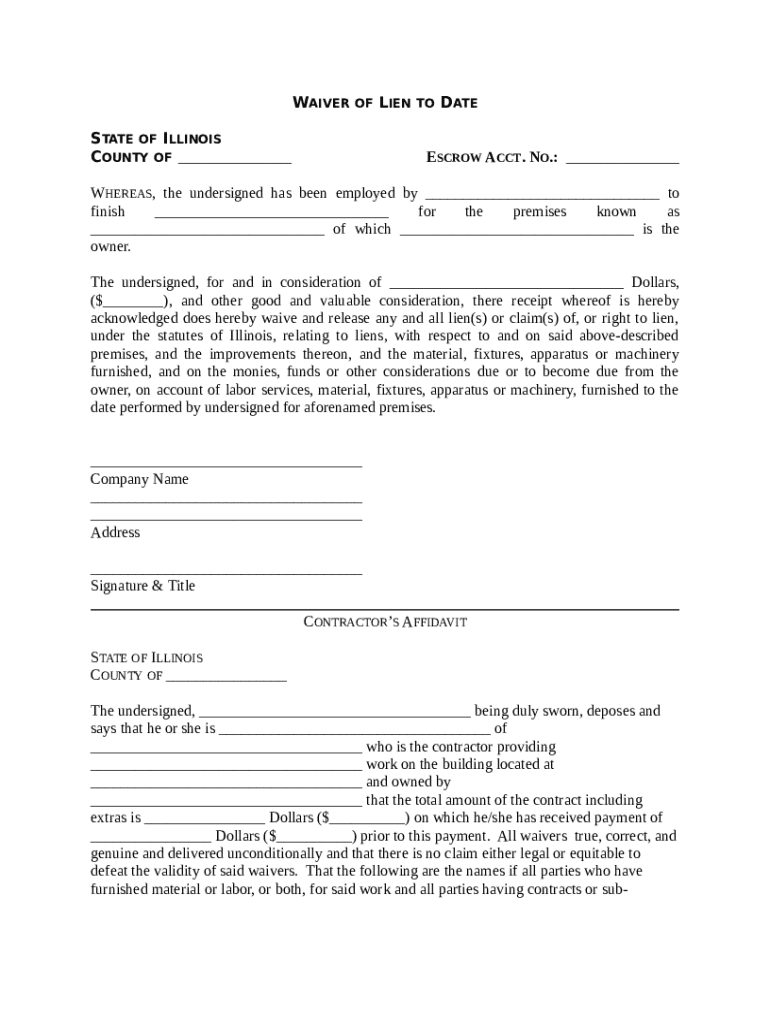







Definition and Meaning of a Waiver of Lien to Date
A Waiver of Lien to Date is a crucial legal document in the construction and real estate industries. This waiver acknowledges that a contractor, subcontractor, or supplier has received payment for work completed up to a specific date and, consequently, relinquishes any right to place a lien on the property for that period. The primary function of this form is to ensure that the party waiving the lien will not impede the property's sale or refinancing due to claimed unpaid dues. It is essential for protecting property owners from potential legal challenges regarding ownership clarity, ensuring smooth transitions in transactions involving real estate.
How to Use the Waiver of Lien to Date
To effectively utilize the Waiver of Lien to Date, it is essential to follow structured steps:
- Identify Lien Holders: Determine all parties entitled to file a lien, such as contractors, subcontractors, and suppliers who've performed work on the property.
- Assess Payment Status: Verify that full payment up to the agreed date has been made to these parties.
- Complete the Waiver: Accurately fill in the form with details about the payer, payee, payment amount, and the period this waiver covers.
- Obtain Signatures: Have the concerned lien holder sign the document, acknowledging the receipt of payment and relinquishing their right to a lien for the specified period.
- Notarization: Ensure the waiver is notarized if legally required, strengthening its validity and enforceability.
Using these steps, parties can systematically manage lien waivers, maintaining clear and legally secure transactions.
How to Obtain the Waiver of Lien to Date
Acquiring the Waiver of Lien to Date involves several straightforward procedures:
- Download from Legal Platforms: Many legal service websites offer downloadable forms customized to state-specific requirements.
- Consult with a Lawyer: If unsure about the content and implications, consult with a legal professional who can provide a tailored form based on unique contractual agreements.
- Request from a Contract Partner: Contractors or suppliers may provide the form during the payment transaction period.
Ensuring the form is sourced through reputable means is crucial for maintaining its legal integrity.
Steps to Complete the Waiver of Lien to Date
Completing the Waiver of Lien to Date requires careful attention to detail:
- Gather Information: Collect all necessary data, including the names of the parties involved, property details, payment amount, and relevant dates.
- Fill Out the Form: Input all required information precisely, ensuring no errors or omissions that could render the waiver ineffective.
- Review for Accuracy: Double-check all entries against payment records and contractual terms to ensure the document correctly reflects the transaction.
- Sign and Date: The lien holder should sign the document, adding the date to confirm when the waiver goes into effect.
- Secure Notarization: If required, have the document notarized to validate its legality.
These steps are vital for safeguarding legal rights and ensuring the lien waiver fulfills its intended purpose.
Key Elements of the Waiver of Lien to Date
The Waiver of Lien to Date comprises several components critical to its legal function:
- Party Information: Includes the names, addresses, and roles (e.g., contractor, supplier) of all involved parties.
- Property Description: Detailed identification of the property linked to the waiver, ensuring no ambiguity.
- Payment Details: Specifies the total payment received and dates covered by the waiver, clarifying financial transactions.
- Signatures and Dates: Authentication from all signing parties, confirming their acknowledgment and agreement to the waiver terms.
- Notary Section: Acknowledgment by a notary public if mandated by state law.
Each element plays a pivotal role in upholding the document's legal authority and ensuring enforceability.
Legal Use of the Waiver of Lien to Date
The Waiver of Lien to Date carries specific legal functions to protect both property owners and contractors:
- Prevents Lien Filing: It legally bars the party from filing a mechanics lien for work performed up to the specified date.
- Facilitates Transactions: It clears potential legal encumbrances on property titles, easing sales or refinancing.
- Promotes Payment Verification: Serves as proof of payment, reducing disputes over financial transactions.
Understanding these legal uses ensures all parties comply with relevant laws while participating in construction projects.
Examples of Using the Waiver of Lien to Date
Real-world scenarios illustrate the utility of the Waiver of Lien to Date:
- Residential Construction: A homeowner pays a contractor for initial construction phases and receives a waiver to ensure no liens can be filed for work up to that payment.
- Commercial Projects: A commercial developer issues partial payments and receives waivers from subcontractors, allowing the project to secure further financing without lien-related delays.
These examples demonstrate the form's importance in maintaining project timelines and financial stability.
State-Specific Rules for the Waiver of Lien to Date
Usage and enforcement of the Waiver of Lien to Date can vary significantly across different U.S. states:
- Illinois: Often requires waivers to be notarized, adding an extra verification layer.
- California: Employs strict regulations regarding what can and cannot be waived before work is complete.
It is imperative to understand these state-specific rules to ensure compliance and prevent any legal missteps that could affect the lien waiver's validity.
Important Terms Related to Waiver of Lien to Date
Several technical terms relate to the Waiver of Lien to Date, forming the foundation for understanding its full implications:
- Mechanics Lien: A security interest in the property for the benefit of those who have supplied labor or materials.
- Partial Waiver: A waiver applicable only to work completed and paid for up to a specific date.
- Final Waiver: Indicates that all work is complete, and all payments have been received.
Grasping these terms is essential for navigating the intricacies of lien law within the construction industry.