Definition & Meaning
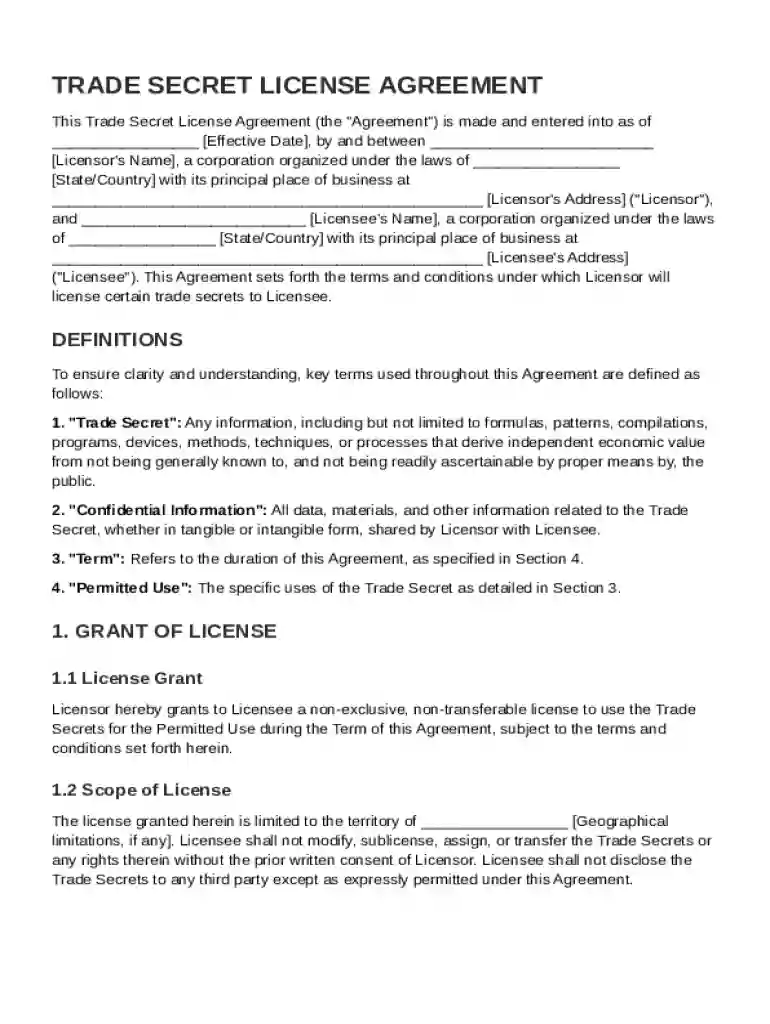
A Trade Secret License Agreement is a legal contract that defines the conditions under which a licensor permits a licensee to use certain trade secrets. These secrets are crucial proprietary information that gives an organization a competitive advantage. Such an agreement outlines what constitutes a trade secret, details what is classified as confidential information, and specifies how these secrets can be utilized by the licensee. The primary purpose is to protect the licensor's intellectual property while enabling the licensee to benefit from the use of the trade secret within agreed parameters.
Practical Examples
- Tech Company Formula: A software company licenses a unique algorithm to another software firm for application in a specific product.
- Manufacturing Process: A manufacturing business grants rights to its patented production techniques to a partner firm to scale manufacturing output.
- Artisan Recipe: An artisanal food producer allows a culinary firm to use a secret recipe to create a gourmet product line.
Key Elements of the Trade Secret License Agreement Template
Several essential elements make up a comprehensive Trade Secret License Agreement Template, each contributing to legal enforceability and clarity.
Core Components
- License Scope: Details the extent and limitations of the trade secret's use.
- Confidentiality Clauses: Emphasizes the licensee's duty to protect and not disclose any confidential information.
- Terms and Termination: Specifies the agreement period and conditions under which it can be terminated.
- Usage Restrictions: Outlines the permissible usages of the trade secret to prevent unauthorized exploitation.
- Indemnification: Allocates responsibility for breaches or legal claims arising from the use or misuse of the trade secret.
Additional Features
- Licensor’s Rights: Reserves rights to withdraw the license under certain conditions.
- Audit Rights: May allow licensors to verify compliance through audits.
- Legal Jurisdiction: Establishes which jurisdiction's laws govern the agreement.
Important Terms Related to Trade Secret License Agreement Template
Understanding the terminologies used in the Trade Secret License Agreement Template is vital for both parties involved. Here's a breakdown of the critical terms.
Key Definitions
- Trade Secret: Information, including a formula, practice, process, design, instrument, or compilation of information not generally known.
- Licensor and Licensee: The parties involved, where the licensor grants the license and the licensee receives it.
- Confidential Information: Specific data or information labeled by the licensor as confidential.
- Non-Exclusive License: Allows the licensor to grant similar licenses to other entities.
Detailed Explanations
- Permitted Use: Conditions under which the licensee can use the provided information.
- Restrictions: Limitative clauses restricting the licensee’s actions regarding the trade secret.
How to Use the Trade Secret License Agreement Template
Utilizing the Trade Secret License Agreement Template effectively requires a step-by-step approach to ensure it aligns with the specific needs of both parties involved.
Steps to Follow
- Identify Parties: Clearly define the licensor and licensee in the agreement.
- Detail Trade Secrets: Specify the trade secret being licensed.
- Draft Confidentiality Clauses: Include terms for protecting the trade secret’s confidentiality.
- Define Scope of Use: Clearly outline how the trade secret can be utilized under the license.
- Establish Term and Termination: Specify the duration and conditions for ending the agreement.
- Include Legal Provisions: Add jurisdiction and governing law preferences.
Practical Considerations
- Customization: Adjust the template to the specific needs of the licensor and licensee.
- Legal Review: Have a legal expert review the drafted agreement to ensure enforceability.
Legal Use of the Trade Secret License Agreement Template
The legal application of a Trade Secret License Agreement Template ensures that all parties are protected and their rights are enforceable under U.S. law.
Legal Requirements
- Compliance with ESIGN Act: Ensuring any digital signatures are legally binding.
- Adherence to State Laws: Aligning terms with jurisdiction-specific legislation.
- Enforceability: Drafting the agreement to meet legal standards for contracts.
Jurisdiction Considerations
- Federal Laws: Ensuring compliance with U.S. federal laws regarding intellectual property.
- State-Specific Requirements: Adjusting terms to align with specific state legislation.
State-by-State Differences
Trade Secret License Agreement Templates may need adjustments based on varying state laws across the United States.
State-Specific Requirements
- California: Some clauses around non-competes are highly regulated and often unenforceable.
- New York: Requires comprehensible definitions and clear language to ensure contractual obligations are understood.
Exception Cases
- Non-Disclosure Agreements (NDAs): Varying enforceability and acceptance standards in each state.
Examples of Using the Trade Secret License Agreement Template
Understanding how this template is applied in real-world scenarios can clarify its use and benefits.
Use Cases
- Software Development: A tech startup licenses a unique code to augment a partner's software offering.
- Pharmaceuticals: A biotech company allows limited use of its drug formulation for research by another lab.
- Engineering: An engineering consultancy licenses proprietary design plans to streamline partner project timelines.
Outcome Scenarios
- Increased Innovation: Encouragement of growth and innovation through shared access to trade secrets.
- Legal Disputes: Avoidance of potential legal conflicts through clear, well-structured agreements.
Business Types That Benefit Most from Trade Secret License Agreement Template
Industries and business types that leverage proprietary information or processes stand to gain significantly from utilizing a Trade Secret License Agreement Template.
Benefiting Industries
- Technology Firms: Benefit from licensing software algorithms or system designs.
- Pharmaceutical Companies: Licensing drug formulas for production or research.
- Manufacturing Businesses: Sharing patented processes or machinery designs.
Advantages by Business Type
- Startups: Secure partnerships with established firms to accelerate growth.
- Established Corporations: Protect proprietary advances while benefiting from additional research and development.
Consistency and thoroughness in utilizing a Trade Secret License Agreement ensure protection and clarity for all parties involved. Adopting this legal tool underpins strategic partnerships and fosters secure business growth across industries.