01. Edit your form online
Type text, add images, blackout confidential details, add comments, highlights and more.

Type text, add images, blackout confidential details, add comments, highlights and more.

Draw your signature, type it, upload its image, or use your mobile device as a signature pad.

Send it via email, link, or fax. You can also download it, export it or print it out.
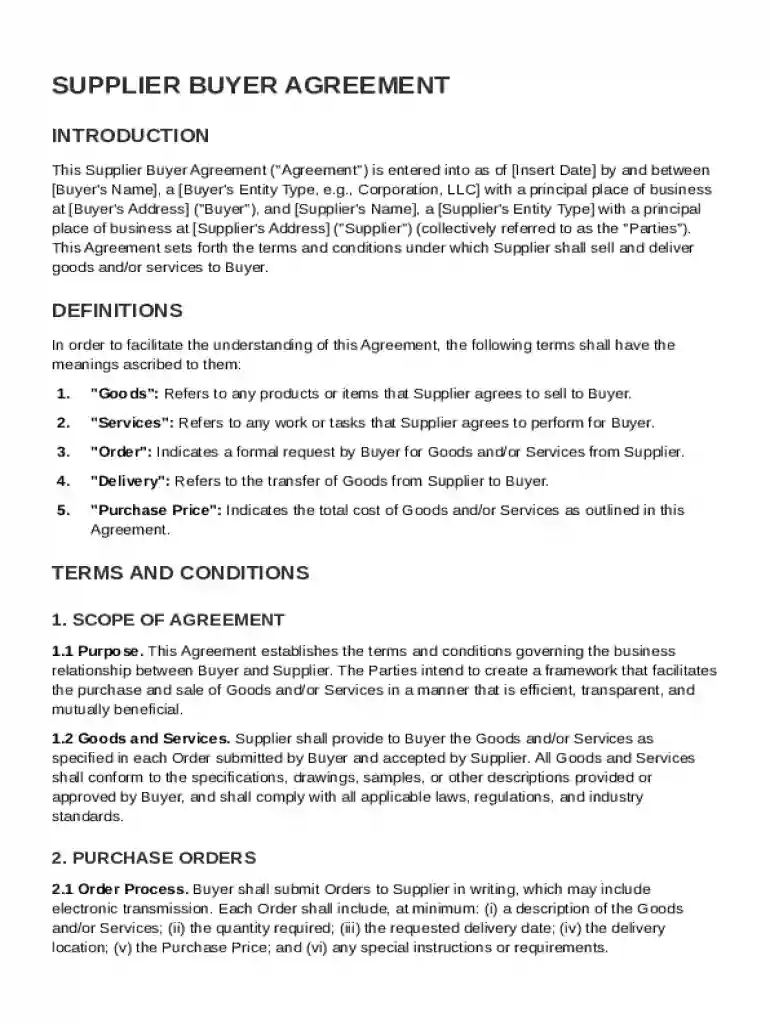
The Supplier Buyer Agreement Template is an essential legal document that outlines the specific terms and conditions under which a supplier and a buyer agree to conduct business. It provides a structured framework for both parties to understand their rights, responsibilities, and the processes involved in the sale and delivery of goods and services. This agreement is crucial for establishing clear communication and reducing potential conflicts, as it defines key aspects such as order placements, pricing, payment terms, delivery responsibilities, and confidentiality obligations. By having a well-defined agreement, both the supplier and the buyer can protect their interests and maintain a mutually beneficial relationship.
The Supplier Buyer Agreement Template contains several critical elements that establish a comprehensive framework for the business relationship. These elements include:
Definitions: Precise terms are clearly defined to avoid ambiguity and misunderstandings.
Order Processes: Detailed procedures for placing, accepting, and managing orders are specified, ensuring efficient transaction handling.
Pricing and Payment Terms: Specific pricing models and payment schedules are outlined to ensure transparency and agreement between parties.
Delivery Responsibilities: Obligations related to the timing, method, and conditions of delivery are described to ensure timely and accurate fulfillment.
Warranties and Indemnifications: These clauses protect both parties by specifying warranties offered and indemnification conditions in case of legal issues or product defects.
Confidentiality Provisions: They ensure sensitive information shared between the supplier and buyer remains protected and secure.
Termination Conditions: Clear terms under which the agreement can be terminated prematurely, specifying the process and consequences involved.
Governing Law: This section determines which jurisdiction's laws will be applied in interpreting the agreement in case of disputes.
Completing a Supplier Buyer Agreement Template involves several methodical steps to ensure both parties fully understand and agree to the stipulated terms:
Gather Information: Collect necessary details about both parties, including company names, addresses, and primary contacts.
Specify Product or Service Details: Clearly describe the goods or services being supplied, including specifications, quality standards, and any variations.
Define Order and Fulfillment Processes: Outline how orders will be placed, accepted, and fulfilled, detailing any forecasts or lead time requirements.
Set Pricing and Payment Conditions: Agree on prices, any applicable discounts, payment terms, and credit facilities.
Agree on Delivery Terms: Establish delivery schedules, methods, and who bears the risk of loss or damage.
Include Warranties and Liabilities: Define what warranties are provided and detail indemnification obligations to safeguard both parties against potential losses.
Clarify Confidentiality Agreements: Make sure any shared confidential information is protected under mutually agreed terms.
Review Termination Clauses: Decide on situations that would warrant early termination of the contract and any costs or penalties associated.
Final Review and Approval: Have legal representatives review the document before final signatures from both parties, ensuring compliance and agreement.
The Supplier Buyer Agreement Template serves as a legally binding contract once signed by both parties. It provides legal protection in cases of disputes and outlines the recourse available if any party breaches the terms. By adhering to the framework provided within the template, companies can ensure compliance with business laws and reduce the risk of legal challenges. This agreement is considered enforceable in a court of law, making it a critical tool for maintaining business integrity and accountability.
While the Supplier Buyer Agreement Template serves as a general framework, it's important to recognize that state-specific rules may affect the execution and enforcement of the agreement. Key considerations include:
Governing Law: Choose the applicable state law that will oversee the contract terms.
State Regulations and Compliance: Ensure the agreement complies with state-specific commerce regulations, such as sales tax requirements and delivery norms.
State-Specific Terms: Adjust clauses to reflect any state-specific legal requirements or standard industry practices in different jurisdictions.
Businesses should consult legal professionals familiar with state laws to ensure all facets of the agreement meet the necessary legal criteria and expectations, potentially adding state-specific clauses or amendments where required.
Several important terms are frequently used within the Supplier Buyer Agreement Template to ensure precision and clarity:
Buyer: The party purchasing goods or services from a supplier.
Supplier: The party providing goods or services under the terms set forth in the agreement.
Purchase Order: The buyer's official order to the supplier outlining quantities, specifications, and agreed-upon prices.
Invoice: The supplier's notification to the buyer detailing the payment due for services or products delivered.
Force Majeure: A clause that relieves parties from fulfilling contractual obligations due to unforeseen events beyond their control, like natural disasters or war.
Confidential Information: Any non-public information shared between the parties that needs protection from unauthorized disclosure.
Understanding these terms is vital for interpreting the agreement accurately and ensuring mutually aligned expectations.
Real-world scenarios often benefit from using a Supplier Buyer Agreement Template to secure business transactions and reduce misunderstandings:
Retail Purchase Orders: A retail company uses the template to formalize large-volume purchases from a wholesaler, securing product supply at agreed prices and delivery timelines.
Technology Services Agreement: A software development firm and a tech service provider use the template to set forth delivery expectations, service levels, and confidentiality obligations.
Manufacturing Supply Chain: An automotive parts manufacturer and its suppliers agree on quality, pricing, and liability conditions using the template, ensuring seamless production processes.
These examples illustrate the template's adaptability across various industries, providing a robust framework for defining business relationships.
The Supplier Buyer Agreement Template can be efficiently managed using platforms like DocHub, integrating seamlessly with digital tools:
File Compatibility: The template can be edited and stored in formats such as DOC, PDF, or XLS, allowing easy integration with existing document management systems.
Digital Signature Capability: Platforms like DocHub support legally binding electronic signatures, enabling remote approval and execution of agreements.
Cloud Storage Synchronization: Use tools like Google Drive or Dropbox to facilitate easy document sharing and version control, enhancing collaboration and accessibility.
Moving towards digital agreements not only improves operational efficiency but also aligns with modern business practices, simplifying the execution process for all parties involved.
At DocHub, your data security is our priority. We follow HIPAA, SOC2, GDPR, and other standards, so you can work on your documents with confidence.