






Definition and Meaning of a Management Service Agreement
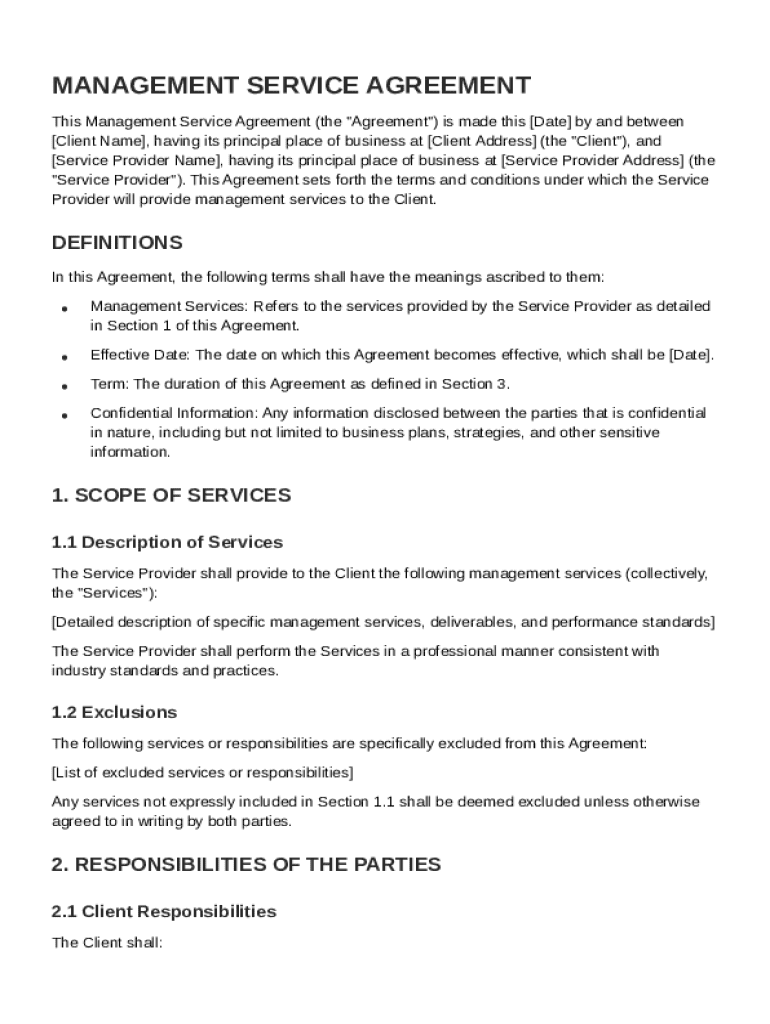
A Management Service Agreement is a formal contract between a Service Provider and a Client, detailing the terms under which management services are delivered. This document serves as a foundation for defining the legal and operational framework of the relationship. Key components include definitions of the parties involved, scope of services, responsibilities, compensation structures, and confidentiality obligations. It also encompasses intellectual property rights, indemnification, liability clauses, governing law specifics, and miscellaneous provisions. This agreement is critical in formalizing expectations, ensuring information security, and providing a clear guideline for resolving disputes that might arise.
Core Components and Their Functions
- Definitions and Parties: Clearly specified terms and the identification of the Client and Service Provider.
- Scope of Services: Detailed description of the services to be provided, including performance expectations.
- Responsibilities and Obligations: Outlines the duties and commitments of each party, ensuring clarity in execution.
- Compensation Details: Comprehensive explanation of payment terms, including amounts, schedules, and methods.
- Confidentiality and Data Protection: Policies to safeguard proprietary information and protect sensitive data.
- Intellectual Property Rights: Rights allocation concerning creations or developments made during the contract term.
- Liability and Indemnity: Framework addressing liabilities and the conditions under which indemnification is applicable.
- Governing Law and Dispute Resolution: Jurisdictional laws applicable and preferred methods for dispute resolution.
How to Use the Management Service Agreement Template
Using a Management Service Agreement Template efficiently requires understanding its components and customizing them to fit the specific needs of both parties involved. The template provides a flexible framework that can be adapted to various scenarios and industries.
Steps for Effective Utilization
- Identify Parties and Objectives: Clearly state the names and roles of both the Service Provider and the Client, and outline the primary objective of the agreement.
- Customize the Scope of Services: Adapt the template to include specific services that the Service Provider will offer, ensuring all expected outcomes are included.
- Define Responsibilities: Clearly articulate the responsibilities of each party to prevent ambiguities.
- Negotiate Compensation Terms: Agree upon and document the financial terms, including payment schedules and methods.
- Address Legal and Confidentiality Issues: Include clauses that protect sensitive information and intellectual property.
- Review and Finalize: Both parties should thoroughly review the document, suggest modifications if necessary, and agree on the final version.
- Sign and Store Securely: Obtain signatures from authorized representatives and securely store the signed document for future reference.
Practical Examples
- A tech company employing an IT firm to manage its network infrastructure.
- A retail chain contracting an agency to oversee logistics and supply chain management.
Key Elements of the Management Service Agreement Template
Understanding the critical elements of a Management Service Agreement Template is essential for creating an effective and enforceable document. Each section of the agreement plays a specific role in defining and governing the business relationship.
Essential Sections to Include
- Parties Involved: Names, addresses, and contact information of the Client and Service Provider.
- Service Description: Detailed enumeration of management services to be delivered.
- Term and Termination: Duration of the contract and conditions under which it can be terminated.
- Performance Metrics: Specific criteria and metrics used to evaluate the service delivery.
- Compensation and Payment Terms: Includes details on rates, frequency, and mode of payment.
- Confidentiality: Terms ensuring non-disclosure of confidential and competitive information.
- Dispute Resolution: Preferred methods for resolving disagreements, like arbitration or mediation.
- Amendment Clause: Process for making changes to the agreement with mutual consent.
Scenarios Highlighting Importance
- Ensuring clarity in expectations for long-term consulting services.
- Defining intellectual property ownership in research and development collaborations.
Steps to Complete the Management Service Agreement Template
The completion of a Management Service Agreement Template involves several critical steps to ensure accuracy and comprehensiveness, reflecting the mutual understanding and agreement of both parties involved.
Detailed Process Breakdown
- Initial Meeting: Both parties should sit together to discuss their expectations, objectives, and concerns.
- Drafting: Use the template to draft an initial version, incorporating specific requirements and conditions.
- Critical Review: Conduct a detailed review to verify that all key elements are covered and accurately described.
- Mutual Revisions: Share the draft with the other party and invite feedback and suggestions for modifications.
- Legal Review: Have the document reviewed by legal experts to ensure it complies with applicable laws and regulations.
- Finalization: Once all parties agree on the content, revise the document accordingly for finalization.
- Execution: Obtain signatures from both parties to execute the agreement legally.
- Secure Storage: Keep the signed document in a safe and accessible location, such as a secure cloud storage service, for future reference and compliance.
Examples of Common Pitfalls
- Failure to explicitly state compensation details might lead to payment disputes.
- Neglecting confidential data clauses can result in unauthorized data sharing.
Who Typically Uses the Management Service Agreement Template
Management Service Agreement Templates are widely used across diverse industries, primarily by entities seeking to formalize the provision of management services.

Primary Users
- Corporations and Business Enterprises: Businesses looking to outsource certain management tasks or require external expertise.
- Consulting Firms: Organizations providing management consulting services to various sectors.
- Non-Profit Organizations: Entities needing specialized management services without engaging full-time staff.
- Government Agencies and Departments: Public bodies engaging third-party service providers for efficient management.
Industry Applications
- Healthcare: Hospitals contracting management services for administrative operations.
- Information Technology: Tech companies hiring service providers to manage IT infrastructures.
- Retail and Supply Chain: Retail businesses outsourcing supply chain management to logistics experts.
Real-World Case Studies
- A healthcare provider engages a management consultant to streamline operations and improve patient care pathways.
- An e-commerce business collaborates with a third-party logistics service provider to enhance distribution efficiency.
Legal Use and Compliance for the Management Service Agreement Template
Legal considerations are a crucial aspect of any Management Service Agreement Template. It is essential to ensure the agreement is legally binding and compliant with relevant laws.
Compliance Requirements
- Adherence to Contract Laws: Ensure all terms are consistent with U.S. contract law principles, including offer, acceptance, and consideration.
- Binding Nature: Incorporate clear language and terms making the contract legally enforceable.
- Confidentiality and Data Protection Regulations: Align with federal and state laws regarding data protection and confidentiality.
- Intellectual Property Laws: Define IP rights in accordance with U.S. intellectual property law to avoid disputes.
- Fair Labor Standards Act (FLSA): Consider regulations that may apply concerning compensation and working conditions.
Legal Review Best Practices
- Engage legal counsel to review and approve the agreement.
- Confirm clauses are compatible with applicable state regulations.
- Assure amendments and modifications are legally documented.
Avoiding Legal Issues
- Specify the governing law and jurisdiction for dispute resolution.
- Define roles, responsibilities, and expectations explicitly to prevent misunderstandings.
Important Terms in the Management Service Agreement Template
The Management Service Agreement Template includes several important terms that define its scope and nature. Understanding these terms is critical for ensuring clear communication and avoiding legal pitfalls.
Key Terminologies and Definitions
- Service Provider and Client: Identifies the parties to the agreement, specifying their roles.
- Confidential Information: Any non-public information shared between parties.
- Effective Date: The date upon which the agreement becomes enforceable.
- Default: Conditions under which a party fails to fulfill its contractual obligations, leading to potential trouble.
- Indemnification: Protects a party from liabilities incurred due to the other party's actions or negligence.
- Force Majeure: Circumstances beyond either party’s control that may prevent fulfilling obligations, like natural disasters.
Examples and Usage
- Compensation Clause: Payment structured as “per project” or “hourly” specific to service type.
- Confidentiality Agreements: Restrict dissemination of trade secrets and proprietary procedures.
- Termination Clause: Provisions for ending the agreement before its term due to breach or mutual consent.
State-Specific Rules for the Management Service Agreement Template
While Management Service Agreements are governed by general contract law principles, several state-specific nuances must be considered.
State Regulations Affecting Agreements
- Governing Law Clause: Must specify which state’s law will apply.
- Local Compliance Requirements: Local laws may impose additional requirements or restrictions.
- Enforcement Clauses: Vary by state, especially regarding non-compete or restraint of trade clauses.
Tailoring the Agreement for State Compliance
- Research State Laws: Understand the specific contractual requirements of the state where services are rendered.
- Legal Consultation: Seek advice from legal experts familiar with state-specific contract law.
- Modify Templates Accordingly: Adjust terms to align with state regulations without compromising the agreement's effectiveness.
Practical State-Specific Scenarios
- A California company needs to ensure compliance with state labor laws, such as requiring specific compensation formats.
- A New York-based business must adhere to unique privacy laws impacting confidentiality agreements.