




01. Edit your form online
Type text, add images, blackout confidential details, add comments, highlights and more.

Type text, add images, blackout confidential details, add comments, highlights and more.

Draw your signature, type it, upload its image, or use your mobile device as a signature pad.

Send it via email, link, or fax. You can also download it, export it or print it out.
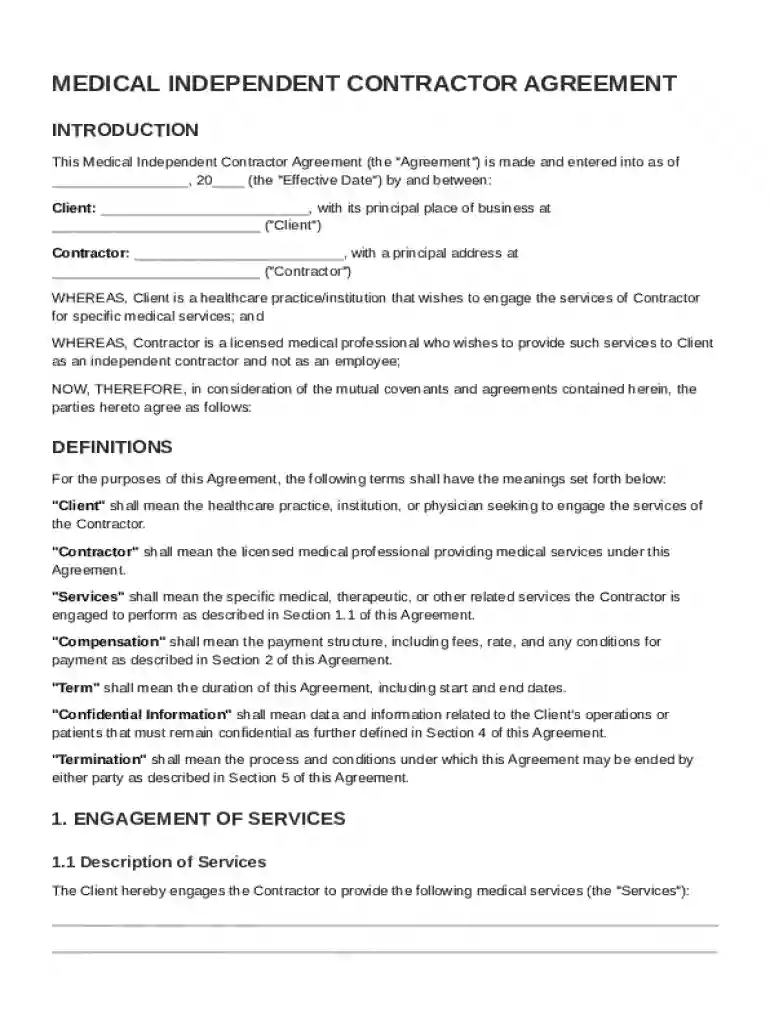
The Medical Independent Contractor Agreement Template is a legal document that sets forth the terms under which a licensed medical professional provides services to a healthcare practice or institution as an independent contractor. This agreement delineates the relationship between the Contractor and the Client, ensuring clarity on expectations, responsibilities, and legal obligations. An independent contractor differs from an employee, mainly in terms of tax implications and autonomy in work arrangements. Understanding this distinction is crucial as it affects not only how services are rendered but also how they are taxed and regulated.
Utilizing the Medical Independent Contractor Agreement Template involves a thorough understanding of both legal and operational dynamics. The template can be customized to reflect the specific circumstances of the engagement between the healthcare institution and the medical professional.
If a hospital hires a freelance surgeon for a series of operations, the agreement will specify the number of operations, payment per operation, and expected completion timeline.
Completing this template requires careful attention to detail and the inclusion of all necessary legal stipulations to safeguard both parties involved.
Understanding the vital terminologies in this agreement helps in crafting a precise and enforceable contract.
If a medical malpractice issue arises, the indemnification clause may protect the Client from financial liability, provided the Contractor's actions were negligent.
This template is designed to comply with legal requirements and ensure that the Contractor's work classification aligns with IRS guidelines, avoiding misclassification that could incur legal penalties.
A medical transcriptionist hired independently needs to complete IRS Form 1099 instead of W-2, as expected for employees.
Identifying and elaborating on core components of this agreement not only protects but also provides clear expectations for both parties.
An oncologist contracted to consult on a research project can use outlined invoicing procedures to submit monthly reports for processing.
State laws can influence various aspects of an independent contractor agreement. Different states have unique regulations regarding work classification, taxation, and employment rights.
In California, the Contractor might need to ensure the contract expressly states independence in performing tasks and not being under direct supervision.
This template is frequently used by healthcare institutions and medical professionals who require flexible work arrangements without the obligations of traditional employment.



An experienced nurse practitioner freelancing through various clinics uses this agreement to set terms with multiple healthcare providers without full-time commitments.
Failing to comply with the terms within the Medical Independent Contractor Agreement can lead to significant consequences for both parties, often involving financial, legal, and reputational costs.
A contractor disclosing patient information inappropriately might face fines, lawsuits, and potential revocation of their professional certification.
Choosing between digital and paper formats for the Medical Independent Contractor Agreement influences convenience, security, and accessibility.
Using a digital version allows a healthcare staffing agency to instantly update agreement terms and send them to multiple Contractors, reducing overhead.
At DocHub, your data security is our priority. We follow HIPAA, SOC2, GDPR, and other standards, so you can work on your documents with confidence.






AVAILABLE FTL CONTRACT FOR IMMEDIATE ASSIGNMENT **CONTRACT DETAILS** A reliable and hardworking entry-level courier is needed to ferry a delivery in Stanton
This Agreement sets forth the obligations and agreements of the Parties relating to compliance with HIPAA Laws (defined below). This Agreement applies to allRead more


