




01. Edit your form online
Type text, add images, blackout confidential details, add comments, highlights and more.

Type text, add images, blackout confidential details, add comments, highlights and more.

Draw your signature, type it, upload its image, or use your mobile device as a signature pad.

Send it via email, link, or fax. You can also download it, export it or print it out.
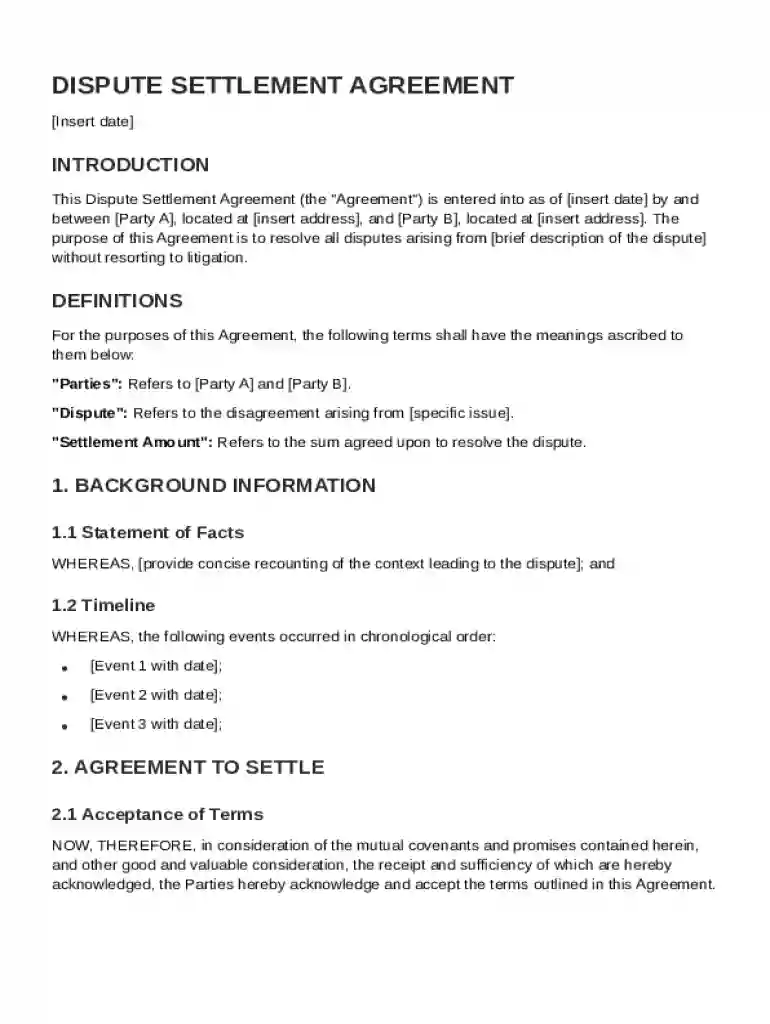
A Dispute Settlement Agreement Template is a pre-designed legal document used to resolve disputes amicably between two or more parties without pursuing litigation. This template provides a structured format that parties can customize to their specific situation, outlining the terms under which they agree to settle their differences. Essentially, it serves to detail the obligations, concessions, and mutual understanding needed to resolve conflicts in a civil manner, covering elements like payment terms, non-monetary arrangements, and confidentiality clauses.
The template typically includes pertinent background information about the dispute and the involved parties, ensuring clarity regarding the nature and scope of the disagreement. Furthermore, it provides guidelines on how to draft an enforceable agreement tailored to the needs of the parties involved, highlighting the importance of mutual consent and clear communication in arriving at a legally binding resolution.
The Dispute Settlement Agreement Template is composed of several crucial sections that collectively form a comprehensive document. Understanding these elements is essential to ensure the agreement is both effective and legally sound:
Definitions and Background: This section clarifies the terms used throughout the document and provides context for the dispute, ensuring both parties have a mutual understanding of the issue at hand.
Settlement Terms: Outlines both monetary and non-monetary obligations agreed upon to settle the dispute. This could include payment schedules, service agreements, or any other arrangement that requires fulfillment.
Confidentiality Clauses: Details the degree of discretion required from both parties regarding the terms of the settlement and any underlying information that should remain private.
Release and Waiver of Claims: Specifies any rights or claims the parties agree to waive as part of the settlement. This is crucial for preventing future litigation over the resolved dispute.
Governing Law: Identifies which jurisdiction’s laws will apply to interpret and enforce the agreement. This could be a specific state or federal jurisdiction in the United States.
Dispute Resolution Procedures: Establishes how any subsequent disagreements regarding the settlement will be handled, possibly including arbitration or mediation provisions.
Completing a Dispute Settlement Agreement Template involves several methodical steps to ensure accuracy and legal integrity:
Clearly Identify the Parties: Specify all involved parties, including their full legal names and contact information. Clear identification prevents ambiguity.
Detail the Dispute: Provide a concise summary of the dispute’s background, ensuring both parties have a common understanding of the issue being resolved.
Settle on Terms: Negotiate and draft the terms of settlement, including any payments or actions each party must undertake. Confirm these terms align with both parties’ expectations.
Confidentiality Agreement: Decide the scope of confidentiality required and detail it within the agreement, protecting sensitive information as needed.
Include Waivers: Clearly state any legal rights or claims waived by the parties, ensuring such waivers are knowingly and voluntarily agreed upon.
Choose Governing Law: Agree on which state or federal law will govern the agreement, setting the legal framework for its enforcement.
Outline Dispute Resolution: Determine and document the method for resolving potential future disputes related to the agreement, such as mediation or arbitration.
Using the Dispute Settlement Agreement Template legally binds the parties to the terms agreed upon within the document, provided it is executed correctly. Legal use ensures that the terms are enforceable in a court of law and that both parties have willingly accepted the obligations and restrictions stipulated.
The template allows for customizable provisions that adapt to unique situations, but it’s imperative that the completed document adheres to general principles of contract law, including offer, acceptance, consideration, capacity, and lawful purpose. Consulting with a legal professional when using this template can help ensure compliance with relevant laws and regulations.
The template contains several key terms that are essential for understanding and correctly using the document. These terms often have specific legal meanings and implications:
Settlement: The act of resolving a dispute or conflict by mutual agreement and without pursuing litigation.
Party: A person or entity involved in a contract or legal agreement, whose rights and obligations are affected by the document.
Waiver: The voluntary relinquishment or surrender of a known right or privilege, often related to legal claims in a dispute.
Arbitration: A method of dispute resolution where an arbitrator, an independent third party, makes a decision to resolve the conflict, which is binding on both parties.
Confidentiality: A clause that defines the need to keep certain information private and establishes the parameters for nondisclosure.
Consideration: Something of value exchanged between parties, making the agreement legally binding. This could be monetary compensation, services, or a promise.
Understanding these terms is crucial for effectively drafting and implementing a Dispute Settlement Agreement, allowing both parties to navigate complex legal landscapes confidently.
Utilizing a Dispute Settlement Agreement Template provides multiple benefits:
Efficiency: It streamlines the process of dispute resolution by offering a pre-structured format that parties can customize according to their needs, thus saving time and effort.
Clarity and Precision: By providing a clear structure and standardized language, the template minimizes misinterpretations and ensures that all parties have a mutual understanding.
Legal Assurance: Proper use of the template ensures that the resulting document holds up under legal scrutiny and offers enforceable protections for all involved parties.
Protection of Relationships: By resolving conflicts amicably without escalating to litigation, the template helps maintain professional or personal relationships, avoiding further tension.
Understanding and complying with state-specific regulations is crucial since legal requirements can vary significantly across different jurisdictions in the United States.
Jurisdictional Variations: Each state may have its own laws regarding contracts, dispute resolution processes, and enforceability of certain terms, such as confidentiality and waiver clauses.
Mediation and Arbitration Requirements: Some states may mandate specific mediation or arbitration procedures before resorting to litigation. It’s essential to ensure that your agreement is aligned with these mandates.
Governing Law Provisions: Including a choice-of-law clause in the agreement specifies which state’s laws will govern the document and can affect its interpretation and enforcement. Ensure this is clearly decided and stated.
Reviewing relevant state laws or consulting with legal professionals familiar with the applicable jurisdiction is necessary to tailor the agreement appropriately and ensure compliance with state regulations.
There are numerous scenarios where a Dispute Settlement Agreement Template could be employed:
Business Disputes: Two companies involved in a conflict regarding a breached contract can use the template to reach an out-of-court settlement, agreeing to new terms that satisfy both parties’ needs.
Employment Disagreements: An employer and employee may resolve issues such as claimed wrongful termination or workplace disputes by negotiating a settlement agreement that compensates for purported damages while maintaining privacy.
Partnership Dissolutions: When partners in a business decide to part ways, this template can formalize the distribution of assets and responsibilities, ensuring a smooth transition without resorting to litigious processes.
By providing a blueprint for resolving a wide range of conflicts inconsistently, the template facilitates effective negotiation and resolution across various contexts.
At DocHub, your data security is our priority. We follow HIPAA, SOC2, GDPR, and other standards, so you can work on your documents with confidence.






Aug 1, 2022 This Release and Settlement Agreement. In resolving the dispute, the Court will apply Title II of the Americans with Disabilities Act.
Defendants shall make or cause to be made a one-time, lump sum payment ofthirty-seven million, five hundred thousand dollars ($37,500,000.00)
Aug 29, 2026 This guide is for people in India who resolved a dispute through mediation, signed a written settlement, and are now facing the other side


