




01. Edit your form online
Type text, add images, blackout confidential details, add comments, highlights and more.

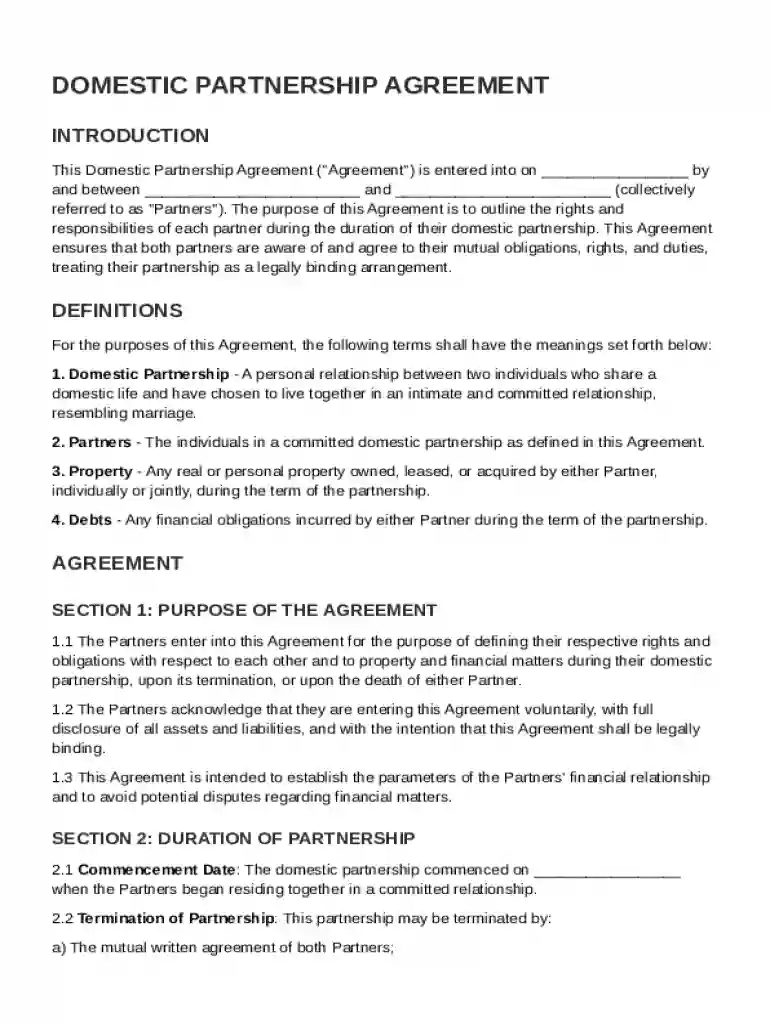
Type text, add images, blackout confidential details, add comments, highlights and more.

Draw your signature, type it, upload its image, or use your mobile device as a signature pad.

Send it via email, link, or fax. You can also download it, export it or print it out.
The Domestic Partnership Agreement Template is a vital legal document designed to outline the rights and responsibilities of two individuals who are in a committed domestic partnership. This template serves as a guide for drafting agreements that clarify financial obligations, property rights, and procedures for dissolution, ensuring both parties have mutual understanding and consent. It emphasizes voluntary participation and seeks to prevent disputes, especially concerning child custody and financial matters, where applicable. The agreement typically includes provisions for mediation to resolve any disagreements that might arise and aligns with state laws governing such partnerships.
Using the Domestic Partnership Agreement Template involves several key steps to ensure that all necessary details are thoroughly addressed:
Review the Template Structure: Familiarize yourself with the sections provided in the template, which cover financial arrangements, property division, and expectations during the partnership.
Customize Personal Information: Insert relevant personal details specific to both partners, such as names, addresses, and pertinent identification information.
Define Financial Arrangements: Clearly state the financial responsibilities of each partner, detailing how income, expenses, and debts will be managed and shared.
Outline Property Rights: Specify the ownership and division of property, including property acquired before and during the partnership.
Establish Exit Procedures: Include clear guidelines on how to dissolve the agreement, addressing division of finances and property, as well as any arrangements concerning children.
Consult Legal Counsel: Consider seeking legal advice to ensure the agreement fully complies with state laws and addresses all necessary concerns specific to your partnership.
The Domestic Partnership Agreement Template encompasses several critical elements to comprehensively cover all aspects of the partnership:
Personal Information: Identification and personal details of both partners.
Financial Obligations: Details on income sharing, debt responsibilities, and budget management.
Property Division: Instructions on managing owned, acquired, and shared property.
Termination Process: Defined steps for dissolving the partnership, including asset division and child custody arrangements.
Conflict Resolution: Mediation clauses to facilitate dispute resolution.
Governing Law: Designation of applicable state laws regulating the agreement.
Several key terms are integral to understanding and executing a Domestic Partnership Agreement:
Partner: Refers to each individual in the domestic partnership.
Assets: Include any property or financial resources owned by the partners.
Liabilities: Debts for which one or both partners are responsible.
Cohabitation: Living arrangement of the partnered individuals.
Beneficiary Designations: Assignments concerning medical, insurance, or financial benefits.
Understanding these terms is crucial for drafting a comprehensive and legally binding agreement.
The Domestic Partnership Agreement Template serves as a legally binding document when correctly drafted and executed. Its legal significance includes:
Recognition of Rights: Establishes clear recognition of each partner's rights and responsibilities.
Legal Protection: Offers legal recourse and protection in instances of a partnership breakup.
Financial Security: Secures financial interests and prevents unilateral financial decisions.
Child Custody Arrangements: Legally supports agreed-upon child custody and visitation rights.
This agreement must conform to state-specific legal requirements for validity.
Rules regarding the Domestic Partnership Agreement vary by state, influencing how the agreement is used and enforced:
Recognition: Some states have specific statutes recognizing domestic partnerships, while others may require additional documentation.
Enforceability: Enforcement of financial and property distribution clauses can differ depending on local laws.
Registration Requirements: Certain states may require registration of the partnership for legal recognition.
It is essential to consult local regulations and seek legal advice to ensure compliance with state-specific requirements.
Completing the Domestic Partnership Agreement Template involves:
Gather Necessary Information: Collect all personal, financial, and property-related details needed to fill out the template accurately.
Draft the Agreement: Begin with a draft using the template, customizing each section to suit the specific circumstances of your partnership.
Review and Revise: Double-check the details for accuracy and comprehensiveness. Make revisions where necessary.
Legal Review: Have a legal professional review the agreement to ensure it is binding and compliant with state laws.
Finalization: Once reviewed and agreed upon by both partners, sign the document in presence of witnesses if required.
Secure Storage: Store the finalized agreement in a safe location accessible to both partners.
Examples of scenarios where a Domestic Partnership Agreement can be useful include:
Financial Planning: Couples with shared financial obligations use the agreement to outline budget management and liability responsibilities.
Real Estate Ownership: Partners purchasing property together can define ownership stakes and proceeds division in case of a split.
Parental Arrangements: Couples with children detail custody and support responsibilities to avoid future disputes.
These examples highlight the practical application of the agreement to manage complexities in a partnership and provide clarity and security for both parties.
At DocHub, your data security is our priority. We follow HIPAA, SOC2, GDPR, and other standards, so you can work on your documents with confidence.



May 21, 2026 Key elements of PPPs include governance and stakeholder alignment, long-term contracting, risk-sharing, financing mechanisms, and sustainabilityRead more
A domestic partnership shall be established in California when both persons file a Declaration of Domestic. Partnership (Form DP-1) with the Secretary of State.Read more


