




01. Edit your form online
Type text, add images, blackout confidential details, add comments, highlights and more.

Type text, add images, blackout confidential details, add comments, highlights and more.

Draw your signature, type it, upload its image, or use your mobile device as a signature pad.

Send it via email, link, or fax. You can also download it, export it or print it out.
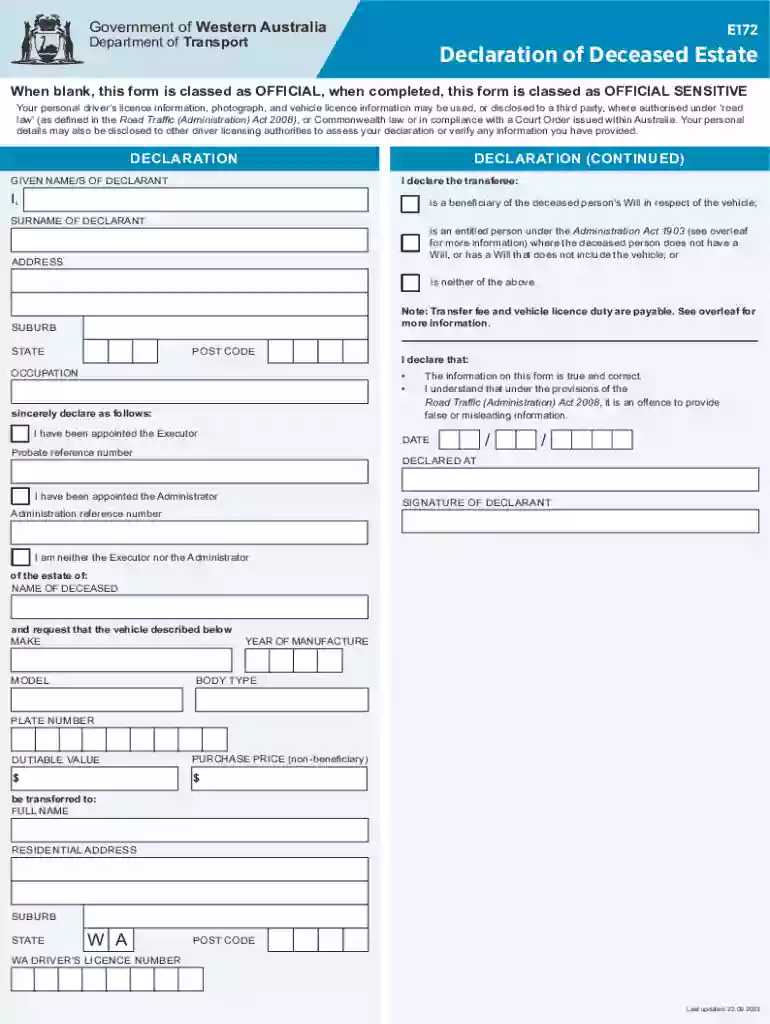
E172 is a form used for specific official purposes related to declaring the transfer of vehicle ownership due to a deceased estate. This form is utilized within certain jurisdictions, primarily focusing on ensuring that the vehicle transfer process is compliant with local laws and regulations. It mandates the inclusion of pertinent declarations from the declarant about their entitlement to the vehicle and contains detailed sections about the legal framework within which such transfers must operate. Understanding the specific legal definitions and requirements outlined in E172 is essential for accurately processing the document.
To successfully complete the E172 form, follow these comprehensive steps. Start by collecting all necessary personal information, including the deceased's details and your own as the declarant. Accurately fill out sections regarding the vehicle, such as make, model, and registration number. Subsequently, you will need to provide legal documents supporting your claim, which may include probate documentation or letters of administration. Each step should be taken with attention to detail to avoid errors that could delay the process. Completing supplementary sections about legal obligations and possible penalties for false information is also critical.
Submitting the E172 form requires a collection of important documents. These include proof of the deceased's ownership, such as vehicle registration papers and a certified copy of the death certificate. Legal documents that establish your right to claim the deceased estate, like probate or letters of administration, are also mandatory. Additionally, some jurisdictions might necessitate affidavits or declarations under oath, verifying the legality of the transfer. Ensuring every required document is complete and attached is vital for the timely acceptance of the form.
The E172 form plays a crucial role in the legal transfer of vehicle ownership from a deceased individual to a rightful heir or designated representative. Under the governing legal framework, the form outlines specific declarations that the declarant must make, covering aspects of entitlement and compliance with any applicable probate or estate settlement law. Misrepresentation or errors in this document could result in significant legal consequences, emphasizing the importance of consulting legal expertise when necessary to ensure all information is accurate and appropriate.
Failure to comply with the requirements of the E172 form can lead to severe penalties. These may include fines, legal repercussions, or even criminal charges if intentional misreporting of information on the form is detected. Incorrectly declaring one’s entitlement without the proper legal documentation like probate or administration papers may also invalidate the transfer process, further compounding potential legal issues. Understanding these penalties underscores the importance of ensuring accurate and complete submissions to avoid costly and time-consuming litigations.
Real-world scenarios highlight the practical application of the E172 form. For instance, an individual named as the sole heir in a will might use E172 to transfer the vehicle title from a deceased relative. Alternatively, an appointed executor managing the deceased's estate might complete the form as part of their duty to distribute the estate's assets appropriately. These examples illustrate the form's utility in facilitating legal transfers that respect the intentions of the deceased and the rights of the heirs.
While the fundamental structure of the E172 form is largely consistent, state-specific variations exist that accommodate local legal frameworks and requirements. Some states might have additional documentation requirements, while others may prioritize electronic submissions over paper formats. Knowing the peculiarities of your state’s regulations is essential, as non-compliance with these can lead to delays. Checking with local Department of Motor Vehicles offices or legal advisors for clarification can prove beneficial in navigating these state-specific rules.
Different submission methods for E172 forms offer varying conveniences and requirements. Many jurisdictions provide online submission portals where forms can be uploaded with attached digital documents. Alternatively, mailing the completed form and accompanying documentation is a traditional method; ensure all parts are legible and fully completed to avoid processing delays. In-person submissions at local offices allow for direct interaction and immediate feedback on form completeness. Each method has its guidelines, making it vital to choose the one that best fits your situation and resources available.
At DocHub, your data security is our priority. We follow HIPAA, SOC2, GDPR, and other standards, so you can work on your documents with confidence.





E172 Print and Copy Center. Amounts expended for copy, duplication and reproduction services performed by a University Copy Center. See All Account CodesRead more
by L Voss 2020 Cited by 66 Iron oxides used as food colorants are listed in the European Union with the number E172. However, there are no specifications concerning


