




01. Edit your form online
Type text, add images, blackout confidential details, add comments, highlights and more.

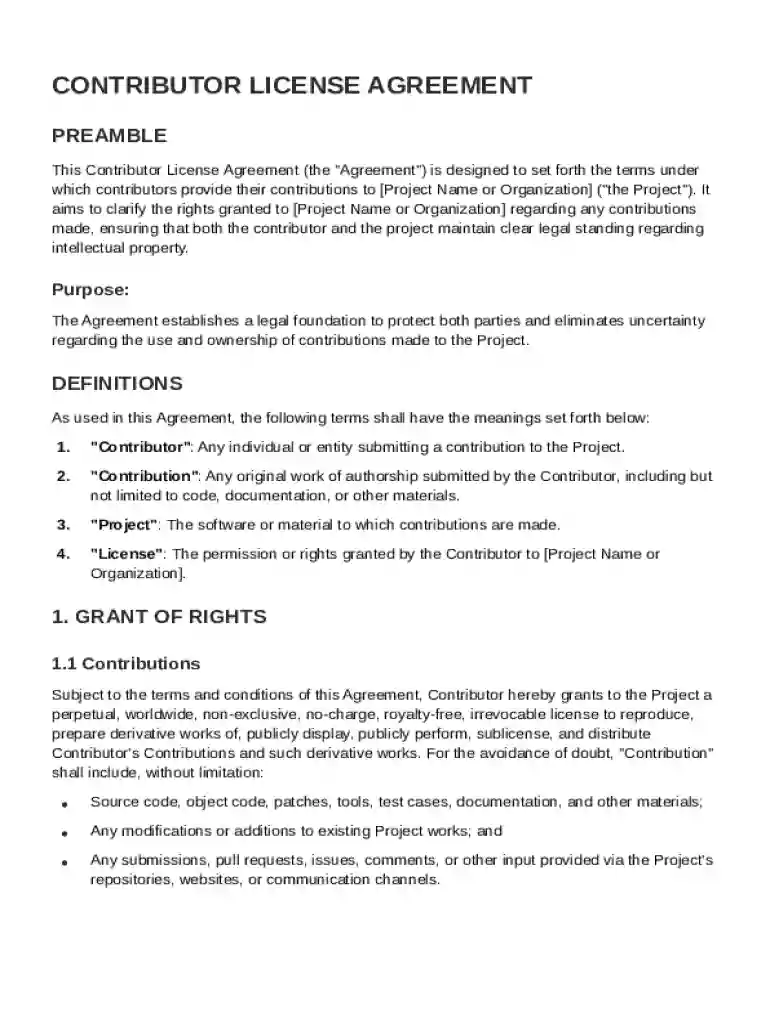
Type text, add images, blackout confidential details, add comments, highlights and more.

Draw your signature, type it, upload its image, or use your mobile device as a signature pad.

Send it via email, link, or fax. You can also download it, export it or print it out.
A Contributor License Agreement (CLA) is a legal document outlining the terms under which a contributor can provide contributions to a project. It establishes a formalized framework ensuring that contributions are original, free from third-party claims, and legally protect both the contributor and the project. Key elements generally include but are not limited to the granting of rights for contributions, representations and warranties by contributors, and procedures for acceptance and termination. Each component is structured to secure intellectual property rights while enabling collaborative progress.
Utilizing the Contributor License Agreement Template involves a few essential steps. First, customize the template to fit the specific requirements of your project, ensuring that all necessary rights and responsibilities are clearly delineated. Once tailored, distribute the agreement to potential contributors for their review and signature. This process creates a legally-binding environment where contributors understand the impact and legal standing of their additions to the project. The template can be modified to accommodate changes in project scope or legal requirements, providing flexibility for ongoing and future contributions.
Completing the Contributor License Agreement Template requires precision to uphold its enforceability. Begin by filling out the basic information, including the date, contributor's name, and project details. Include sections for the assignment of rights, representations, warranties, and termination conditions. As you proceed, ensure that there is a section outlining the governing law and dispute resolution mechanisms. After completing these sections, carefully review the document for accuracy before sending it to all parties for signing using platforms like DocHub, which ensures legally binding electronic signatures.
The primary components of a Contributor License Agreement Template include:
Each element is meticulously crafted to solidify the collaborative relationship while maintaining project integrity.
Contributor License Agreement Templates are employed by various stakeholders in software development, open-source projects, and other collaborative initiatives. Entities such as software companies, non-profit organizations, and academic institutions use CLAs to manage contributions and uphold legal standards. Individual developers and contributors also engage with these agreements to protect their intellectual property while contributing to larger projects. This broad applicability necessitates a well-rounded understanding of CLAs to facilitate secure and effective collaboration.


The legal utilization of a Contributor License Agreement Template is pivotal to ensure compliance and protect all parties involved in a project. The template serves as a binding legal document that safeguards intellectual property and contributions. By clearly defining the scope of rights and protections, the agreement preempts potential disputes by pre-establishing the terms of collaboration and contribution. Expert legal consultation is encouraged when drafting or amending the template to ensure it aligns with jurisdictional legal standards and project needs.
Real-world scenarios demonstrate the practical application of CLAs. For instance, a major open-source project might use a CLA to manage contributions from diverse global contributors, ensuring consistent legal protections across varying jurisdictions. Similarly, a software company developing proprietary software might implement a CLA to integrate external code, ensuring all contributions are free from third-party claims. In each example, the CLA plays a vital role in preserving the legal and operational integrity of the project.
While the Contributor License Agreement serves a universal purpose, state-specific rules can influence its formation and enforcement. Legal nuances related to intellectual property law, contract law, and electronic signatures vary by state, affecting the construction and application of CLAs. In particular, states may have differing requirements regarding dispute resolution clauses or governing law stipulations. It's crucial to customize the CLA in accordance with both federal and state laws to ensure robust legal standing.
Understanding the Contributor License Agreement requires familiarity with several key terms:
These terms are integral to crafting a comprehensive and enforceable CLA, providing clarity and protection for all parties involved.
At DocHub, your data security is our priority. We follow HIPAA, SOC2, GDPR, and other standards, so you can work on your documents with confidence.





Sep 28, 2017 This agreement is based on a template from the Harmony Agreements project, whose goal is to standardize CLAs within the Open Source community.Read more
This license is for your protection as a Contributor as well as the protection of Argonne authorized by the copyright owner that is making this Agreement with
Sep 19, 2025 List of templates Glossary Licensing Contributor. To apply for your share, please read the following Terms of Agreement and then proceed to the


