






Definition & Meaning
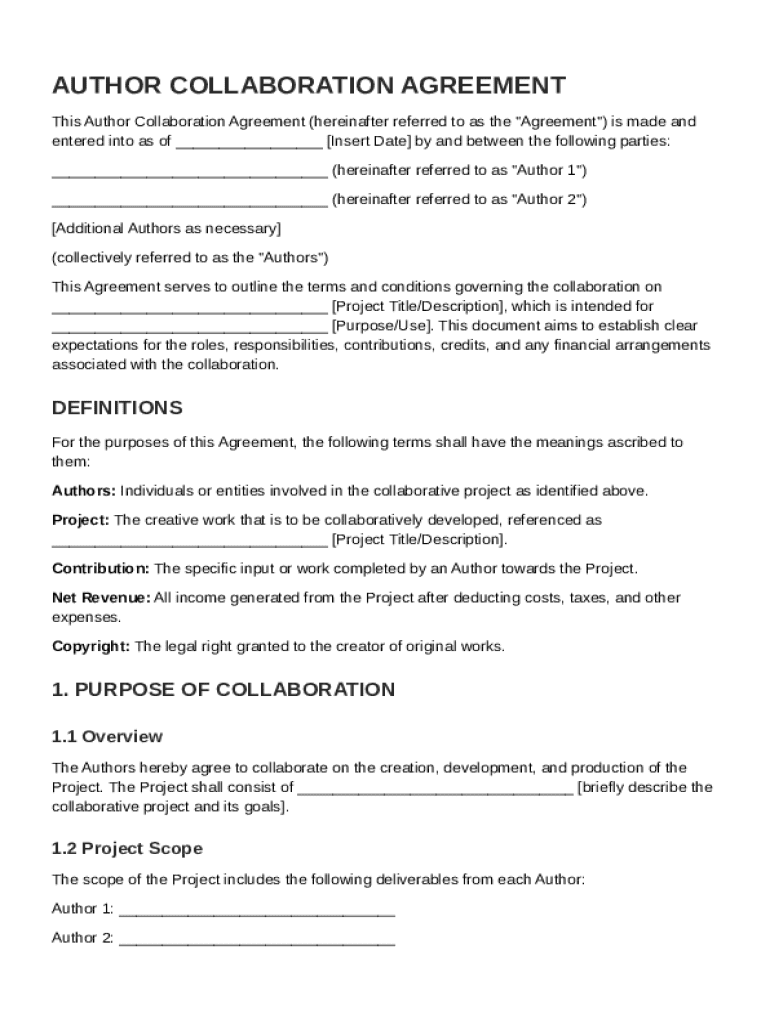
The Author Collaboration Agreement Template serves as a formal document outlining the terms and conditions under which multiple authors collaborate on a project. This agreement is vital for establishing clear roles, responsibilities, and expectations among collaborators. By defining each contributor's duties, the agreement helps avoid conflicts and ensures a smooth workflow. It typically includes provisions for copyright ownership, revenue sharing, confidentiality, dispute resolution, and termination conditions, all aimed at promoting transparency and mutual understanding among parties.
Key Elements of the Author Collaboration Agreement Template
The Author Collaboration Agreement Template encompasses several critical elements that ensure comprehensive coverage of collaboration details:
- Roles and Responsibilities: Each author's duties and areas of responsibility are clearly defined to prevent overlap and ensure accountability.
- Contributions and Copyright Ownership: This section specifies how contributions are credited, who holds copyright ownership, and how intellectual property rights are handled.
- Revenue Sharing: Outlines how profits and expenses are distributed among collaborators, taking into account contributions and ownership stakes.
- Confidentiality: Details the measures taken to protect sensitive information shared during the collaboration.
- Dispute Resolution: Provides a framework for resolving disagreements or conflicts that may arise, often including mediation or arbitration clauses.
- Termination Conditions: Specifies conditions under which the agreement can be dissolved and the implications of such termination.
Steps to Complete the Author Collaboration Agreement Template
Completing the Author Collaboration Agreement Template involves a series of steps to guarantee thorough and accurate documentation:
- Identify Collaborators: List all individuals involved in the project and their respective roles.
- Define Contributions: Clearly outline what each collaborator will contribute to the project, whether it's writing, research, editing, or other tasks.
- Establish Copyright and Revenue Terms: Decide how copyright ownership will be shared and how any profits or losses will be split among collaborators.
- Set Confidentiality and Dispute Resolution Terms: Include clauses to protect confidential information and establish a process for handling disputes.
- Review and Edit: Collaborators should review the draft agreement to ensure clarity and completeness.
- Sign the Agreement: All parties must sign the document to formalize their commitment to its terms.
Legal Use of the Author Collaboration Agreement Template
The Author Collaboration Agreement Template is a legally binding document used to protect the rights and interests of collaborating authors. To be legally enforceable, the agreement must meet several criteria:
- Written Documentation: Oral agreements are difficult to enforce; therefore, the agreement should be in written form.
- Clear Terms: All terms and conditions should be explicitly stated to avoid ambiguity and misinterpretation.
- Consideration: Each party must offer something of value, such as time, effort, or resources, to validate the agreement.
- Compliance with Laws: The agreement must adhere to relevant copyright laws and regulations within the jurisdiction where it is executed, particularly within the United States.
Important Terms Related to Author Collaboration Agreement Template
Several specific terms are frequently associated with the Author Collaboration Agreement Template that are essential for understanding its scope:
- Joint Authorship: The concept that multiple authors share rights and responsibilities equally unless otherwise stipulated in the agreement.
- Derivative Works: Works that are based on or derived from the collaboration, often requiring separate agreements.
- First Right of Refusal: A clause that gives collaborators the option to accept or refuse additional opportunities before they are offered to others.
- Moral Rights: Rights related to the personal and reputational aspects of authorship, which may include the right to be credited and the right to object to derogatory treatment of the work.
Software Compatibility and Digital Versus Paper Versions
The Author Collaboration Agreement Template is conducive to both digital and paper versions, accommodating diverse preferences and technical requirements:
- Digital Version: Can be edited, signed, and shared electronically, offering convenience and efficiency through platforms like DocHub.
- Paper Version: Allows for a traditional approach where collaborators prefer hard copies for signature and storage.
- Compatibility: Templates can be filled out using various document editing software compatible with formats such as DOC, PDF, and TXT. Integration with cloud storage and digital signature tools enhances utility.
State-Specific Rules for the Author Collaboration Agreement Template
The applicability and enforcement of an Author Collaboration Agreement may vary based on state laws:
- Copyright Laws: Different states may have unique regulations in place which can influence ownership and usage rights.
- Contractual Formalities: Some states require specific formalities, such as notarization, for certain types of agreements to be enforceable.
- Dispute Resolution Preferences: State laws may dictate preferred or mandated methods of dispute resolution, affecting how those clauses are crafted in the agreement.
Examples of Using the Author Collaboration Agreement Template
In practice, the Author Collaboration Agreement Template is used across various scenarios:
- Multi-Author Books: Multiple authors collaborate to write, edit, and publish a book, sharing royalties based on their respective contributions.
- Academic Research Papers: Researchers co-authoring a paper use the agreement to delineate responsibilities, data ownership, and publication rights.
- Screenwriting Teams: Writers working on a screenplay ensure clear acknowledgment of each contributor's role and equitable distribution of potential earnings.
- Scientific Studies: Collaboration on scientific studies often involves sharing sensitive data, requiring stringent confidentiality agreements as part of the template.
This structured approach to using the Author Collaboration Agreement Template ensures that collaborators are protected, informed, and aligned throughout their joint endeavor.