






Definition and Purpose
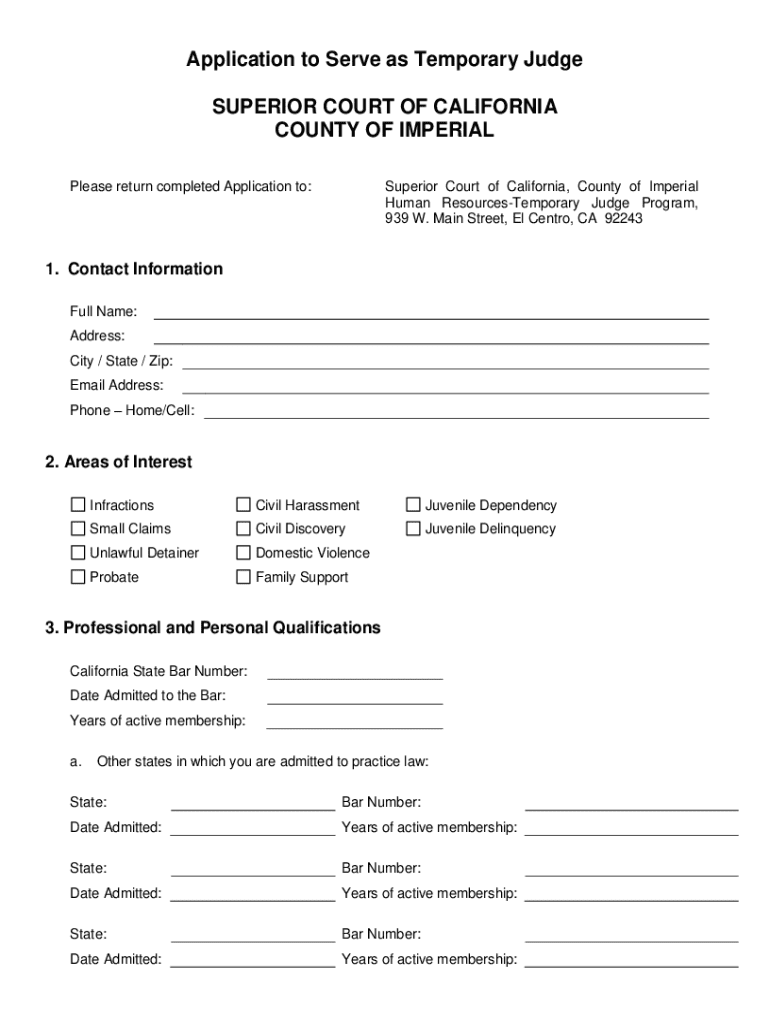
The "Application to Serve as Temporary Judge" is a formal document required by individuals aiming to serve as temporary judges within the Superior Court of California, County of Imperial. This application serves as both an expression of interest and a comprehensive profile of the applicant's legal qualifications and suitability for the role. Temporary judges, often referred to as pro tem judges, fill in for regular judges when additional judicial resources are needed. This application acts as an essential step in ensuring that only qualified and competent legal professionals are entrusted with judicial responsibilities.
Key Responsibilities of a Temporary Judge
Serving as a temporary judge entails several critical responsibilities, such as presiding over cases, making judicial decisions, and ensuring fair and impartial proceedings. Temporary judges manage courtroom procedures, evaluate evidence, and rule on legal matters in the absence of a full-time judge. They are expected to adhere to the same ethical and professional standards as regular judges.
Steps to Complete the Application
Completing the "Application to Serve as Temporary Judge" involves several systematic steps to ensure all essential information is accurately provided.
-
Provide Personal Information: Applicants must supply personal and contact details, including name, address, phone number, and email address. This information is crucial for communication and verification purposes.
-
Detail Professional Qualifications: Applicants need to list their educational background, bar admission details, and any relevant certifications. This section establishes the candidate's legal expertise and ability to perform judicial functions.
-
Disclose Experience and Training: The form requires a detailed account of the applicant's legal experience, including previous cases handled and any training related to judicial responsibilities. Specific examples of courtroom experience can bolster the applicant's profile.
-
Answer Disciplinary and Criminal History Questions: Questions about any past disciplinary actions or criminal history must be answered honestly. A transparent record is vital for assessing the applicant's integrity and suitability for a judicial role.
-
List References: Applicants should provide contact details of professional references who can vouch for their legal acumen and ethical standing. References often include peers, supervisors, or colleagues within the legal community.
Eligibility Criteria
To qualify for serving as a temporary judge, applicants must meet specific eligibility requirements outlined by the Superior Court of California. These criteria ensure that candidates possess the requisite legal knowledge and ethical standards.
-
Active Bar Membership: Applicants must be active members of the State Bar of California, in good standing, without suspensions or pending disciplinary actions.
-
Relevant Experience: Significant legal and courtroom experience is required. Applicants typically have several years of practice in relevant fields of law and courtroom procedure.
-
Ethical and Professional Standing: A clean disciplinary record is essential. The court prioritizes candidates who have consistently demonstrated ethical behavior and professional responsibility.


Legal Use and Ethical Obligations
Temporary judges are entrusted with significant legal authority and must adhere to strict ethical standards outlined by judicial conduct codes. This ensures the integrity and impartiality of the judicial process. Below are key legal and ethical obligations:
-
Impartiality: Temporary judges must conduct hearings and trials impartially, avoiding any conflicts of interest or bias.
-
Confidentiality: They must maintain strict confidentiality regarding case details and any sensitive court information.
-
Continuous Education: Temporary judges are encouraged to engage in ongoing legal education to remain informed about legal developments and judicial best practices.
Important Terms Related to Application
Understanding certain legal terms is pivotal when completing the application and performing duties as a temporary judge.
-
Pro Tem Judge: Short for "Pro Tempore," meaning temporary or for the time being. It refers to judges who serve on a temporary basis.
-
Recusal: The process by which a judge abstains from participating in a legal proceeding due to potential conflicts of interest.
-
Judicial Ethics: A set of guiding principles that govern the conduct and decision-making of judges to promote integrity and trust in the legal system.
How to Obtain the Application
The "Application to Serve as Temporary Judge" can be obtained through several methods, ensuring accessibility for interested candidates.
-
Online Access: The application form is available for download on the official website of the Superior Court of California, County of Imperial. This method allows for easy access and submission.
-
Physical Copies: Applicants may request a physical copy of the form from the court clerk's office if they prefer to fill out a paper version.
-
Email Request: Candidates can also request the application form via email, especially if mailing options suit their circumstances.
Application Process and Approval Time
The process of applying to serve as a temporary judge and the expected timeline for approval involves several steps and considerations.
-
Submission: Completed applications can be submitted either online through the court's official portal or in person at the court clerk's office. All required supporting documents should accompany the application for seamless processing.
-
Review and Evaluation: The court will review applications to ensure all eligibility criteria are met. This includes verifying legal qualifications, experience, and disciplinary records.
-
Approval Notification: Candidates will be notified of the court's decision once the evaluation is complete. Approval timelines vary but generally range from a few weeks to a couple of months, depending on the volume of applications and court schedules.
Key Elements of the Application Form
Understanding and correctly completing key sections of the application is crucial for a successful submission.
-
Personal Statement: This section allows candidates to articulate their interest in serving as a temporary judge and highlight specific skills or experiences relevant to the role.
-
Professional Undertaking: Applicants agree to abide by judicial ethics and standards to uphold the integrity of the role.
-
Consent to Background Check: Candidates must consent to background checks conducted by the court to verify their legal standing and suitability for the role.