




01. Edit your form online
Type text, add images, blackout confidential details, add comments, highlights and more.

Type text, add images, blackout confidential details, add comments, highlights and more.

Draw your signature, type it, upload its image, or use your mobile device as a signature pad.

Send it via email, link, or fax. You can also download it, export it or print it out.
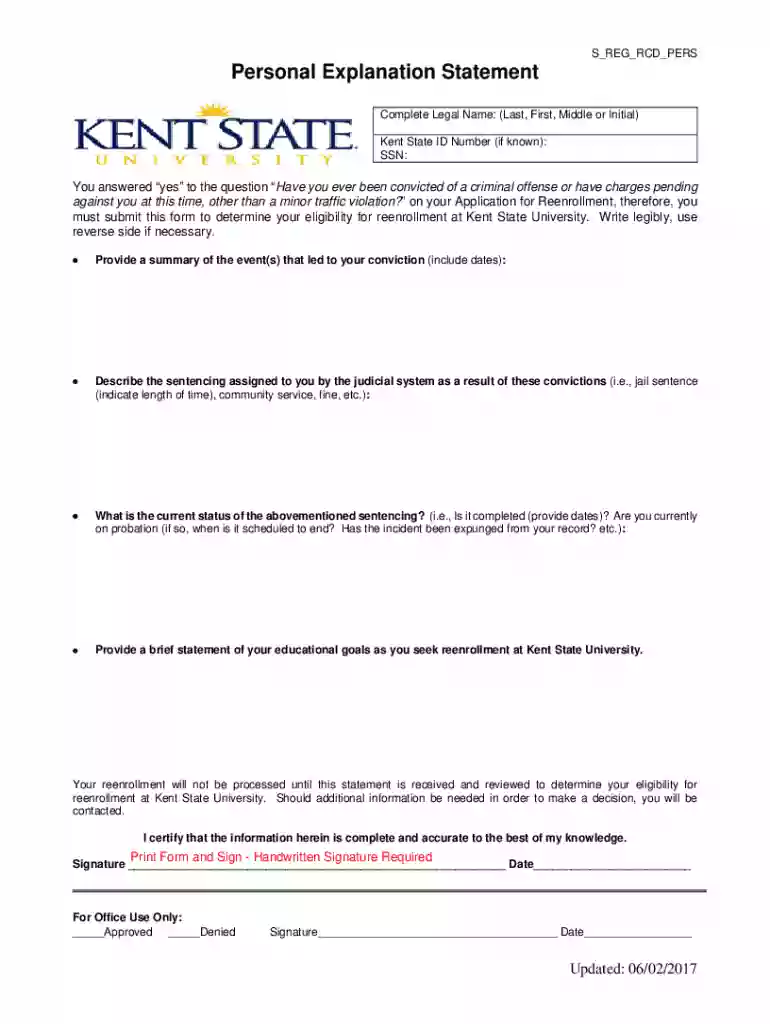
The Personal Explanation Statement is a document typically required by educational institutions, such as Kent State University, for individuals seeking reenrollment. This document is essential for applicants who have indicated a criminal conviction or pending charges on their re-enrollment application. It serves to provide detailed information about the criminal conviction, including particulars of the sentencing, the current status of any sentences, and the individual's educational goals. This statement is crucial for assessing the individual's current circumstances and their motivation to continue their education.
When completing the Personal Explanation Statement, it is essential to provide an honest and comprehensive account of the events leading to the criminal conviction or charges. The form should be used as a platform to explain any extenuating circumstances or personal development since the incident. Individuals should focus on demonstrating accountability and the steps taken towards rehabilitation and personal growth. Furthermore, articulating future educational and career objectives can provide insight into the applicant's commitment to returning to a constructive path.
The Personal Explanation Statement can be submitted in various formats depending on institutional requirements. Typically, the options include online submission through the institution’s portal, via email, or physical mail. It's crucial to confirm the preferred submission method with the institution to ensure timely receipt and processing of the application.
This form is primarily used by individuals with prior criminal convictions or pending charges who seek reenrollment in educational institutions. It is particularly relevant for students who previously attended a university or college and are attempting to return after a period of absence due to legal issues. Beyond the education sector, similar documents might be required by other organizations for background checks or character assessments.


The Personal Explanation Statement not only serves an explanatory purpose but also carries legal implications. Providing false information can result in rejection of the application or future legal consequences. This document should be completed with the same seriousness and accuracy as any other legal document, ensuring that all provided information is truthful and verifiable.
Consider a scenario where a student at Kent State University was previously convicted of a misdemeanor. The student's statement might detail the offense, the lessons learned, and their rehabilitation journey. Such examples highlight the structure and type of information expected. In another instance, an applicant might emphasize personal growth through community service or educational courses undertaken since the conviction, showcasing a proactive approach to personal development.
We've got more versions of the Personal Explanation Statement form. Select the right Personal Explanation Statement version from the list and start editing it straight away!
At DocHub, your data security is our priority. We follow HIPAA, SOC2, GDPR, and other standards, so you can work on your documents with confidence.
PERSONAL EXPLANATION STATEMENT. You answered yes to the question, Have you ever been convicted of a criminal offense or have charges pending against youRead more
by D Jones 2022 Cited by 13 Ten Steps for Writing an Exceptional Personal Statement Background Preparing Writing and Structuring Optimizing Summary References ACTIONS PERMALINK.Read more


