Definition and Purpose of a Molecular Geometry Worksheet
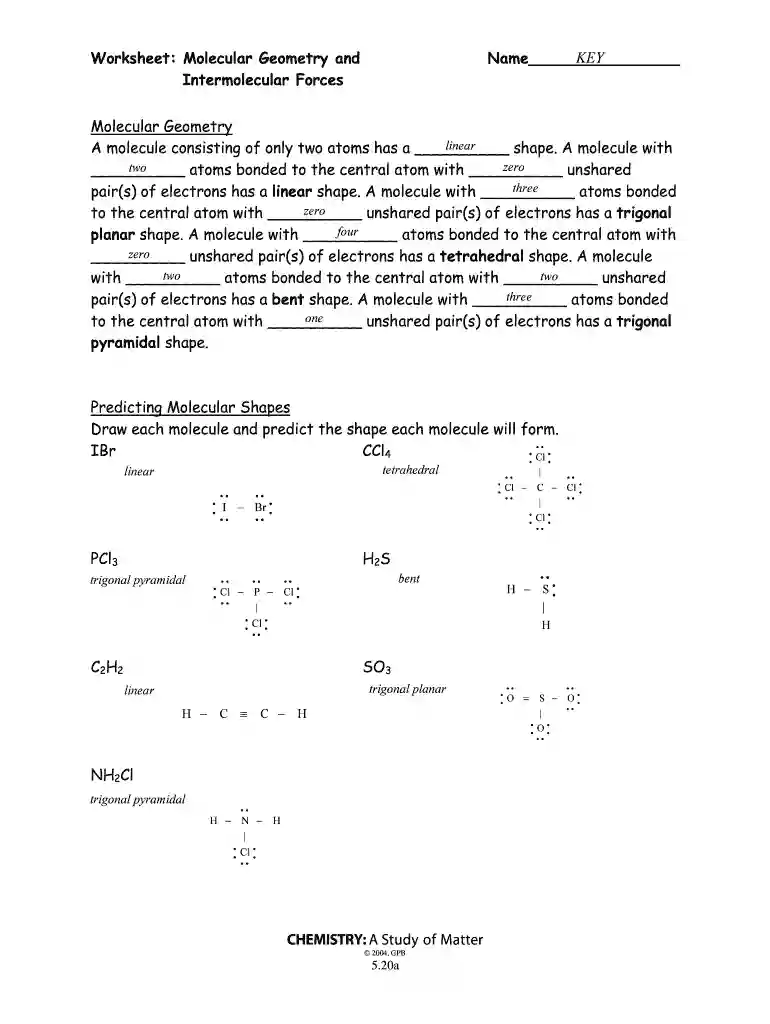
A molecular geometry worksheet serves as an educational resource that aids in understanding the spatial arrangement of atoms within molecules. This worksheet typically includes diagrams that illustrate molecular shapes such as linear, trigonal planar, tetrahedral, bent, and trigonal pyramidal structures. It is valuable for both students and educators in identifying the geometry of molecules based on the number of bonding and nonbonding electron pairs. By analyzing electron-pair geometry and molecular shapes, learners can predict molecular behavior and properties.
Key Concepts Featured in the Worksheet
The worksheet emphasizes the study of molecular geometry principles, including:
- VSEPR Theory: Focused on the Valence Shell Electron Pair Repulsion Theory, which predicts molecular shape by analyzing electron pair arrangements.
- Electron Pair Geometry vs. Molecular Geometry: Differentiates between the broader electron pair geometry and the more specific molecular geometry, considering lone pairs' influence.
- Bond Angles and Molecular Shapes: Highlights typical bond angles associated with different molecular shapes, such as 180° for linear and 109.5° for tetrahedral geometries.
Guidelines for Using the Molecular Geometry Worksheet
Students can maximize their learning by following these steps when utilizing the worksheet:
- Review Basic Chemistry Concepts: Ensure familiarity with fundamental chemistry principles, such as atomic structure and electronegativity.
- Identify Central Atoms: Determine the central atom in each molecule and its surrounding atoms or groups.
- Count Electron Pairs: Calculate the total number of electron pairs (bonding and lone pairs) around the central atom to ascertain the electron pair geometry.
- Use Diagrams and Models: Refer to provided diagrams and build molecular models if possible to visualize three-dimensional structures.
- Practice with Examples: Apply the worksheet's examples and exercises for hands-on practice in predicting molecular shapes and properties.
Obtaining the Molecular Geometry Worksheet
To access a molecular geometry worksheet, consider the following sources:
- Educational Institutions: Often provide these worksheets as part of their chemistry curriculum.
- Online Resources: Numerous websites offer downloadable versions of molecular geometry worksheets for different education levels.
- Textbooks and Chemistry Guides: Typically include worksheets and exercises within relevant chapters.
Steps to Complete the Worksheet
Completing a molecular geometry worksheet involves methodical steps:
- List Molecules: Identify and list the molecules provided in the worksheet.
- Determine Electron Pair Count: Count all bonding and lone electron pairs around central atoms.
- Predict Geometries: Utilize the VSEPR model to predict molecular geometry based on electron pair count.
- Assess Bond Polarity: Calculate electronegativity differences to classify each bond as polar or nonpolar, helping to determine overall molecular polarity.
- Answer Questions: Respond to any theoretical or practical questions accompanying the worksheet activities.
Key Elements of the Molecular Geometry Worksheet
A well-designed molecular geometry worksheet typically includes:
- Molecule Lists: Provides a list of molecular formulas to analyze.
- Electron Pair Calculations: Tasks related to calculating and categorizing electron pairs.
- Shape Diagrams: Visual aids and diagrams displaying various molecular shapes.
- Theoretical Questions: Inquiries that prompt critical thinking about molecular interactions and properties.
Importance of the Worksheet in Chemistry Education
Molecular geometry worksheets are essential educational tools that:
- Enhance Understanding: Deepen understanding of molecular structures and their real-world implications.
- Aid Visualization: Help visualize abstract concepts through diagrams and models.
- Develop Analytical Skills: Foster critical thinking and analytical skills necessary for recognizing patterns and predicting molecular behavior.
Common Applications and Use Cases
Molecular geometry worksheets have various applications, including:
- Academic Assessments: Used for quizzes, exams, and homework assignments in high school and college-level chemistry courses.
- Scientific Research: Beneficial for researchers needing a quick reference for predicting molecular interactions.
- Professional Development: Useful for chemistry educators and professionals seeking to refresh their knowledge of molecular structures.
Examples and Case Studies
- Water (H₂O): A classic example of a bent molecular geometry due to its lone pair-induced bond angle deviation.
- Carbon Dioxide (CO₂): Demonstrates linear molecular geometry with no lone pairs on the central carbon atom.
By exploring each component of the molecular geometry worksheet thoroughly, students and educators can gain a comprehensive understanding of the spatial arrangements and properties of molecules, which is fundamental to the study of chemistry.