




01. Edit your form online
Type text, add images, blackout confidential details, add comments, highlights and more.

Type text, add images, blackout confidential details, add comments, highlights and more.

Draw your signature, type it, upload its image, or use your mobile device as a signature pad.

Send it via email, link, or fax. You can also download it, export it or print it out.
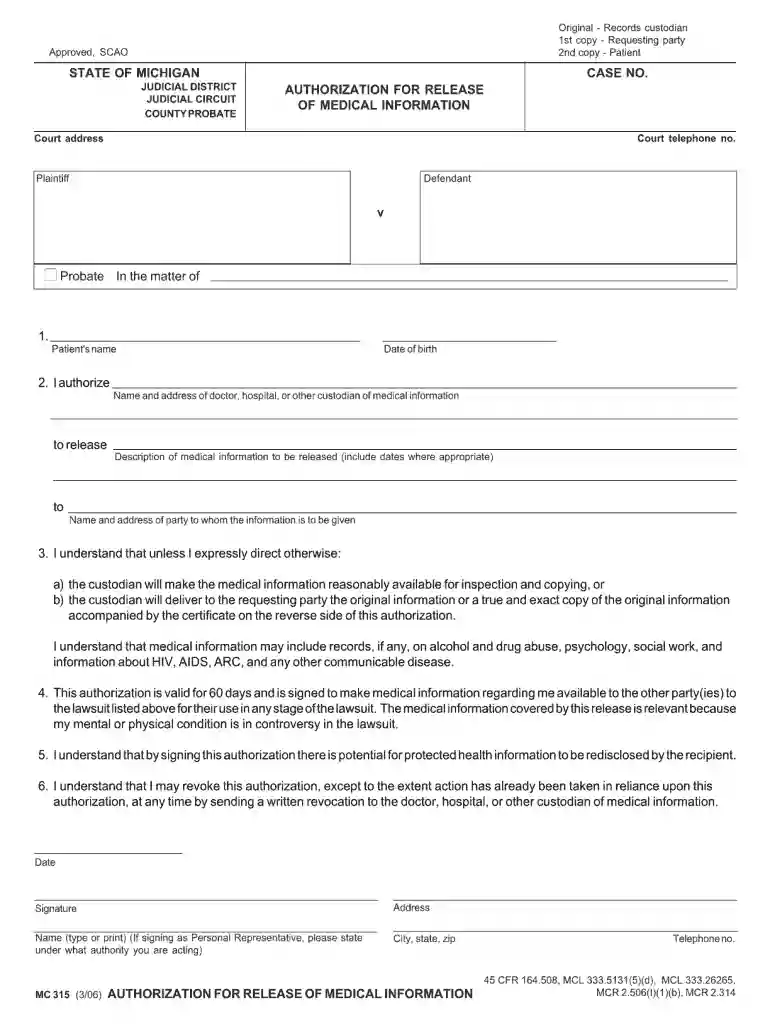
The "MC 315 Authorization 2006 Form" is a legal document used primarily within the judicial and health systems of Michigan. It enables the disclosure of sensitive information, typically medical records, while complying with privacy laws. This form facilitates the transfer of data between entities such as healthcare providers, legal professionals, or insurance companies, under structured authorization. Understanding the intended use and scope of this form is crucial for maintaining compliance and ensuring proper handling of confidential information.
The form is most often employed in scenarios where express permission is required to release personal or health information. This is vital in contexts such as court cases, legal settlements, or employment verifications, where detailed personal data must be shared with third parties. The MC 315 form ensures that all parties involved are legally protected and informed about the data exchange.
Understanding how to use this form can significantly streamline the process of obtaining necessary approvals for information dissemination. Here is a practical guide:
Identify the Purpose: Determine why the authorization is needed, ensuring it aligns with legal standards.
Fill Out the Form: Clearly enter all required information, including the parties involved and the specific details of the data to be disclosed.
Obtain Signatures: The form must be signed by the person authorizing the release to validate the consent.
Submit Correctly: Follow submission guidelines to ensure the form is processed without delays. This may involve mailing it to a specific department or filing it electronically.
A detailed understanding of the completion process ensures accuracy and compliance:
Gather Required Information: Collect all necessary documents and information before starting the form.
Fill with Attention to Detail: Make sure all sections are complete, including recipient details, specific data to be released, and duration of authorization.
Verification: Double-check all entered data to prevent errors.
Signing: Signatures are crucial for the form’s validity. Ensure they match the requirements stated on the form.
Retain Copies: Always keep a copy for personal records in case of future disputes or clarifications.
A thorough understanding of its elements improves form handling:
Understanding the legal framework governing the use of the form ensures compliance:
HIPAA Compliance: The form must adhere to HIPAA guidelines, ensuring the protection of health information.
State Regulations: Michigan-specific laws dictate additional compliance measures, emphasizing data protection and privacy.
Different states may have varying interpretations and uses of similar forms:
A grasp of relevant terminology enhances comprehension:
Failure to comply with the regulations governing the MC 315 Authorization 2006 Form can result in:
Understanding these penalties underscores the importance of accurately completing and processing the form within legal constraints.
We've got more versions of the mc 315 authorization 2006 form form. Select the right mc 315 authorization 2006 form version from the list and start editing it straight away!
At DocHub, your data security is our priority. We follow HIPAA, SOC2, GDPR, and other standards, so you can work on your documents with confidence.
copy of the authorization form and / or number to the requested Provider/Practitioner. Direct Referral. The Direct Referral process allows PCPs to provide
Michigan SCAO Approved Form 315, Authorization for Release of Medical Information,.
(a) Scope. These rules apply to proceedings in Mississippi courts. The specific courts and proceedings to which the rules apply, along with exceptions,


