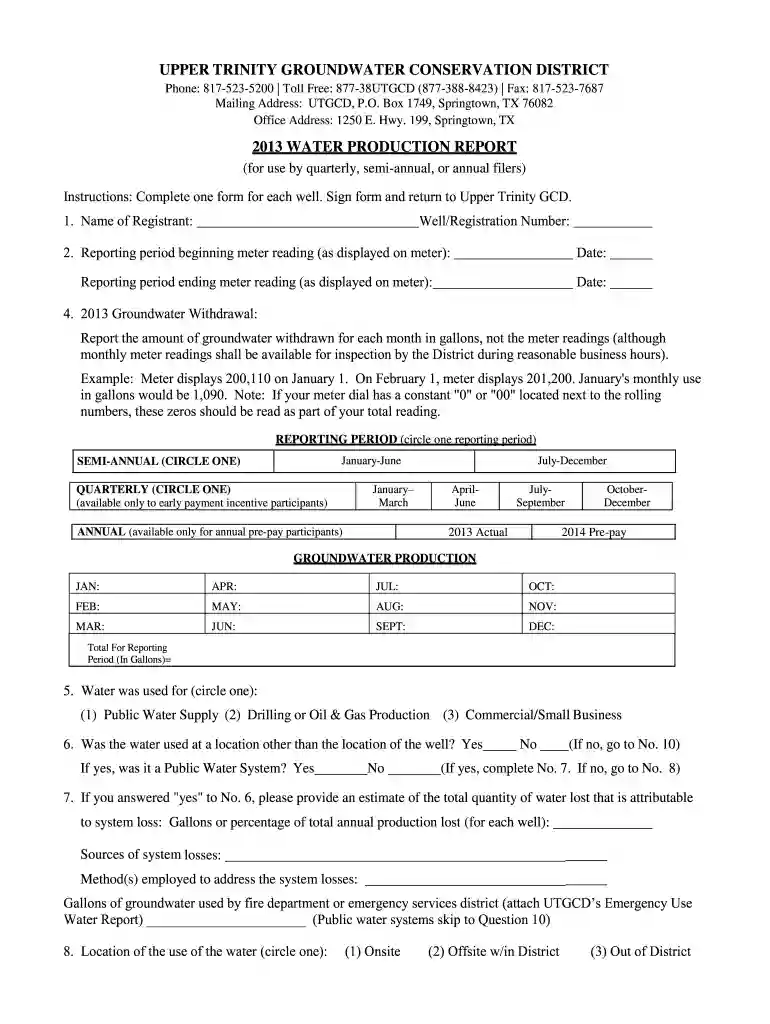
Key Elements of the Upper Trinity Groundwater Conservation District 2014 Water Report
The Upper Trinity Groundwater Conservation District 2014 Water Production Report form requires registrants to provide comprehensive data on groundwater withdrawal activities. Essential components include:
- Well Registration: Each report must specify the registered wells used during the reporting period.
- Meter Readings: Accurate recordings are required to reflect the actual groundwater use.
- Usage Categories: The form outlines distinct categories for reporting the purpose of water use.
- Transportation of Groundwater: Details on the movement of water outside designated counties must be included.
This document helps the district manage and conserve its groundwater resources effectively.
Steps to Complete the Upper Trinity Groundwater Conservation District 2014 Water Report
Completing this report involves several structured steps:
- Gather Necessary Documentation: Collect all data regarding well registration, meter readings, and water usage.
- Accurate Data Entry: Input precise figures for groundwater extraction in the relevant categories.
- Calculate Fees: Determine any applicable fees based on the amount of groundwater used.
- Review and Submit: Double-check all information and submit the completed form through the preferred submission method.
These steps ensure thorough and compliant completion of the water production report.
Required Documents for the Upper Trinity Groundwater Conservation District 2014 Water Report
To adequately complete the report, registrants must provide specific documents:
- Registration Details: Proof of well registration numbers.
- Meter Reading Logs: Documentation of readings during the reporting period.
- Usage Records: Any data supporting the categorization of water use purposes.
- Transportation Documentation: If applicable, records of groundwater transported outside designated areas.
These documents support the accurate filing and verification of groundwater usage data.
Form Submission Methods for the Upper Trinity Groundwater Conservation District 2014 Water Report
The report can be submitted using various methods to suit different preferences:
- Online Submission: Via an electronic form on the district's official website.
- Mail: Physical copies sent through postal services.
- In-Person: Direct submission at designated district offices.
Each method offers flexibility while ensuring that all submissions are properly recorded and processed.
Importance of Using the Upper Trinity Groundwater Conservation District 2014 Water Report
Submitting this report is critical for several reasons:
- Resource Management: Helps the district assess and manage groundwater levels sustainably.
- Compliance: Ensures adherence to local water usage regulations.
- Data Collection: Enables collection of comprehensive data to guide future conservation efforts.
Compliance with this procedure is vital for legal and environmental stewardship.
Who Typically Uses the Upper Trinity Groundwater Conservation District 2014 Water Report?
This report is primarily utilized by:
- Agricultural Producers: Those with substantial groundwater needs.
- Commercial Entities: Businesses relying on significant water extraction.
- Municipalities: Local governments involved in water management.
- Environmental Agencies: Organizations monitoring ecological impacts of water use.
These users provide necessary data for collective water conservation efforts.

State-Specific Rules for the Upper Trinity Groundwater Conservation District 2014 Water Report
This report is governed by several Texas-specific regulations:
- Usage Limits: Caps on groundwater extraction volumes.
- Reporting Deadlines: Specific timelines for report submissions to avoid penalties.
- Fee Structures: Calculated based on the amount of groundwater used.
Understanding these rules ensures adherence to state requirements and minimizes legal liabilities.
Examples of Using the Upper Trinity Groundwater Conservation District 2014 Water Report
Practical applications of the report may include:
- An Agricultural Operation: Reporting seasonal water usage for crops.
- A Commercial Development: Documenting water withdrawal for construction projects.
- A Municipal Water Supply: Tracking annual usage for public consumption.
These scenarios illustrate the report's broad applicability and its role in resource management.
Penalties for Non-Compliance with the Upper Trinity Groundwater Conservation District 2014 Water Report
Failure to submit this report accurately and on time can result in:
- Fines: Monetary penalties imposed on entities failing to report.
- Legal Action: Potential litigation for severe or repeated violations.
- Operational Restrictions: Limits on future groundwater extraction rights.
Ensuring compliance is crucial to avoid these negative consequences.
Digital vs. Paper Version of the Upper Trinity Groundwater Conservation District 2014 Water Report
The report is available in both digital and paper formats, each offering distinct advantages:
- Digital Version: Allows for convenient, secure online submission.
- Paper Version: Offers a tangible record, suitable for physical filing systems.
Both formats are designed to facilitate comprehensive data collection and ease of submission.
Who Issues the Upper Trinity Groundwater Conservation District 2014 Water Report?
This report is issued by:
- Upper Trinity Groundwater Conservation District: Charged with overseeing groundwater use and conservation in the region.
This governmental body monitors compliance and ensures sustainable management of the area's water resources.
Eligibility Criteria for Completing the Upper Trinity Groundwater Conservation District 2014 Water Report
Entities required to submit this report typically include:
- Licensed Water Users: Individuals or businesses with permits for groundwater extraction.
- Registered Well Owners: Those owning wells used for groundwater withdrawal.
Understanding eligibility ensures that all relevant parties contribute to groundwater sustainability efforts.

Connection to Broader Water Conservation Efforts
The Upper Trinity Groundwater Conservation District 2014 Water Report is integral to:
- Broader Conservation Goals: Aims to preserve water resources for future generations.
- Environmental Protection: Minimizes ecological impacts of groundwater extraction.
- Community Engagement: Encourages local participation in sustainable water management.
These efforts collectively contribute to the district's environmental and regulatory objectives.