






Definition & Meaning
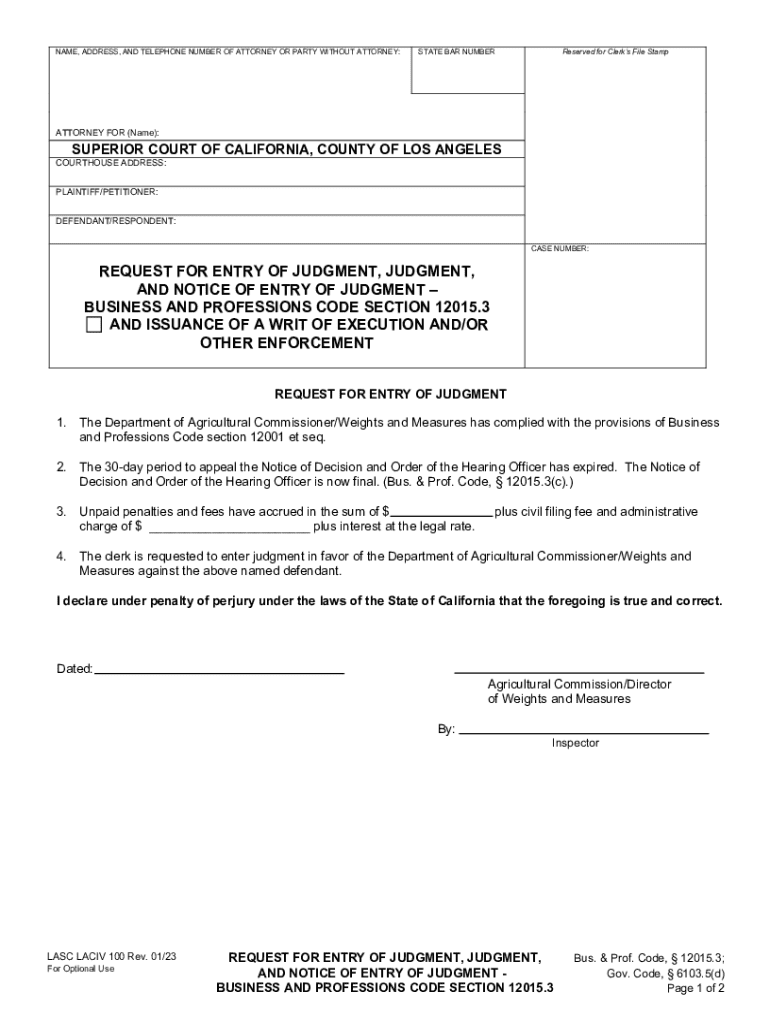
The "Request for Entry of Judgment" is a legal form utilized in the Superior Court of California, specifically within the County of Los Angeles. This document is primarily used by the Department of Agricultural Commissioner/Weights and Measures to request that a judgment be entered against a defendant. The form is typically associated with scenarios where unpaid penalties and fees are due from the defendant, and it includes a detailed outline of the process necessary to enter this judgment. By requesting the entry of judgment, the department seeks to have the court formally recognize the defendant's obligation to pay the owed amounts.
Key Elements of the Request for Entry of Judgment
There are several critical components that make up the "Request for Entry of Judgment" form:
-
Details of the Defendant: Information such as the defendant's name, address, and any identifying numbers.
-
Statement of Unpaid Penalties and Fees: A precise breakdown of the financial amounts that remain unpaid, highlighting the nature of each fee or penalty.
-
Certification of Mailing: Proof that all relevant documents have been sent to the necessary parties, ensuring proper legal notification.
-
Expired Appeal Period Confirmation: A section dedicated to confirming that the time allowed for the defendant to appeal has passed, making the entry of judgment actionable.
These elements ensure that the form is complete and valid, providing the court with the comprehensive information needed to enter a judgment.
Steps to Complete the Request for Entry of Judgment
Completing the "Request for Entry of Judgment" involves several steps:
-
Gather Necessary Information: Collect all relevant details about the defendant and the unpaid amounts.
-
Complete the Form Accurately: Fill in each section of the form with precision, ensuring that all legal and financial information is correct.
-
Mail the Certification: Send the required documents to all specified parties, documenting the mailing process for certification purposes.
-
Submit the Form to the Court: Once filled out, submit the form to the Superior Court of California, County of Los Angeles, for processing.
This step-by-step approach ensures that the form is properly filled out and submitted, reducing the risk of delays or errors.
Legal Use of the Request for Entry of Judgment
The "Request for Entry of Judgment" serves a key legal function within the judicial process. It allows government departments, like the Department of Agricultural Commissioner/Weights and Measures, to enforce financial obligations legally. By processing this form, the court can officially recognize the debt, giving legal standing to pursue collection through various enforcement mechanisms. This process ensures a fair and judicially recognized method of securing owed payments.
State-Specific Rules for the Request for Entry of Judgment
While the "Request for Entry of Judgment" form is primarily used in California, specifically the County of Los Angeles, certain procedural nuances may vary from county to county. However, common requirements typically include:
-
Compliance with County Procedures: Each county may have specific guidelines regarding how the form is completed and submitted.
-
Timelines and Deadlines: Variations in deadlines for filing or submitting additional documentation can differ across locations.
Understanding these nuances is crucial for ensuring full compliance and successful processing of the form.
Who Typically Uses the Request for Entry of Judgment
The "Request for Entry of Judgment" is commonly used by government departments, particularly those seeking to enforce financial regulations. However, various entities might find themselves utilizing this form:
-
Departments like the Agricultural Commissioner/Weights and Measures: Typically engage in collecting fees for regulatory compliance.
-
Legal Departments within Businesses: Businesses that have been awarded a monetary judgment by a court may use similar forms to apply for entry of judgment.
This wide applicability highlights the form's utility in enforcing financial obligations across multiple contexts.


Penalties for Non-Compliance
Failing to comply with the requirements of the "Request for Entry of Judgment" form can lead to several potential consequences:
-
Delay in Judgment Entry: Missing or incorrect information can delay the court's ability to enter the judgment.
-
Increased Legal Costs: Reactive measures to fix errors or omissions could result in higher legal costs and time expenditure.
-
Potential Legal Sanctions: Non-adherence to legal requirements if discovered can attract legal sanctions, affecting the applicant's legal standing.
Understanding and adhering to compliance standards is critical in avoiding these penalties.
Examples of Using the Request for Entry of Judgment
Practical scenarios illustrate the use of the "Request for Entry of Judgment":
-
Agricultural Regulations: A business with unpaid penalties relating to agricultural regulations uses the form to seek an official court judgment to enforce payment.
-
Consumer Weights and Measures: A company failing to meet weights and measures standards might be liable for penalties, prompting the use of this form by the relevant department to secure their dues.
These examples provide context for understanding how the form applies to real-world situations and the range of uses across different scenarios and regulatory environments.