




01. Edit your form online
Type text, add images, blackout confidential details, add comments, highlights and more.

Type text, add images, blackout confidential details, add comments, highlights and more.

Draw your signature, type it, upload its image, or use your mobile device as a signature pad.

Send it via email, link, or fax. You can also download it, export it or print it out.
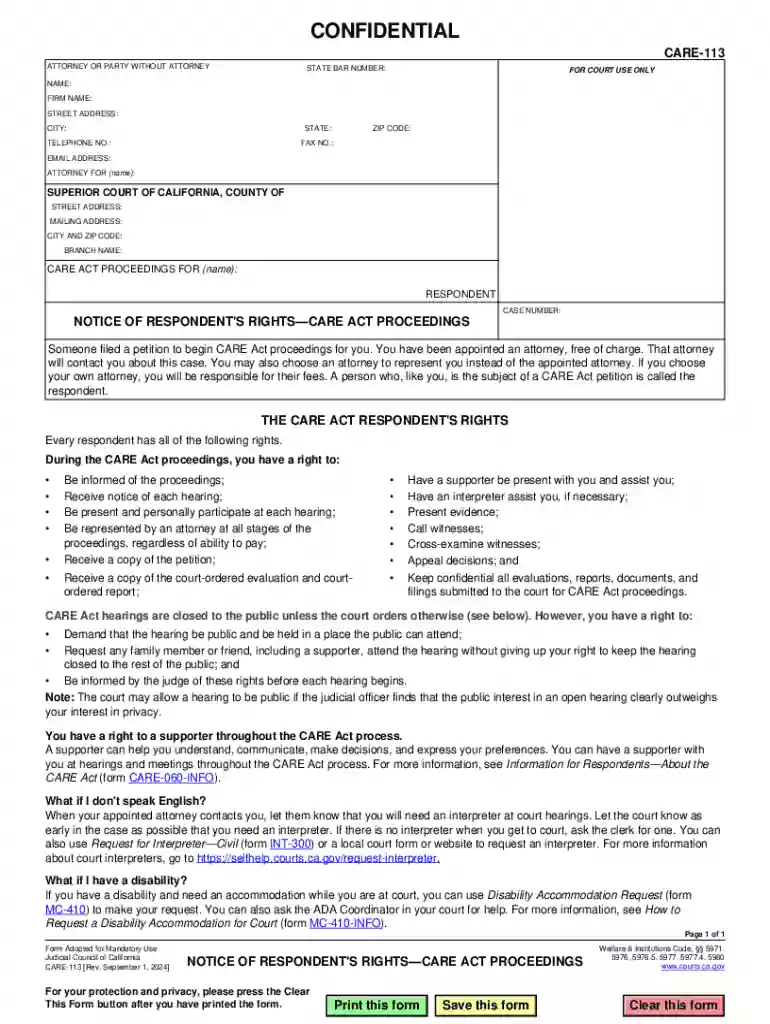
The Care-113 form serves as a crucial document in legal proceedings related to the CARE Act within the state of California. This form plays a significant role in ensuring that individuals involved in these proceedings are informed of their rights. It acts as an official notice, detailing the respondent's rights, such as having an appointed attorney, the ability to present evidence, access to a supporter, and, if necessary, the option to request an interpreter. The emphasis on confidentiality is a critical aspect of this form, safeguarding sensitive information while outlining conditions under which hearings may be made public. The Care-113 is specifically tailored to address legal requirements and procedural nuances in California's legislative context, ensuring compliance with regional legal standards.
Understand the purpose: Recognize that the Care-113 outlines your rights as a respondent in CARE Act proceedings in California.
Collect necessary information: Ensure you have all relevant personal details and any documentation related to the case at hand.
Review your rights and obligations: Carefully read through the form to understand your legal rights, including the right to an attorney at no cost.
Seek legal counsel: Utilize the option to have an appointed attorney to discuss any questions or concerns about the proceedings.
Request additional support if needed: If necessary, request a supporter or interpreter to aid in your understanding of the proceedings.
Complete all sections accurately: Fill out the form with precise information as required.
Submit the form through the appropriate channels: Depending on the instructions, submit the form either via mail or in-person through designated legal channels.
This step-by-step approach ensures comprehensive and accurate form completion, minimizing potential delays in the legal process.
Each element is critical to safeguarding respondents' rights and promoting fair legal proceedings while maintaining integrity and confidentiality.
The Care-113 is legally utilized within California's jurisdiction to inform respondents of their rights during CARE Act-related proceedings. It acts as an official notification mechanism, ensuring adherence to state-mandated procedures. The legal use includes:
Legal professionals and court officials must adhere to the procedural guidelines outlined in the Care-113, ensuring it is effectively integrated into the legal framework.
Completing the Care-113 necessitates having several key documents, including:
Having these documents on hand ensures seamless completion of the form, streamlining the legal proceedings for all parties involved.
The Care-113 is issued by the California state legal system, typically disseminated through county courts handling CARE Act cases. It is the responsibility of the legal entities involved to provide this form to respondents to inform them of their rights in the legal proceedings. Ensuring the form's issuance follows standardized protocols is crucial for maintaining legal compliance and guaranteeing uniformity across cases.
Failure to comply with the requirements or ignore the instructions outlined in the Care-113 can result in adverse legal outcomes, including:
Respondents must understand the seriousness of compliance to avoid unnecessary legal complications and ensure their rights are protected throughout the legal process.
Eligibility to receive the Care-113 form is tied to involvement in CARE Act proceedings in California. Individuals eligible for this form include:
Understanding eligibility ensures that only appropriate parties receive the information necessary for legal conformity under the CARE Act.


We've got more versions of the Care-113 form. Select the right Care-113 version from the list and start editing it straight away!
| Versions | Form popularity | Fillable & printable |
|---|---|---|
| 2024 | 4.2 Satisfied (28 Votes) |
At DocHub, your data security is our priority. We follow HIPAA, SOC2, GDPR, and other standards, so you can work on your documents with confidence.



gg-113 - Continuity of care. Ensuring continuity of care with respect to terminations of certain contractual relationships resulting in changes in provider
Notice of Respondents RightsCARE Act Proceedings (CARE-113) Tells respondents what their rights are in the CARE Act process. Get form CARE-113.Read more


