






Definition and Meaning
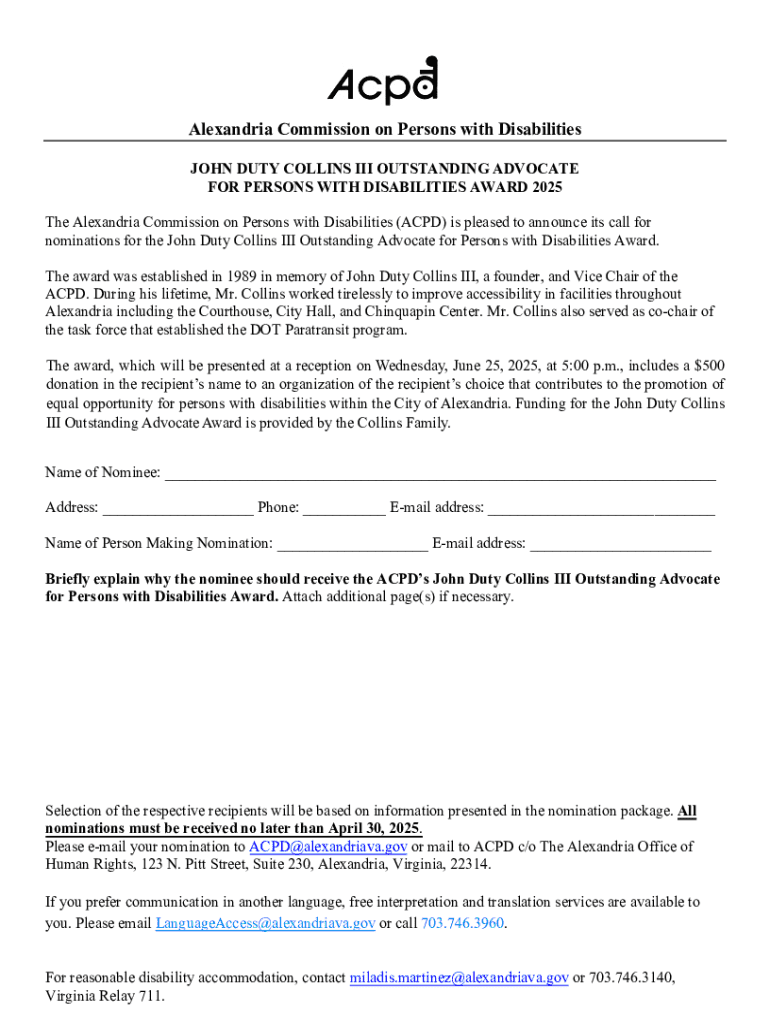
The John Duty Collins III Outstanding Advocate for Persons With Disabilities Award 2025 is a prestigious accolade established to honor individuals or organizations that have made significant contributions to enhancing accessibility and promoting the rights of persons with disabilities. Designed to recognize advocacy efforts, it serves as a tribute to John Duty Collins III's impact in fostering equal opportunities for those with disabilities in Alexandria.
Eligibility Criteria
To qualify for the John Duty Collins III Outstanding Advocate for Persons With Disabilities Award 2025, nominees must demonstrate a commitment to advancing the rights and welfare of individuals with disabilities. This includes developing innovative programs, leading advocacy campaigns, or significantly contributing to community accessibility initiatives. Nominees can be from various sectors such as education, business, or non-profit organizations, and must have active involvement in promoting disability rights.


Application Process and Approval Time
The application process for the John Duty Collins III Outstanding Advocate for Persons With Disabilities Award 2025 involves submitting detailed nomination forms. These forms require comprehensive information about the nominee’s achievements and contributions to disability advocacy. Applications are submitted via email or mail, with a deadline of April 30, 2025. Once all applications are received, a panel reviews them to select the awardee. The approval time may vary, but typically decisions are announced a few months after the submission deadline.
Key Elements of the Award
Critical components of the award include a $500 donation made to a charity of the recipient's choosing that supports disability rights. This provision allows the award to have a wider impact by bolstering initiatives that align with the values upheld by John Duty Collins III. Additionally, the award itself serves as a platform to raise awareness about the importance of accessible environments and inclusive practices.
Steps to Complete the Nomination Form
- Download the Nomination Form: Obtain the form from the Alexandria Commission on Persons with Disabilities’ official site.
- Gather Necessary Information: Collect details about the nominee's achievements in advocating for the rights of persons with disabilities.
- Complete the Form with Accuracy: Fill in all required fields, ensuring that each section is detailed and highlights the nominee's contributions.
- Submit the Form: Send the completed form via the prescribed method—either email or mail—before the deadline on April 30, 2025.
Important Dates and Deadlines
The primary date to remember for the John Duty Collins III Award is April 30, 2025, which marks the deadline for submitting nominations. It is crucial to adhere to this deadline to ensure the nomination is considered. Award announcements typically occur a few months later, offering ample time for the selection committee to assess all applications.
Who Should Consider Applying?
Individuals or organizations deeply involved in disability advocacy should consider applying or nominating others for the award. This encompasses educators who develop inclusive learning environments, businesses with accessible workplace initiatives, and community leaders who have influenced policy changes that benefit persons with disabilities.
Examples of Advocacy Efforts Recognized
The award has previously acknowledged a wide range of advocacy efforts. Examples include launching city-wide accessibility projects, initiating educational programs emphasizing disability rights, and leading campaigns that significantly alter public spaces to be more inclusive. These examples highlight the diverse avenues through which advocates can make impactful contributions.
Who Typically Uses the Award
Typically, the award is utilized by disability rights organizations, educational institutions, and community groups that advocate for improved accessibility and inclusivity. These entities often leverage the recognition to further their initiatives, raise awareness, and influence policy changes. The award thus serves as both a recognition and a tool for continuing advocacy efforts.