




01. Edit your txr150000 online
Type text, add images, blackout confidential details, add comments, highlights and more.

Type text, add images, blackout confidential details, add comments, highlights and more.

Draw your signature, type it, upload its image, or use your mobile device as a signature pad.

Send tpdes general permit txr150000 form via email, link, or fax. You can also download it, export it or print it out.
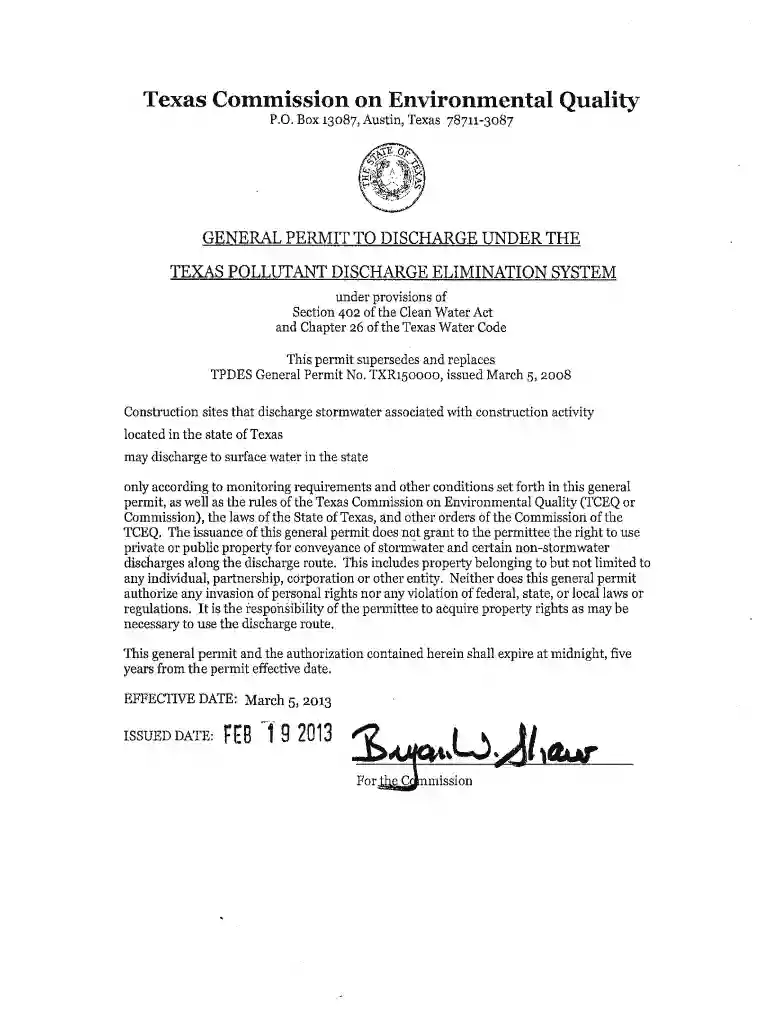
The TPDES General Permit TXR150000 is a regulatory permit that governs stormwater discharges related to construction activities across Texas. It outlines comprehensive guidelines to manage stormwater run-off effectively to minimize environmental pollution during construction projects. This permit is crucial for operators and construction businesses to comply with water quality standards to ensure sustainable practices on job sites.
The permit specifies several critical components, such as the creation of Stormwater Pollution Prevention Plans (SWP3). These plans detail the measures to prevent stormwater contamination, including erosion and sediment control. They also involve routine inspections and maintenance protocols to ensure ongoing compliance. Construction operators need to abide by these detailed requirements to avoid non-compliance penalties.
Understanding the implementation of TXR150000 is essential for construction operators in Texas. The process involves assessing the construction site to identify potential sources of stormwater pollution. Operators must then develop a SWP3 that outlines specific measures to be taken to mitigate these risks. Once the plan is in place, it must be implemented, monitored, and revised as necessary to ensure environmental compliance.
Determine Applicability: Confirm if your construction project requires a TPDES permit based on the size and scope of your project.
Prepare SWP3: Draft a Stormwater Pollution Prevention Plan detailing site-specific control measures.
Documentation: Accumulate required documentation, such as site maps, control measures, and erosion and sediment control practices.
Submit NOI: File a Notice of Intent (NOI) to obtain coverage under the permit.
Implement & Monitor: Execute the SWP3 and regularly monitor the site to ensure compliance.
Maintain Records: Keep all compliance documents and monitoring records accessible for review.
Utilizing the TXR150000 ensures compliance with state and federal environmental regulations, which is critical to minimize the legal risks associated with construction activities. Legal adherence safeguards the company’s reputation and helps avoid costly penalties or fines. Moreover, implementing the permit's guidelines fosters sustainable construction practices, benefiting the broader environment.
The TXR150000 is specific to Texas and mandates adherence to the state’s water quality standards. It requires operators to implement control measures that are specifically tailored to local climatic and geological conditions. Operators must stay informed about any amendments to the Texas Administrative Code (TAC) that pertain to stormwater management.
Consider a construction company undertaking a substantial residential development in Texas. The company engages an environmental consultant to help draft a SWP3. They then secure permit coverage by filing an NOI and implement an array of BMPs, such as sedimentation basins and silt fencing, to control stormwater run-off effectively, thereby ensuring compliance with TXR150000.
Compliance with the TXR150000 is legally binding for construction activities disturbing over one acre of land in Texas. Non-compliance can attract severe penalties, including significant fines and legal action. Adhering to the permit ensures the construction business is legally protected and can operate without interruptions caused by regulatory breaches.
We've got more versions of the txr150000 form. Select the right txr150000 version from the list and start editing it straight away!
At DocHub, your data security is our priority. We follow HIPAA, SOC2, GDPR, and other standards, so you can work on your documents with confidence.
TXR150000 RELATING TO STORMWATER DISCHARGES ASSOCIATED WITH CONSTRUCTION ACTIVITIES must submit an NOI to renew authorization
Jul 13, 2026 The TCEQ has begun the process for the renewal of the TPDES Stormwater Construction General Permit, TXR150000, which expires on March 5, 2028.Read more


