




01. Edit your form online
Type text, add images, blackout confidential details, add comments, highlights and more.

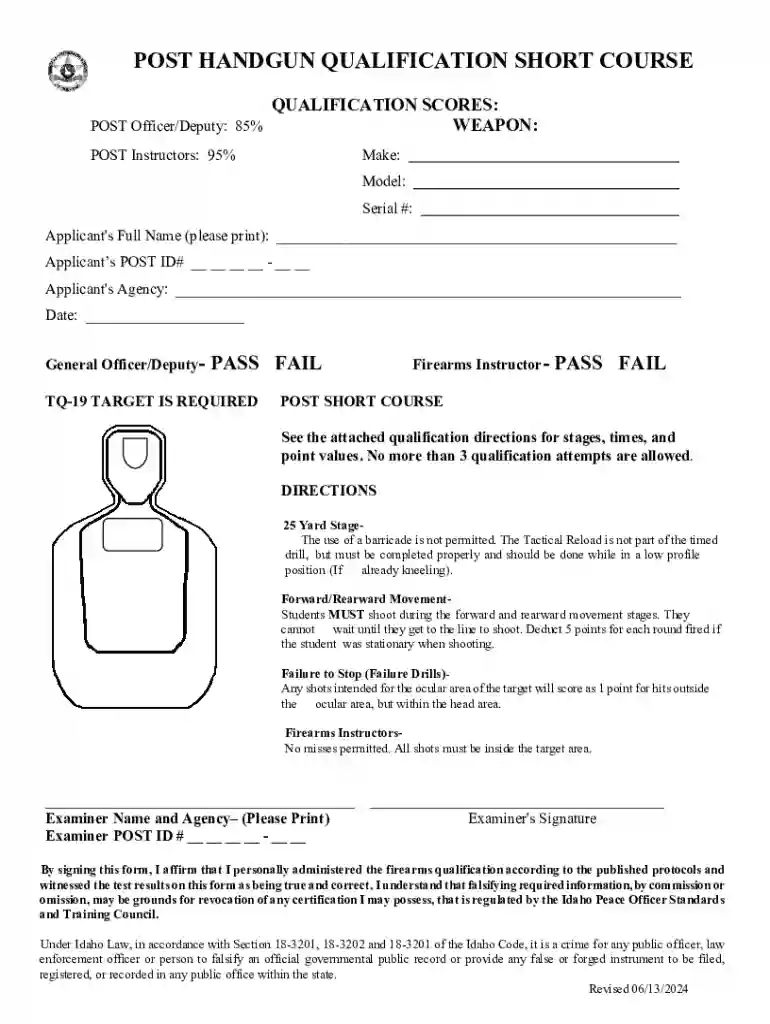
Type text, add images, blackout confidential details, add comments, highlights and more.

Draw your signature, type it, upload its image, or use your mobile device as a signature pad.

Send it via email, link, or fax. You can also download it, export it or print it out.
The Maryland Police and Correctional Training Commissions (MPCTC) are regulatory bodies responsible for establishing standards and providing oversight for law enforcement and correctional training within Maryland. These commissions ensure that officers meet specific educational and training requirements, maintaining professionalism and effectiveness in the field. The commissions also develop curricula and administer certification programs critical for compliance with state regulations.
Eligibility to participate in programs governed by the MPCTC often requires individuals to meet specific criteria, including age, education, and background checks. Prospective candidates must typically be residents of Maryland, have a high school diploma or equivalent, and pass comprehensive background investigations to confirm suitability for public service roles. These standards are in place to ensure that only qualified candidates enter the training pipeline, thereby maintaining integrity and trust in public safety services.
Application Submission: Prospective applicants must submit an application to the MPCTC, which includes personal information, educational background, and professional references.
Initial Screening: An initial review is conducted to verify eligibility, encompassing education verification and background checks.
Entrance Examination: Applicants may be required to take an entrance exam to assess their knowledge and aptitude related to law enforcement or correctional duties.
Training Enrollment: On successful clearance of the entrance examination and other prerequisites, candidates enroll in a training academy, which includes physical fitness programs, legal education, and hands-on skills training.
Completion and Certification: Upon successful completion of the training program, candidates receive certification, qualifying them for employment in police or correctional facilities.
The programs developed by the MPCTC are crucial for preparing law enforcement and correctional officers to effectively perform their duties. These programs are designed to enhance public safety by providing comprehensive education that addresses the evolving challenges faced by officers. Graduates of the MPCTC programs are typically well-equipped to handle diverse scenarios, from community policing to crisis intervention, thus improving overall community relations and trust.
Maryland has specific standards that all law enforcement and correctional officers must meet, as defined by the MPCTC. These standards include both physical and educational requirements, with each officer needing to complete periodic recertification to maintain their credentials. Additionally, the programs are tailored to address Maryland's particular legal framework and societal needs, ensuring that officers are proficient in state-specific laws and regulations.
Failure to comply with MPCTC regulations can result in significant penalties, including revocation of certification, fines, or disciplinary actions. Non-compliance might involve failure to complete required training hours, violating conduct codes, or falsifying records. Enforcement of these penalties is vital to uphold the quality and reliability of law enforcement practices across the state.
The MPCTC offers both digital and paper formats for documentation related to training and certification. Digital formats allow for easier access and storage, reducing the burden of maintaining physical records. These digital documents can be integrated with various software programs, enabling seamless updates and tracking of certifications. However, paper documentation is still available for those who prefer traditional methods or require hard copies for specific purposes.
Officers trained under the MPCTC programs have demonstrated success in various real-world scenarios, such as community engagement initiatives, crisis negotiation, and crime scene management. For example, graduates have effectively utilized conflict resolution skills acquired during training to defuse potentially volatile situations, minimizing risks to public safety and enhancing community trust.
We've got more versions of the maryland police and correctional training commissions form. Select the right maryland police and correctional training commissions version from the list and start editing it straight away!
At DocHub, your data security is our priority. We follow HIPAA, SOC2, GDPR, and other standards, so you can work on your documents with confidence.


Maryland Police and Correctional Training Commission. An official website of the State of Maryland. Main 410-552-6300 Website
This certified program, authorized by the Maryland Police and Correctional Training Commissions (MPCTC), has enabled us to train and DocHub new officers


