Cms-20072 2026

Get Form
Cms-20072 Preview on Page 1

Here's how it works

01. Edit your form online
Type text, add images, blackout confidential details, add comments, highlights and more.

02. Sign it in a few clicks
Draw your signature, type it, upload its image, or use your mobile device as a signature pad.

03. Share your form with others
Send it via email, link, or fax. You can also download it, export it or print it out.

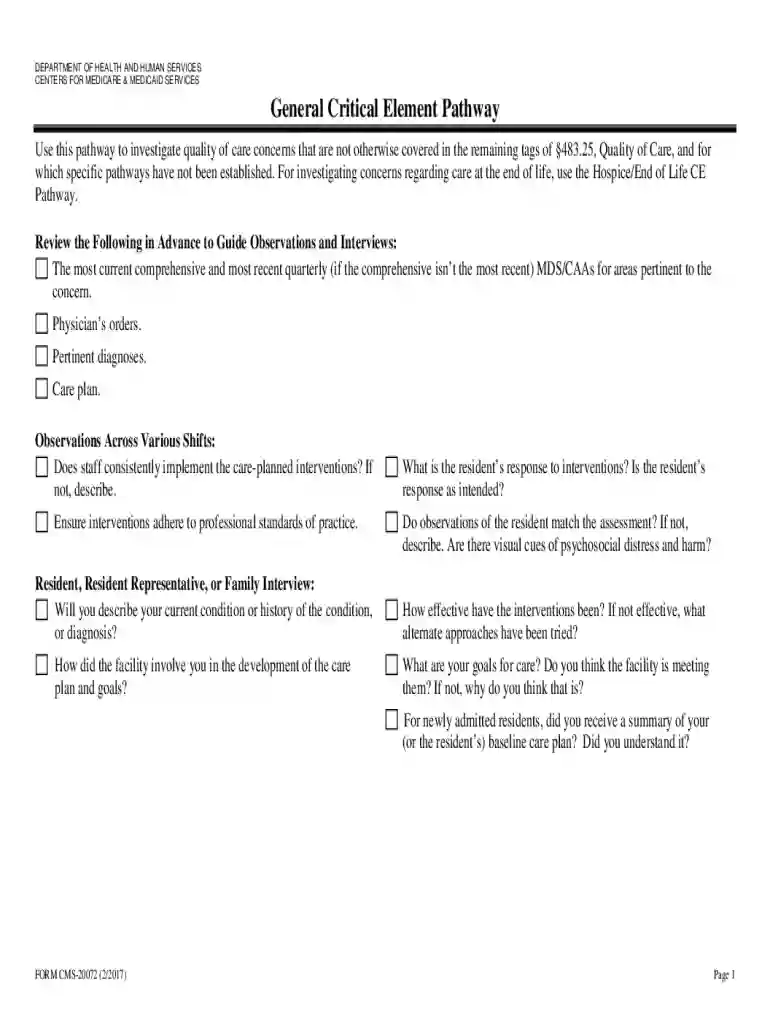
Definition and Purpose of CMS-20072

CMS-20072, also known as the General Critical Element Pathway, is a tool used within healthcare facilities under the Centers for Medicare & Medicaid Services (CMS). Its primary purpose is to guide the investigation of quality of care concerns. It ensures that professional standards are upheld while evaluating the care provided to residents.

Key Functions

  • Assessment and Compliance: The form provides steps to review resident care plans, ensuring they are compliant with established professional standards.
  • Staff Interviews: An integral part of the pathway involves conducting staff interviews to gather insights into the care processes and adherence to protocols, which help in identifying any deviations from expected standards.
  • Resident Involvement: CMS-20072 emphasizes the participation of residents in their care plans, fostering a patient-centered approach.

Steps to Complete CMS-20072

Completing the CMS-20072 involves a systematic process that ensures thorough evaluation and documentation.

  1. Initial Review: Begin by gathering existing care plans, medical records, and any prior assessments related to the resident.
  2. Interview Process: Conduct interviews with healthcare staff to understand the implementation and monitoring of care plans.
  3. Documentation: Accurately document your findings, ensuring all relevant aspects of care are captured.
  4. Evaluation and Recommendations: Assess the quality of care provided and recommend necessary interventions or changes to existing care practices.

Considerations During Completion

  • Accuracy and Detail: Ensure all observations and interviews are recorded with precision.
  • Compliance: Stay informed about the latest CMS guidelines to maintain compliance throughout the evaluation.

Who Typically Uses the CMS-20072

The CMS-20072 form is widely used by healthcare professionals responsible for quality assurance and compliance within facilities under CMS oversight.


decoration image ratings of Dochub

Common Users

  • Quality Assurance Teams: Utilize the form to systematically evaluate care standards and identify areas for improvement.
  • Healthcare Administrators: Use it to ensure their facilities meet CMS requirements and provide high-quality care.
  • Regulatory Inspectors: Assist inspectors in assessing compliance with federal regulations.
decoration image

Legal Use of the CMS-20072

The CMS-20072 is governed by legal standards that ensure the form is used to uphold quality care in accordance with federal mandates.

Compliance and Regulations

  • Federal Standards: This form is a federally mandated tool, designed to maintain a consistent quality of care across facilities.
  • Accountability: By documenting assessments and findings, facilities demonstrate accountability and a commitment to continual improvement.

Key Elements of CMS-20072

The form comprises several critical elements designed to provide a comprehensive overview of care quality.

  • Care Plan Review: Verifies that resident care plans are detailed and meet individual needs.
  • Monitoring Interventions: Ensures that the facility is actively monitoring interventions and making necessary adjustments.
  • Residents' Rights: Upholds the rights of residents to be involved in their own care decisions.

Steps to Obtain the CMS-20072

Obtaining the CMS-20072 requires accessing the appropriate channels within the healthcare regulatory framework.

Acquisition Process

  1. Contact CMS: Reach out to CMS directly or visit their official website to access the form.
  2. Facility Administration: Typically coordinated through a facility's administrative department to ensure proper use and distribution.

Important Terms Related to CMS-20072

Understanding the terminology used in CMS-20072 is essential for its correct application and interpretation.

Key Terms

  • Critical Element Pathway: A methodical approach to evaluating and documenting care processes.
  • Compliance: Adhering to established standards and regulations set by CMS.
  • Intervention Monitoring: The process of tracking and assessing the effectiveness of care interventions.

Penalties for Non-Compliance

Non-compliance with the CMS-20072 can result in significant repercussions for healthcare facilities.

Possible Consequences

  • Fines and Sanctions: Facilities failing to maintain compliance may face penalties, including fines.
  • Reputation Damage: Non-compliance can impact a facility's reputation, affecting patient trust and potential funding.
  • Operational Constraints: Facilities may face operational restrictions or increased scrutiny from regulatory bodies.

Software Compatibility and Integration

CMS-20072 requires compatibility with various software tools to streamline workflow and data management.

Common Software

  • Healthcare Management Systems: Forms such as CMS-20072 are often integrated with healthcare management software for efficient data handling.
  • Document Management Tools: These tools facilitate the secure storage and easy access to completed forms and related documents.

By leveraging the structured approach outlined by CMS-20072, healthcare facilities can ensure consistent and high-quality care, meeting both legal mandates and patient expectations efficiently.

be ready to get more

Complete this form in 5 minutes or less

Get form

Got questions?

We have answers to the most popular questions from our customers. If you can't find an answer to your question, please contact us.
Contact us
The Hospital-wide, 30-Day, All-cause Unplanned Readmission (HWR) Measure for the Meritbased Incentive Payment System (MIPS) Groups is a risk-standardized readmission rate for Medicare Fee-for-Service (FFS) beneficiaries aged 65 or older who were hospitalized and experienced an unplanned readmission for any cause to a
Risk adjustment is the process that the Centers for Medicare and Medicaid Services (CMS) uses to determine the appropriate premiums that health exchanges are permitted to charge, or which determine the appropriate reimbursement that CMS will give to Medicare Advantage programs.
Dividing the number of readmissions by the number of index admissions and multiplying by 100 gives the readmission rate as a percentage. This rate is called an observed readmission rate because it is derived directly from what was observed during the study period.
This measure assesses the number of acute inpatient and observation stays during the measurement year that were followed by an unplanned acute readmission for any diagnosis within 30 days for members 18 years of age and older in the following categories: Count of Index Hospital Stays (denominator).

Security and compliance

At DocHub, your data security is our priority. We follow HIPAA, SOC2, GDPR, and other standards, so you can work on your documents with confidence.
Learn more
ccpa2
pci-dss
gdpr-compliance
hipaa
soc-compliance
be ready to get more

Complete this form in 5 minutes or less

Get form