01. Edit your form online
Type text, add images, blackout confidential details, add comments, highlights and more.

Type text, add images, blackout confidential details, add comments, highlights and more.

Draw your signature, type it, upload its image, or use your mobile device as a signature pad.

Send it via email, link, or fax. You can also download it, export it or print it out.
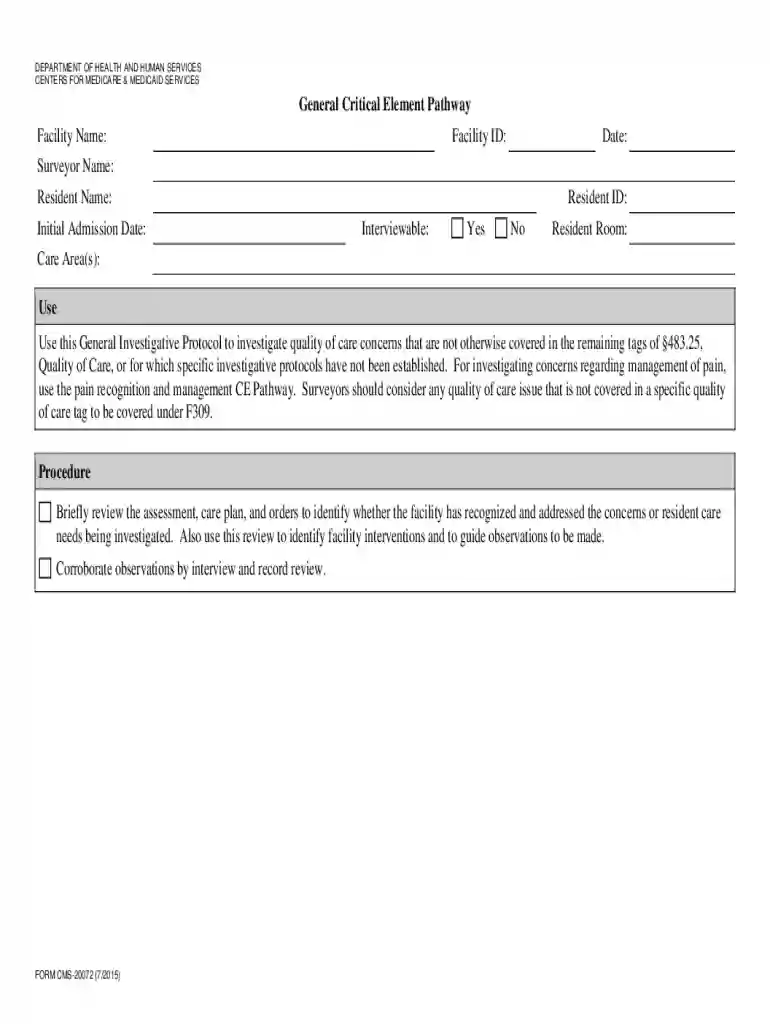
The General Critical Element Pathway is a structured protocol used by surveyors from the Centers for Medicare & Medicaid Services (CMS) to investigate quality of care concerns in healthcare facilities. This pathway provides an organized framework for assessing the care provided to residents, ensuring compliance with established standards. The protocol includes reviewing assessments, care plans, and conducting staff interviews to confirm that residents' needs are consistently met according to professional criteria. By utilizing a systematic approach, the General Critical Element Pathway plays a crucial role in maintaining high-quality healthcare across various facilities.
The General Critical Element Pathway consists of several critical components designed to thoroughly assess resident care. These elements include:
The General Critical Element Pathway is predominantly used by health surveyors from CMS when evaluating healthcare facilities. These professionals are responsible for ensuring that facilities meet regulatory requirements aimed at protecting resident health and well-being. Additionally, facility administrators and staff members may engage with this protocol to prepare for inspections or to conduct internal evaluations to maintain adherence to care standards.


Upon identifying a facility where residents have reported inadequate care, surveyors might deploy the General Critical Element Pathway to perform a thorough investigation. For instance, a situation in which a resident’s care plan hasn’t been updated to reflect their current health conditions would be documented and addressed. By following the pathway, surveyors can ensure necessary changes are implemented swiftly.
Under the legal framework established by CMS, the General Critical Element Pathway serves as a guiding tool for ensuring healthcare facilities comply with federal regulations. This assessment method helps safeguard residents' rights by powering regulatory enforcement that holds facilities accountable for the care provided. Facilities that fail to comply with pathway findings may face sanctions or other corrective actions mandated by CMS.
While the General Critical Element Pathway is a federally established protocol, individual states may have additional regulations or variations that affect its application. These differences may involve state-specific reporting requirements, additional inspections, or specific criteria for assessing facilities based on local health standards. It is essential for healthcare facilities to understand both federal and state guidelines to ensure full compliance during evaluations.
Facilities using electronic health record (EHR) systems, such as DocHub, which can integrate securely and efficiently with the CMS requirements, can streamline the pathway assessment process. By utilizing compatible software tools, surveyors and healthcare administrators can seamlessly manage documents, annotations, and updated care plans, thus improving compliance with CMS standards and enhancing overall workflow efficiency.
We've got more versions of the General Critical Element Pathway form. Select the right General Critical Element Pathway version from the list and start editing it straight away!
At DocHub, your data security is our priority. We follow HIPAA, SOC2, GDPR, and other standards, so you can work on your documents with confidence.