JV-816 Application for Extension of Time to File Brief (Juvenile 2026

Get Form
JV-816 Application for Extension of Time to File Brief (Juvenile Preview on Page 1

Here's how it works

01. Edit your form online
Type text, add images, blackout confidential details, add comments, highlights and more.

02. Sign it in a few clicks
Draw your signature, type it, upload its image, or use your mobile device as a signature pad.

03. Share your form with others
Send it via email, link, or fax. You can also download it, export it or print it out.

Definition & Meaning

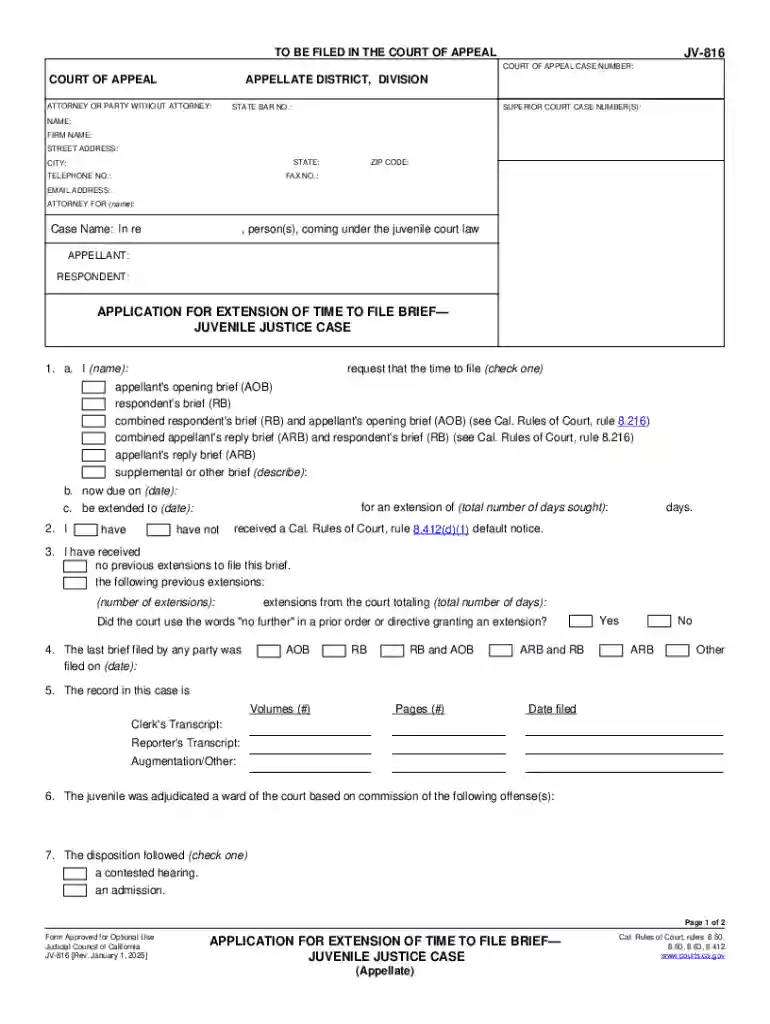
The JV-816 Application for Extension of Time to File Brief (Juvenile) is a formal request often filed in juvenile justice cases. This court form is utilized when an involved party requires additional time to submit a brief to the Court of Appeal. The request aims to seek approval for an extension by detailing the reasons and circumstances supporting the need for extra time. Key sections of this form include a declaration under penalty of perjury and proof of service to ensure that all involved parties are informed about the extension request.

How to Use the JV-816 Application for Extension of Time to File Brief (Juvenile)

To effectively use the JV-816 form, an individual must follow a structured approach:

  1. Identify Parties Involved: Clearly state the names and roles of the parties involved in the case.
  2. Specify the Type of Brief: Indicate the specific type of brief for which you are requesting an extension.
  3. Detail Previous Extensions: Provide information on any previous extensions granted, including the duration and reasons.
  4. Reason for Request: Clearly articulate the reasons necessitating an extension, providing sufficient evidence to support your claim.
  5. Declare Under Penalty of Perjury: Complete the declaration section, attesting to the truthfulness of your statements under penalty of perjury.
  6. Proof of Service: Ensure that proof of service is documented, confirming that copies of the request have been distributed to all relevant parties.

Steps to Complete the JV-816 Application for Extension of Time to File Brief (Juvenile)

Completing the JV-816 form involves several critical steps:

  1. Access the Form: Obtain the form through the appropriate legal channels, such as a court’s website or office.
  2. Fill in Personal Information: Accurately record your name, address, and contact details.
  3. Identify Case Details: Include the case number, name of the court, and other pertinent details.
  4. Explain Need for Extension: Articulate why the extension is necessary, addressing any special circumstances.
  5. Complete Perjury Declaration: Agree to the declaration under penalty of perjury, affirming the accuracy of all information provided.
  6. Serve Other Parties: Distribute copies of the form to other involved parties along with proof of service, ensuring compliance with legal requirements.
  7. Submit to the Court: Deliver the completed form to the appropriate judicial entity by the specified deadline, choosing a submission method that aligns with court guidelines.

Why Use the JV-816 Application for Extension of Time to File Brief (Juvenile)

The JV-816 form serves a vital purpose within the juvenile justice system. It allows parties the necessary time to prepare comprehensive briefs, ensuring all aspects of a case are thoroughly addressed. This can be crucial in the handling of complex legal issues where detailed analysis and thorough preparation are required. By facilitating an extension, this form helps uphold the principles of fairness and justice, given the procedural demands of the Court of Appeal.

Who Typically Uses the JV-816 Application for Extension of Time to File Brief (Juvenile)

The JV-816 form is predominantly used by legal professionals, including attorneys representing parties in juvenile court cases. Judicial clerks may also assist in the form’s preparation. This application is particularly relevant for cases where attorneys need additional time to gather evidence, review case laws, or engage with expert witnesses. It is a critical tool in ensuring that all parties have equitable opportunities to present their arguments effectively.


decoration image ratings of Dochub

Key Elements of the JV-816 Application for Extension of Time to File Brief (Juvenile)

The form contains several key sections that require attention:

  • Case Information: Details such as the case number and court name.
  • Party Information: Names and roles of all involved parties.
  • Brief Specifications: The specific document requiring an extension.
  • Reason for Extension: An explanation of why more time is necessary.
  • Previous Extensions: Insight into any prior extensions granted.
  • Perjury Declaration: A mandatory declaration verifying the truth of the information.
  • Proof of Service: Containing information about document dissemination to all parties.

Important Terms Related to JV-816 Application for Extension of Time to File Brief (Juvenile)

Understanding legal terminology is crucial for correctly completing the JV-816 form:

  • Brief: A written argument submitted to the court.
  • Perjury Declaration: A legal statement attesting to the truthfulness of the form’s contents.
  • Proof of Service: A form verifying that documents have been served to all parties in a case.
  • Extension Request: A formal request to delay the submission deadline for a brief.
  • Court of Appeal: The appellate court reviewing the case.

Legal Use of the JV-816 Application for Extension of Time to File Brief (Juvenile)

The use of the JV-816 application is strictly governed by legal procedures and is employed within the judicial framework of the United States_ In any case, the court evaluates the merit of each request, ensuring that extensions are justified on procedural or substantive grounds. The court must approve the application to grant an extension. Proper usage of this form demonstrates procedural diligence and a commitment to fulfilling judicial requirements.

State-Specific Rules for the JV-816 Application for Extension of Time to File Brief (Juvenile)

Although the JV-816 form is standardized, individual states may have specific guidelines regarding its use:

  • Submission Deadline: Each state may have unique submission deadlines for extension requests.
  • Format Requirements: Variations in format and required accompanying documents can exist.
  • State-Specific Protocols: Some states may mandate additional documentation or approval procedures.
  • Judicial Authority: Procedures may differ slightly based on judicial discretion or court rules within different jurisdictions.

Required Documents

Using the JV-816 form effectively demands the inclusion of specific documents:

  • Completed JV-816 Form: The application itself, accurately filled out.
  • Proof of Service: A document evidencing service to other parties.
  • Supporting Evidence: Documentation supporting the need for an extension, such as affidavits.
  • Supplementary Filings: Any additional court documents or forms as mandated by state law.

Form Submission Methods (Online / Mail / In-Person)

The JV-816 application can typically be submitted through various methods:

  • Online: Some jurisdictions might offer electronic submission via court websites or designated platforms.
  • Mail: Traditional postal submission to the court’s clerk office.
  • In-Person: Direct handover at a court administrative office, possibly featuring a time-stamped receipt.

Choosing the appropriate method depends on court-specific rules and personal preference, with due consideration of deadlines and processing times.

be ready to get more

Complete this form in 5 minutes or less

Get form

Got questions?

We have answers to the most popular questions from our customers. If you can't find an answer to your question, please contact us.
Contact us
A motion for extension of time to file a brief must be filed well in advance of the date the brief is due and must set forth the additional time requested and the reasons for the request. The court discourages these motions and may deny the motion entirely or grant a lesser period of time than requested.
In Gault, the U.S. Supreme Court determined that the Constitution requires that youth charged with delinquency in juvenile court have many of the same due process rights guaranteed to adults accused of crimes, including the right to an attorney and the right to confront witnesses against them.
CIV-141 Guidance: Declaration in Support of Extension (California) The CIV-141 form is used when a responding party seeks an automatic 30-day extension to file a pleading or motion for judgment in a civil case, due to an inability to meet and confer with the opposing party.
Your request via email and/or letter will need to include the original filing dates, new proposed filing dates, the number of previous requests (if any), and whether the other party consents to the extension. Email a copy of the letter you file to the other party (usually its an attorney).

Security and compliance

At DocHub, your data security is our priority. We follow HIPAA, SOC2, GDPR, and other standards, so you can work on your documents with confidence.
Learn more
ccpa2
pci-dss
gdpr-compliance
hipaa
soc-compliance