MECOSTA OSCEOLA COUNTY STANDARD PARENTING TIME SCHEDULE 2026

Get Form
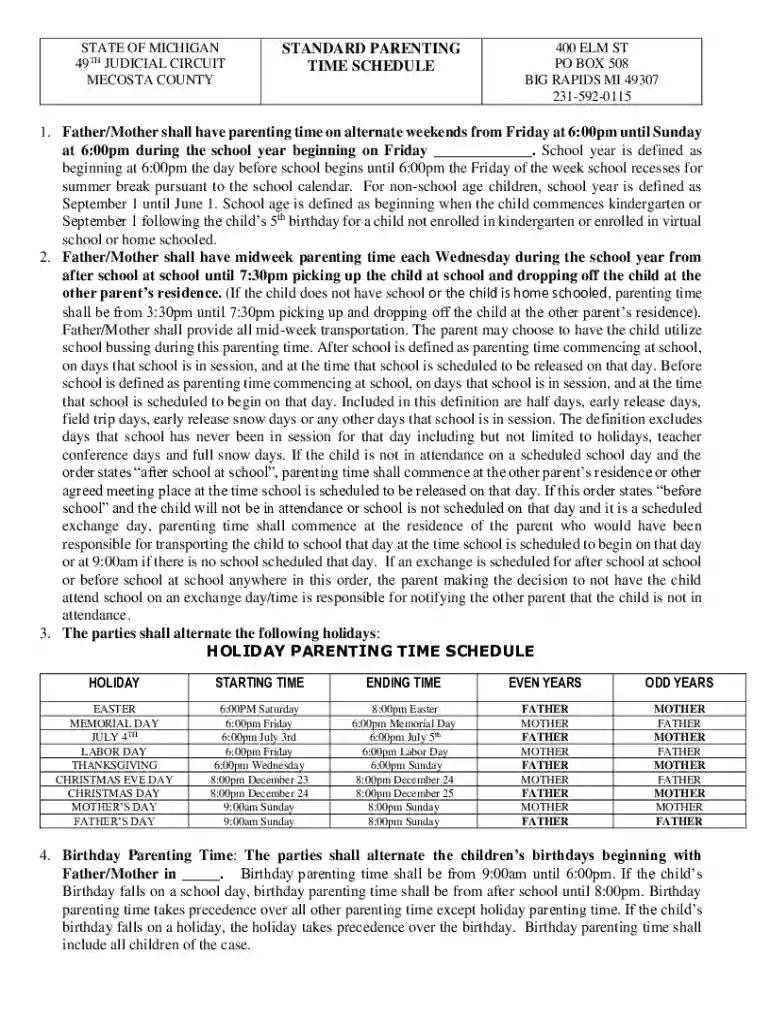
MECOSTA OSCEOLA COUNTY STANDARD PARENTING TIME SCHEDULE Preview on Page 1

Here's how it works

01. Edit your form online
Type text, add images, blackout confidential details, add comments, highlights and more.

02. Sign it in a few clicks
Draw your signature, type it, upload its image, or use your mobile device as a signature pad.

03. Share your form with others
Send it via email, link, or fax. You can also download it, export it or print it out.

Understanding the MECOSTA OSCEOLA COUNTY STANDARD PARENTING TIME SCHEDULE

The Mecosta Osceola County Standard Parenting Time Schedule serves as a formal framework designed to help parents in Mecosta and Osceola counties, Michigan, arrange co-parenting schedules. This structured plan clarifies how parenting time is allocated during school seasons, holidays, birthdays, and school vacations. By providing clear guidelines, it aims to facilitate effective communication and cooperation between parents, ensuring consistent and meaningful involvement in their child’s life.

Key Elements of the Parenting Schedule

  • Alternating Weekends: Parents alternate weekends throughout the year to allow both parties equal opportunity for weekend activities.
  • Midweek Visits: Midweek visits are scheduled to maintain a regular connection between the child and non-custodial parent during the school week.
  • Holidays and Birthdays: The schedule outlines specific sharing arrangements for holidays and birthdays, providing clear rotation schedules to ensure fair division of special occasions.
  • Summer Vacation: It includes guidelines for summer break periods, typically involving extended stays with the non-custodial parent to balance time away from school.

How to Use the MECOSTA OSCEOLA COUNTY STANDARD PARENTING TIME SCHEDULE

Parents can utilize the standard parenting time schedule as a reference to maintain structure and clarity in their co-parenting arrangements. It acts as a guide that both parties can follow to minimize conflicts and ensure the child's well-being through consistent schedules.

  1. Reference for Disputes: Use the schedule to resolve potential disagreements relating to pick-up and drop-off times or holiday arrangements.
  2. Communication Tool: Regularly discuss the schedule to address any upcoming changes and plan accordingly.
  3. Customization: Adapt the standard schedule to suit specific family needs by mutually agreeing on any modifications.

Who Typically Uses the Schedule

This schedule is predominantly used by divorced or separated parents residing in Mecosta and Osceola counties, Michigan. However, it can also assist unmarried co-parents who share custody as well as legal professionals involved in family law to provide guidance during custody hearings.


decoration image ratings of Dochub

Legal Implications and Compliance

Legal Use of the Schedule

The schedule's guidelines are enforceable by Michigan family courts, serving as a benchmark for parenting responsibilities. Non-compliance may result in court interventions or modifications to the existing custody agreement.

  • Reporting Violations: Parents can document and report any violations of the agreed-upon schedule to the court to seek enforcement or redress.
  • Modifications: Legal amendments to the schedule can be petitioned in court if circumstances such as relocation or changes in work schedules arise.

State-Specific Rules and Variations

While the core premises of the scheduling guidelines are consistent within Michigan, nuances in application may exist depending on the specific county's court orders or judgments. It is advisable to consult with a legal expert familiar with local family laws for tailored advice.

How to Obtain the MECOSTA OSCEOLA COUNTY STANDARD PARENTING TIME SCHEDULE

  1. Access Through Court: The judge handling the custody case may provide a copy during court proceedings.
  2. Online Resources: Check the local county court's website for downloadable versions of the schedule.
  3. Legal Consultation: Family law attorneys usually have access to standard forms and can guide parents in obtaining and understanding the document.

Steps to Complete the Schedule

  1. Review Initial Agreement: Examine any existing custody arrangements.
  2. Draft Customized Arrangements: Modify the standard template where necessary to reflect changes agreed upon by both parents.
  3. Submit for Approval: Submit the completed schedule to the family court if modifications are made and require formal approval.

Examples of Implementing the Schedule

Real-World Scenarios

  • Scenario 1: A parent who relocated to a neighboring state utilizes virtual communication to maintain midweek visitations.
  • Scenario 2: Parents agree to swap a holiday to accommodate a special event, demonstrating flexibility within the established framework.
  • Scenario 3: Adjustments are made for a parent whose work requires travel, thereby integrating extended visits when in town.

Important Terms Related to the Schedule

Terms You Should Know

  • Custodial Parent: The parent with whom the child primarily resides.
  • Non-Custodial Parent: The parent with visitation rights under the standard schedule.
  • Joint Custody: A form of custody involving both parents sharing decision-making responsibilities regardless of the primary residence.
  • Visitation Rights: The legal allowance for the non-custodial parent to spend time with the child according to the schedule.

These aspects provide a comprehensive understanding of the Mecosta Osceola County Standard Parenting Time Schedule, emphasizing the importance of cooperation and compliance in co-parenting arrangements.

be ready to get more

Complete this form in 5 minutes or less

Get form

Got questions?

We have answers to the most popular questions from our customers. If you can't find an answer to your question, please contact us.
Contact us
Parenting time guidelines help parents, family court judges and mediators to develop appropriate parenting plans and visitation schedules for children of divorce.
The 7-7-7 technique presents a simple yet effective method to reduce stress and enhance your parenting experience. By taking a pause during stressful times to breathe deeply for seven seconds, hold for seven seconds, and exhale for seven seconds, you can activate your bodys relaxation response.
2-2-5-5 custody schedule A 2-2-5-5 arrangement means that one parent gets two days with the children, the other parent gets the next two days with the children, then the first parent gets five days with the children, and the other parent gets the next five days with the children.
The result of the schedule is that Parent 1 gets 5 days in a row, then Parent 2 gets 2 days, then Parent 1 gets 2 days, and then Parent 2 gets 5 days, thus 5225. The total schedule is 14 days, and the schedule gets repeated throughout the year.
In the 2-2-3 co-parenting schedule, your child lives with one parent for two days of the week, spends the next two days with the other parent, and then returns to the first parent for three. The next week, the pattern begins again with the other parent. You can customize this with Custody X Change.

Security and compliance

At DocHub, your data security is our priority. We follow HIPAA, SOC2, GDPR, and other standards, so you can work on your documents with confidence.
Learn more
ccpa2
pci-dss
gdpr-compliance
hipaa
soc-compliance

People also ask

The 5-2-2-5 custody schedule is an increasingly common arrangement where children spend five days with one parent, followed by two days with the other parent, and then switch again for another two days before returning to the initial parent for five days.
These are some mistakes youre going to want to be mindful to avoid. PREVENTING THE OTHER PARENTS ACCESS TO THE CHILDREN. LYING ABOUT DRUG AND ALCOHOL USE. NOT PREPARING FOR COURT SPECIALISTS. INVOLVING YOUR CHILDREN IN LEGAL PROCEEDINGS. WORKING TOO MUCH. NOT PUTTING YOUR KIDS BEST INTERESTS FIRST.

Related links