Ohio epa4520 assessment pdf 2026

Get Form
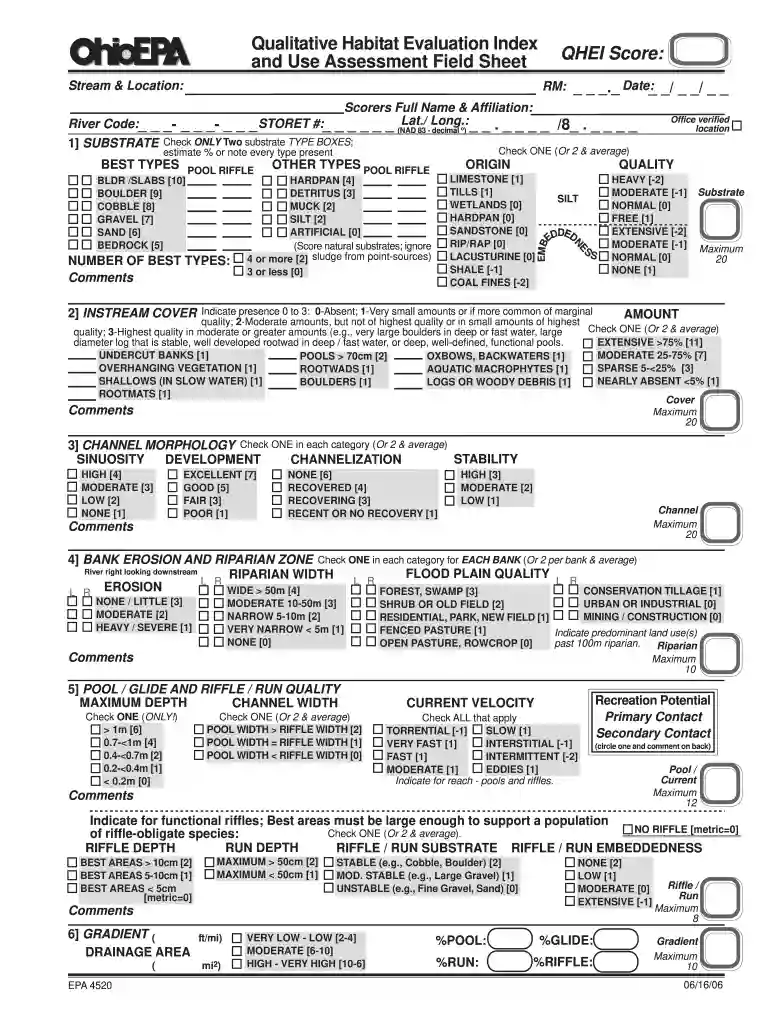
assessment field sheet Preview on Page 1

Here's how it works

01. Edit your assessment field sheet online
Type text, add images, blackout confidential details, add comments, highlights and more.

02. Sign it in a few clicks
Draw your signature, type it, upload its image, or use your mobile device as a signature pad.

03. Share your form with others
Send epa qualitative habitat evaluation via email, link, or fax. You can also download it, export it or print it out.

Definition & Meaning

The "Ohio EPA4520 Assessment PDF" refers to a Qualitative Habitat Evaluation Index (QHEI) and Use Assessment Field Sheet. This document is integral to evaluating stream habitats, focusing on various environmental and physical parameters. The primary goal of this assessment is to quantify the quality of aquatic habitats, providing essential data for environmental management and protection efforts.


Key Elements of the Ohio EPA4520 Assessment

  • Substrate Types: Identifies the composition of the streambed, which is crucial for habitat quality.
  • Instream Cover: Evaluates the availability of protective structures for aquatic organisms.
  • Channel Morphology: Assesses the physical shape and structure of the stream channel.
  • Bank Erosion: Measures the stability of stream banks, which affects habitat and water quality.
  • Riparian Zone Conditions: Considers the vegetation and land use adjacent to the stream, impacting ecological health.

Steps to Complete the Ohio EPA4520 Assessment PDF

  1. Preparation: Gather necessary equipment and resources, such as a map, field equipment, and the assessment form.
  2. Site Inspection: Visit the stream habitat location and conduct a visual inspection to understand the area.
  3. Parameter Recording: Use the form to document substrate types, instream cover, and other habitat features.
  4. Scoring: Assign scores based on the observed conditions, following guidelines provided in the assessment manual.
  5. Data Analysis: Compile the scores to assess overall habitat quality.
  6. Report Generation: Summarize findings in a report that includes both qualitative and quantitative data from the assessment.

Who Typically Uses the Ohio EPA4520 Assessment PDF

  • Environmental Scientists and Biologists: To study and monitor aquatic habitats.
  • State and Local Environmental Agencies: For regulatory compliance and conservation planning.
  • Ecological Consultants: To provide assessments for environmental impact studies.
  • Academic Institutions: For research and educational purposes in environmental science programs.
decoration image ratings of Dochub

How to Obtain the Ohio EPA4520 Assessment PDF

Methods of Acquisition

  • Online Download: Access the form through official Ohio Environmental Protection Agency websites or trusted repositories.
  • Agency Request: Contact the Ohio EPA or local environmental departments for a physical copy or digital version.
  • Workshops and Training Sessions: Obtain the form as part of professional development or training programs focused on habitat evaluation.

Important Terms Related to the Ohio EPA4520 Assessment PDF

Commonly Used Terms

  • Habitat Quality: The overall conditions of a stream, affecting biodiversity and ecological health.
  • Qualitative Metrics: Non-numeric criteria used to evaluate habitat features.
  • Score Index: A numerical representation of assessment results.
  • Riparian Buffer: Vegetated area adjacent to streams, playing a critical role in maintaining ecosystem integrity.

Legal Use of the Ohio EPA4520 Assessment PDF

Compliance Requirements

  • Data Collection Standards: Ensure data is collected following Ohio EPA guidelines to maintain validity and reliability.
  • Confidentiality: Respect any sensitive information or private properties while conducting assessments.
  • Regulatory Reporting: Submit findings to appropriate agencies when required for compliance or conservation mandates.

State-Specific Rules for the Ohio EPA4520 Assessment PDF

Ohio Regulations

  • Stream Classification: Adhere to state-defined stream categories based on size, flow, and ecological value.
  • Habitat Protection Laws: Follow Ohio-specific environmental protection laws aimed at preserving water quality and habitat integrity.

Variations in Requirements

  • Regional Differences: Different regions within Ohio might have specific requirements based on local environmental conditions and conservation priorities.

Software Compatibility

Document Handling Platforms

  • DocHub: Edit, share, and store your completed assessments digitally with enhanced security features.
  • Other Platforms: Ensure compatibility with other document management software like Adobe Acrobat or Microsoft Office for sharing and submission purposes.

Integrating specific software allows for efficient digital management of the Ohio EPA4520 Assessment PDF, ensuring that it can be easily edited, signed, and stored while maintaining compliance with environmental regulations.

be ready to get more

Complete this form in 5 minutes or less

Get form

Got questions?

We have answers to the most popular questions from our customers. If you can't find an answer to your question, please contact us.
Contact us
Those levels, provided in the Ohio PFAS Action Plan, are: GenX compound (700 ppt), PFBS (140,000 ppt), PFHxS (140 ppt) and PFNA (21 ppt). These Action Levels were updated in 2024 to to match the new federal EPA standards.
Adverse health effects related to PFAS exposure are not expected at less than 2 nanograms per milliliter (ng/mL). There is a potential for adverse effects, especially in sensitive populations, between 2 and 20 ng/mL. There is an increased risk of adverse effects above 20 ng/mL.
GALLIPOLIS, Ohio (WV News) Newly released data from a study conducted by the U.S. EPA shows that 21 public water systems in Ohio have PFAS levels above the health advisory limits.
Without a federal PFAS standard, there is a large discrepancy between the regulatory standards established by the various states. For example, for PFAS substances in drinking water, the smallest concentration is 5.1 ppt (California; PFOA only) and one of the largest values is 140,000 ppt (Michigan; PFHxA only).
The qualitative habitat evaluation index (QHEI) gives scientists a quantitative assessment of physical characteristics of a sampled stream similar to IBI and ICI biological data. QHEI represents a measure of instream geography.

Security and compliance

At DocHub, your data security is our priority. We follow HIPAA, SOC2, GDPR, and other standards, so you can work on your documents with confidence.
Learn more
ccpa2
pci-dss
gdpr-compliance
hipaa
soc-compliance