Request for nutritional supplementation 2014 form-2026

Get Form
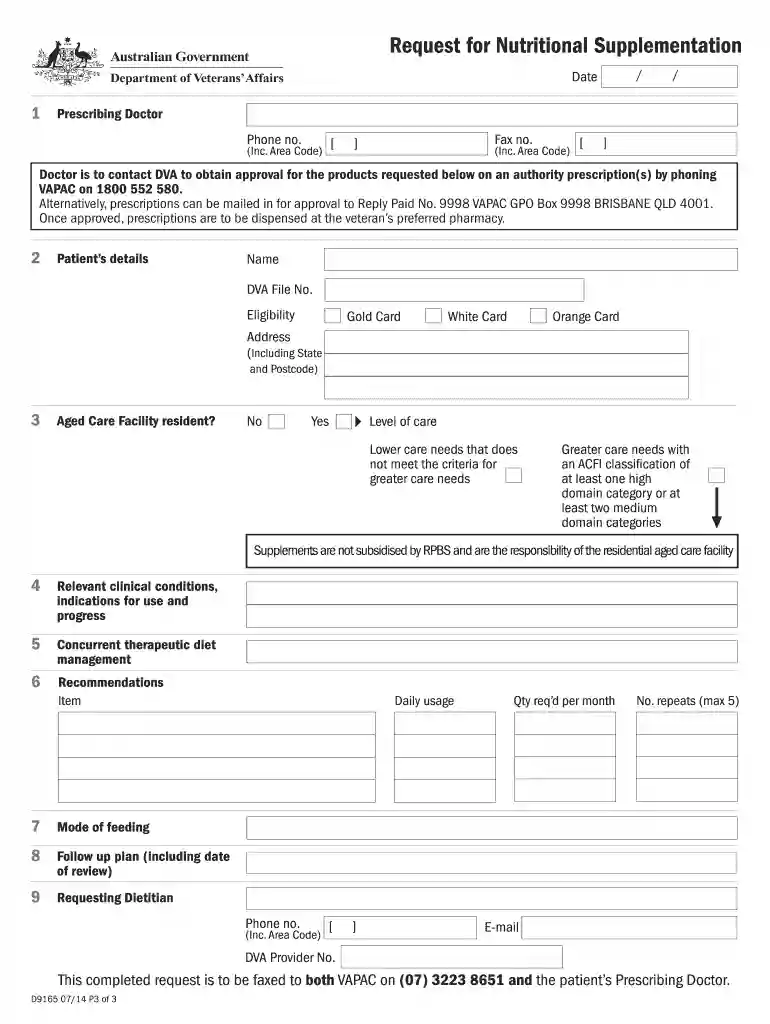
request for nutritional supplementation 2014 form Preview on Page 1

Here's how it works

01. Edit your form online
Type text, add images, blackout confidential details, add comments, highlights and more.

02. Sign it in a few clicks
Draw your signature, type it, upload its image, or use your mobile device as a signature pad.

03. Share your form with others
Send it via email, link, or fax. You can also download it, export it or print it out.

Definition & Meaning

The "request for nutritional supplementation 2014 form" is primarily used by eligible veterans and war widows or widowers seeking subsidized nutritional supplements through the Department of Veterans Affairs (DVA). This form ensures that the recipient meets required eligibility criteria, obtains necessary medical assessments, and secures approval from the Veterans Affairs Pharmaceutical Advisory Centre (VAPAC). Understanding this form's purpose and the associated processes is crucial for those needing nutritional support due to specific medical or dietary needs.

Importance of Nutritional Supplements

Nutritional supplements can play a critical role in maintaining health, especially for individuals with specific dietary deficiencies or who are unable to receive adequate nutrition through regular food intake. This form facilitates access to necessary supplements that can support wellbeing, improve health outcomes, and enhance the quality of life for eligible applicants.

How to Use the Request for Nutritional Supplementation 2014 Form

To effectively use the form, begin by obtaining assessments from a licensed dietitian who can establish the necessity for nutritional supplements. Following this assessment, a physician must prescribe the required supplements. These steps are prerequisites to ensure that the applicant's health condition warrants the need for additional nutritional support.

  1. Dietitian Assessment: Consult a qualified dietitian to evaluate your nutritional needs.
  2. Physician Prescription: Obtain a prescription from your doctor based on the dietitian's assessment.
  3. Form Completion: Complete all sections of the form accurately with the required information and supplementary medical documentation.
  4. Submission: Submit the completed form to the applicable DVA office or VAPAC for review and approval.

Steps to Complete the Request for Nutritional Supplementation 2014 Form

Filling out the form requires attention to detail and accuracy to avoid delays in the approval process. Each section of the form must be filled as instructed, supplemented by necessary medical records.

  1. Personal Information: Include your full name, contact details, and identification number.
  2. Medical Assessment Details: Enter findings from the dietitian and physician, including nutritional needs and prescribed supplements.
  3. Approval Section: Fill in the details for expected approval timelines and any other requested data.
  4. Signature: Ensure both the physician and dietitian signatures are included before submission.

Practical Example

A veteran living in an aged care facility who has been losing weight unexpectedly may use this form. After an evaluation by a dietitian and prescribed supplements by a doctor, the request for supplementation can be processed quickly to meet the veteran’s nutritional needs.

Eligibility Criteria

Eligibility for using this form is centered around individuals who are veterans or war widows or widowers. Additional criteria include being assessed for nutritional support needs and having those needs validated by healthcare professionals. Legal residency and age requirements may apply depending on local legislation.


decoration image ratings of Dochub

Factors Affecting Eligibility

  • Dietary Needs: Must be medically verified for nutritional support.
  • Veteran Status: Must meet the criteria set by the DVA.
  • Facility Residency: Certain conditions may need verification if the applicant is in a residential care facility.

Key Elements of the Request for Nutritional Supplementation 2014 Form

The form includes several key elements such as personal information, medical evaluation details, prescription data, and sections for professional signatures. Each element is designed to capture all necessary information to support the request for nutritional supplements efficiently.

Digital vs. Paper Version

Both digital and paper versions of the form are available. While the paper version remains a traditional method for submission, the digital format offers advantages like easier storage, retrieval, and editing capabilities. Using platforms like DocHub can streamline the completion and submission process, ensuring security and ease of access.

Required Documents

Supporting documents are critical for the submission of the request. These typically include:

  • Medical Assessments: Reports from dietitians and physicians.
  • Prescription Documentation: Specific details regarding the nutritional supplements prescribed.
  • Veteran Identification: Verification of veteran or war widow(er) status.

Submission Methods (Online / Mail / In-Person)

The form can be submitted to the DVA or VAPAC through various channels, depending on the applicant's convenience and available resources.

  • Online Submission: Utilizing platforms like DocHub to fill and send forms digitally directly.
  • Mail Submission: Traditional submission through postal services.
  • In-Person Submission: Delivering completed forms to applicable DVA offices for direct review.

Choosing the Best Method

Depending on the urgency and available resources, online submission may offer the fastest processing times, while mail and in-person methods provide additional options for those who prefer traditional processes.

be ready to get more

Complete this form in 5 minutes or less

Get form

Got questions?

We have answers to the most popular questions from our customers. If you can't find an answer to your question, please contact us.
Contact us
A Supplement Form is an electronic form that allows schools to add custom questions not included in the Standard Forms for applicant-families only.
Common supplements include: Vitamins: such as multivitamins or individual vitamins like vitamin D and biotin. Minerals: such as calcium, magnesium, and iron. Botanicals or herbs: such as echinacea and ginger. Botanical compounds: such as caffeine and curcumin. Amino acids: such as tryptophan and glutamine.
In addition to vitamins, dietary supplements can contain minerals, herbs or other botanicals, amino acids, enzymes, and many other ingredients. Dietary supplements come in a variety of forms, including tablets, capsules, gummies, and powders as well as drinks and energy bars.
Powder supplements typically maintain higher potency levels because they dont require the binders and fillers necessary in tablets. This means you get more active ingredients per equivalent dose. Solubility plays a crucial role in supplement effectiveness.
Dietary supplements are products that are ingested specifically, they must be swallowed so, for example, topical or inhaled products are not supplements. Dietary supplements may be found in many forms, such as pills, tablets, capsules, gummies, softgels, liquids, and powders.

Security and compliance

At DocHub, your data security is our priority. We follow HIPAA, SOC2, GDPR, and other standards, so you can work on your documents with confidence.
Learn more
ccpa2
pci-dss
gdpr-compliance
hipaa
soc-compliance
be ready to get more

Complete this form in 5 minutes or less

Get form

People also ask

Therefore, it is important to understand that FDA does not approve dietary supplement products before they are sold to the public, and is responsible for taking action against any adulterated or misbranded dietary supplement product after it docHubes the market.
Dietary supplements may be found in many forms, such as pills, tablets, capsules, gummies, softgels, liquids, and powders.
Most state Medicaid programs will cover oral nutritional supplements like Ensure if they are deemed medically necessary. This typically includes cases involving: Documented malnutrition or docHub weight loss. Difficulty swallowing or digesting solid food.

Related links