




01. Edit your form online
Type text, add images, blackout confidential details, add comments, highlights and more.

Type text, add images, blackout confidential details, add comments, highlights and more.

Draw your signature, type it, upload its image, or use your mobile device as a signature pad.

Send it via email, link, or fax. You can also download it, export it or print it out.
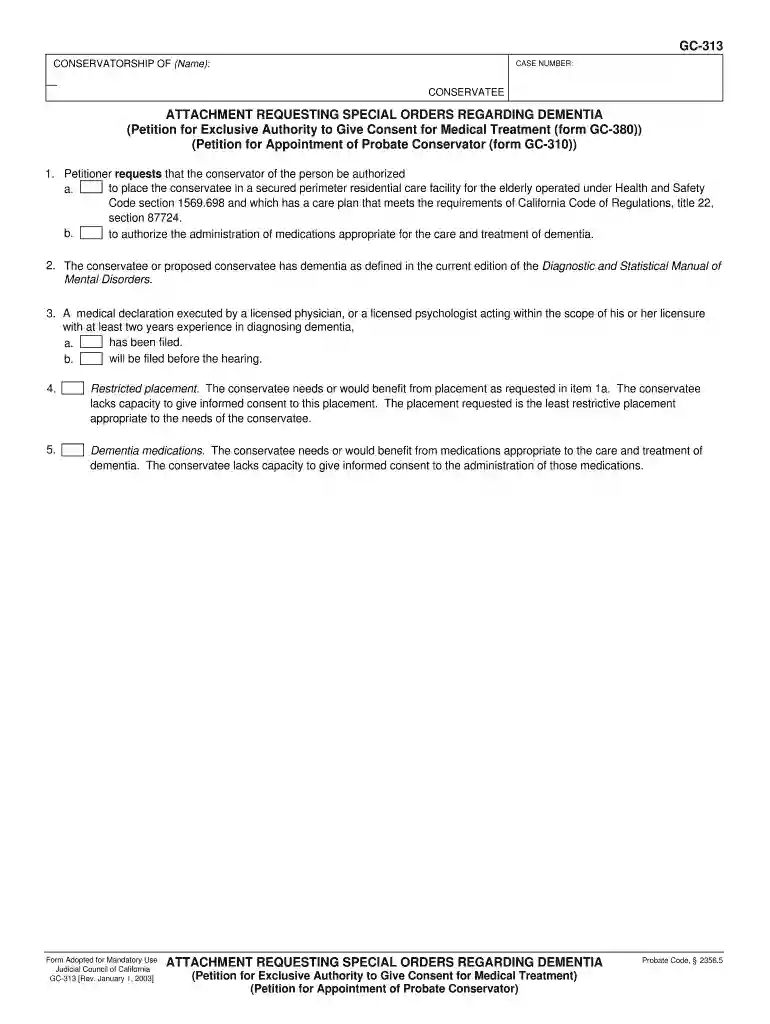
The GC-313 form is a legal document used within the context of conservatorship, specifically targeting individuals with dementia. It is designed to request authorization for the conservator to have the ability to place the conservatee, or the person under their protection, in a secured residential care facility and administer appropriate medications necessary for the treatment of dementia. The form becomes critical when the conservatee is deemed incapable of consenting to these actions themselves, usually substantiated by a medical declaration from a qualified professional submitted prior to the hearing. This ensures that the conservator can act in the best interests of the conservatee within the boundaries of the law.
Using the GC-313 form involves several steps, each requiring careful attention to ensure compliance with legal requirements.
Obtain Professional Evaluation: Before initiating the form, obtain a detailed medical evaluation from a qualified healthcare professional to support the necessity for conservatorship actions, such as placement in a secure facility and administration of medication.
Complete Personal Details: Fill in the required personal information of both the conservator and conservatee, ensuring accuracy as it is essential for legal proceedings.
Specify Requests: Clearly state the actions sought through the form, such as placement in a secured facility or medication administration. Each request should be detailed and justified within the form.
Attach Supporting Documents: Include medical declarations, existing medical records, and any other relevant documents that reinforce the need for the actions requested.
Submit the Form: The GC-313 form must be filed with the court for approval. Verify the submission process with the relevant local court as procedures may vary.
Legal Advice: Given the sensitive nature of conservatorship, consulting with a legal professional before filling the form is advisable to ensure all actions are compliant with state laws.
State-Specific Variations: Certain states may have additional requirements or different processes for submitting conservatorship forms, so checking local statutes is vital.
Completing the GC-313 form thoroughly is crucial for obtaining the necessary court permissions for conservatorship.
Gather Necessary Information: Collect all pertinent details regarding the conservatee's medical history and current condition.
Drafting the Application: Begin by drafting a detailed explanation of the conservatee's needs that necessitate secure housing and specific medical treatments.
Detailed Section Completion: Write clearly and provide details for each section of the form, ensuring no sections are left blank unless they do not apply.
Seek Timely Submissions: Ensure that the GC-313 form is submitted in accordance with the relevant court's deadlines to avoid delays in obtaining the necessary permissions.
Follow Court Guidelines: Adhere to any instructions provided by the court to ensure the form is completed correctly and all legal requirements are met.
Understanding the key terms related to the GC-313 form can help ensure accurate completion and submission.
Conservator: An individual appointed by the court to manage the personal, financial, or medical needs of a conservatee.
Conservatee: The individual for whom the conservatorship is established, often due to an inability to manage their own affairs due to age or a medical condition such as dementia.
Secured Residential Care Facility: A facility designed to safely manage and house individuals with conditions like dementia, providing specialized care and supervision.
Medical Declaration: A written document provided by a qualified healthcare professional that details the conservatee's medical condition and needs.
The legal use of the GC-313 form is to ensure that conservatorship actions, particularly those involving placement in care facilities and medication administration, are sanctioned by the court. The form serves to protect the conservatee's rights while allowing the conservator to fulfill their duties legally and responsibly.
Court Approval: The form's submission to a court is necessary to gain legal permission for the conservator’s actions, ensuring protection under the law.
Compliance with Laws: Adhering to both state and federal laws safeguards the conservator from legal disputes and ensures the protection of the conservatee’s rights.
Different states may have unique requirements and procedures regarding the GC-313 form.
Filing Requirements: Some states may ask for additional documentation or specific formats for the documentation attached to the form.
Approval Processes: The timeline and procedural steps for court approval can vary, necessitating confirmation with local legal resources or professionals familiar with state laws.
Jurisdictional Differences: Certain jurisdictions may implement specific regulations regarding conservatorship to accommodate various legal interpretations of conservatee rights and protections.
Several scenarios illustrate the practical use of the GC-313 form:
Elderly Individual with Dementia: A family seeks to ensure their loved one receives appropriate care in a secure facility, using the form to request authorization for placement and necessary medical treatment.
Emergency Situations: In urgent cases where immediate placement or medication adjustments are necessary, the form can expedite the legal permissions needed for these actions.
Understanding and adhering to filing deadlines and important dates associated with the GC-313 form is crucial for its timely processing.
Court Deadlines: Verify the specific deadlines set by the court for submission, as late filings could delay the approval process.
Medical Declaration Timing: Ensure that any medical declarations are up-to-date and submitted alongside the form, as they are critical for supporting the need for conservatorship actions.
Hearing Dates: Keep track of hearing dates where the form will be reviewed, ensuring all associated parties are informed and prepared.
Several documents accompany the GC-313 form to ensure it meets legal standards.
Medical Declarations: Official documents from medical professionals outlining the conservatee’s condition and treatment requirements.
Personal Identification: Copies of identification for both the conservatee and conservator, verifying their ability to fill the respective roles.
Consent Documentation: While the conservatee may not be able to provide consent, any available previous consents or directives should be included where applicable.
Understanding these elements and procedural steps ensures that the GC-313 form is utilized effectively to protect both the conservatee and the conservator within legal frameworks.
We've got more versions of the gc 313 form. Select the right gc 313 version from the list and start editing it straight away!
At DocHub, your data security is our priority. We follow HIPAA, SOC2, GDPR, and other standards, so you can work on your documents with confidence.
Jan 6, 2021 To access your library account, click on OneSearch Account on the bottom-right of the Search bar in the middle of the page. Page 2. GC LibraryRead more
Located in the heart of prime dairy land with great Mountain views, this 18 hole easy walking Mens 5469m par 71 and ladies 4871m par 72 course offers golfersRead more
a. to place the conservatee in a secured-perimeter residential care facility for the elderly operated under Health and Safety.Read more


