01. Edit your form online
Type text, add images, blackout confidential details, add comments, highlights and more.

Type text, add images, blackout confidential details, add comments, highlights and more.

Draw your signature, type it, upload its image, or use your mobile device as a signature pad.

Send it via email, link, or fax. You can also download it, export it or print it out.
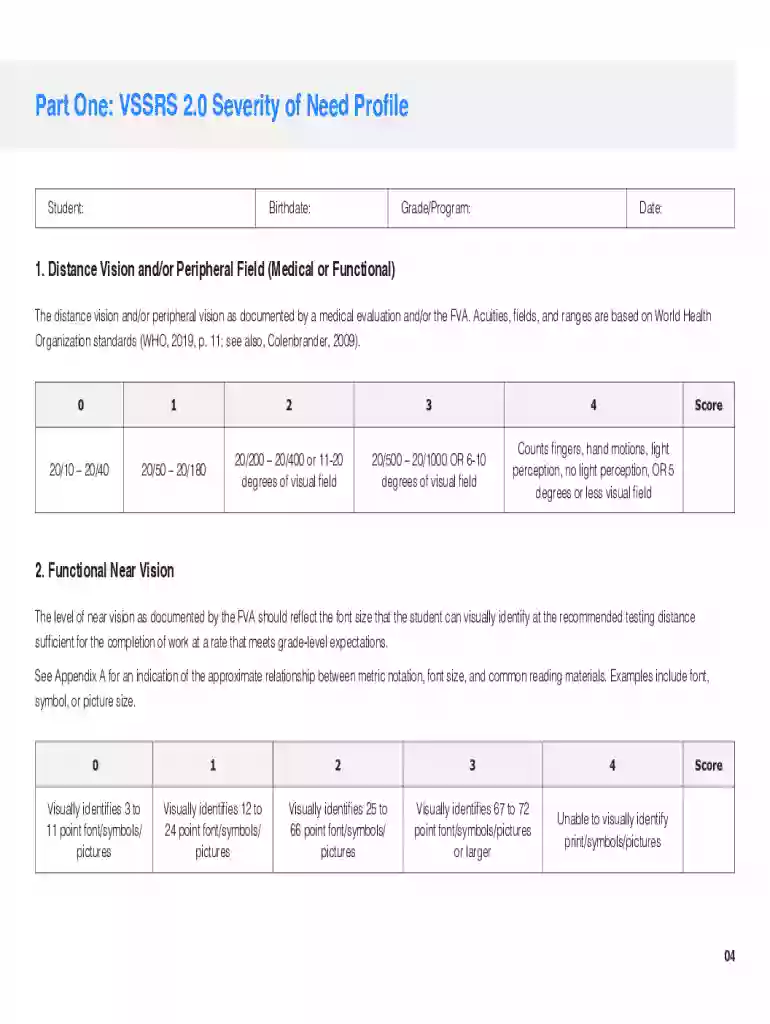
The Michigan Vision Services Severity Rating Scale - MDE-LIO is a specialized tool developed to assist Teachers of Students with Visual Impairment (TVIs). Its primary function is to determine the appropriate level of service required for students who are blind or visually impaired, ranging from birth to the age of 26. Unlike traditional assessment tools, it does not measure skills or knowledge but facilitates decisions regarding service delivery based on individual student needs. By evaluating various factors that influence a student’s visual impairment, it ensures tailored educational and support strategies are in place.
Utilizing the Michigan Vision Services Severity Rating Scale involves a systematic process. Teachers and specialists should first gather pertinent information about the student's visual impairment, including medical reports and educational history. The next step is to assess the severity of the impairment using the scale, which involves evaluating specific criteria outlined in the rating system. This can include assessing both the functional vision and any additional impairments or challenges the student may face. Through these assessments, educators can determine the frequency and intensity of services required to support the student effectively.
The primary users of the Michigan Vision Services Severity Rating Scale are Teachers of Students with Visual Impairment (TVIs), alongside other educational professionals such as special education coordinators and school psychologists. These individuals utilize the scale to guide their decisions regarding service provision and ensure that each student receives the support necessary to succeed in educational settings. Additionally, administrators and policymakers might reference the scale when developing or evaluating programs for visually impaired students to ensure compliance with federal and state regulations.


The key elements of the Michigan Vision Services Severity Rating Scale include:
These elements work together to ensure a comprehensive understanding of each student’s needs and form the basis for strategic service planning.
Completing the Michigan Vision Services Severity Rating Scale involves several critical steps:
By following these steps, educators can accurately assess and document the necessary support for each student.
The Michigan Vision Services Severity Rating Scale plays a pivotal role in ensuring that students with visual impairments receive equitable access to education. It empowers educators to make informed decisions tailored to individual needs, aligning with inclusive education practices. This targeted approach helps maximize educational outcomes and supports the development of personal independence. Moreover, the scale aids in the efficient allocation of resources, ensuring students receive the most benefit from available services.
In the U.S., educational tools like the Michigan Vision Services Severity Rating Scale must adhere to specific legal standards to ensure fair access and non-discriminatory practices. This involves alignment with federal mandates such as the Individuals with Disabilities Education Act (IDEA), which necessitates appropriate educational opportunities for all students. Additionally, the scale’s results inform Individualized Education Program (IEP) development, ensuring compliance with legal requirements for student-centered planning and support.
While the Michigan Vision Services Severity Rating Scale is a state-specific tool developed within Michigan, its principles can be adapted or mirrored in other states with appropriate modifications to meet local educational guidelines. Adjustments may be required to align with varying state regulations and standards for special education and visual impairment services. Schools implementing the scale in different states should remain informed on these variations to maintain compliance and efficacy in service delivery.
We've got more versions of the The Michigan Vision Services Severity Rating Scale - MDE-LIO form. Select the right The Michigan Vision Services Severity Rating Scale - MDE-LIO version from the list and start editing it straight away!
At DocHub, your data security is our priority. We follow HIPAA, SOC2, GDPR, and other standards, so you can work on your documents with confidence.